


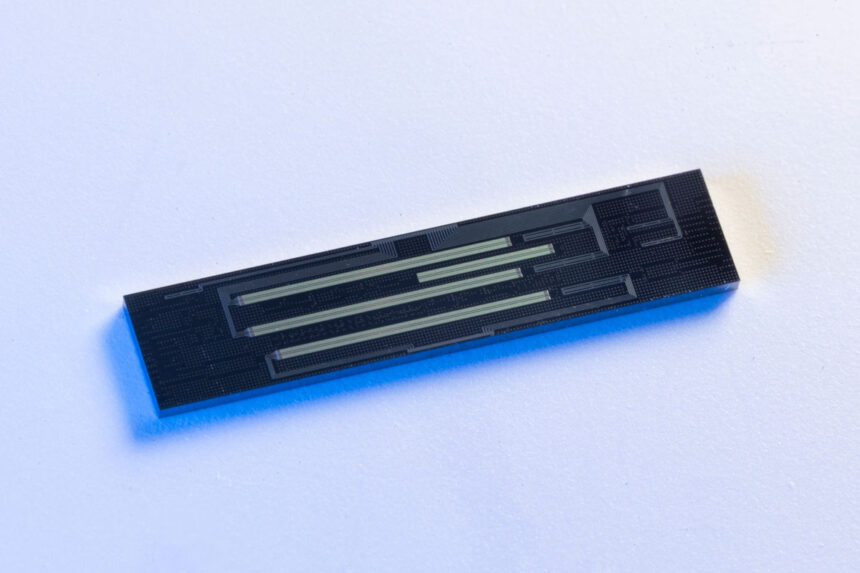
Cisco today announced the Cisco Universal Quantum Switch, a critical milestone in quantum networking that addresses one of the most fundamental barriers to building a quantum network. As a working research prototype, it is the latest initiative in Cisco’s accelerating full-stack quantum networking program.
- Why networking is now the bottleneck
- Cisco’s quantum networking stack
- The Universal Quantum Switch
- Dynamic, on-demand connectivity
- How the switch works
- Tying the hardware to a full end-to-end system
- Classical applications that benefit from quantum networking
- A real-fiber deployment in New York
- Building toward a heterogeneous quantum fabric
- What “working prototype” means
- The case for distributed quantum as the default
- A switch as the scaling primitive for the quantum era
Quantum computers encode information in different ways, and until now, no switch could accept and translate between all major encoding modalities without destroying the quantum information in the process. The Cisco Universal Quantum Switch is designed to address this challenge for the first time, routing quantum information while preserving it at room temperature, on existing telecom fiber, with a Cisco-patented conversion engine that translates between encoding modalities at input and output.

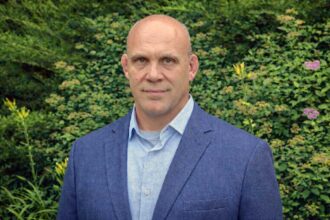
“Reaching this milestone is a pivotal moment for our quantum program and a testament to the transformative potential of quantum networking,” said Vijoy Pandey, SVP/GM of Outshift, Cisco’s Emerging Technologies and Incubation Group. “We’ve long recognized that connecting quantum systems is the key to achieving true scalability, and now we’ve taken a critical step toward making that vision a reality. While this is a significant achievement, it’s just the beginning. The road ahead is long, yet the impact of what we are building—and what is still to come—will be nothing short of profound.”
Why networking is now the bottleneck
The core constraint in quantum computing remains scale: how to reach useful-scale quantum capability without waiting for a single monolithic quantum computer to expand by orders of magnitude?
Pandey believes that the answer cannot be only “vertical scaling” (bigger single quantum machines). Instead, he argues for a second axis: distributed quantum computing, i.e., scaling “horizontally” by connecting multiple quantum compute nodes so they “share a common state” and “appear and behave as one large quantum computer.” Pandey explicitly links this to a proven pattern from classical systems—distributed computing and cloud architectures—where scaling out is foundational for manageability and growth.

This is where networking enters as the enabling infrastructure for scale-out quantum computing. Cisco’s thesis is that quantum computing’s timeline to broad utility can be accelerated if quantum computers can be interconnected reliably, dynamically, and at scale, rather than being trapped in isolated point-to-point demonstrations.
Pandey compares this to trying to build the classical internet as direct links between every pair of endpoints—an approach that could never scale to billions of users or tens of billions of devices. In the classical internet, the missing piece that enabled scale was the switch. Cisco’s announcement centers on providing the analogous missing component for quantum networking: a switch that can scale beyond point-to-point entanglement links.
Cisco’s quantum networking stack
Cisco describes its work as a systematic build-out of a full quantum networking “stack,” spanning hardware components, protocols and control software, and applications designed to be “network aware.” Pandey recounts a sequence of prototypes and components Cisco announced last year:
- Quantum entanglement source chip (announced in May of 2025): Generates entangled photon pairs at “incredible rates,” cited as ~“200 million entangled pairs a second” on-chip, at room temperature.
- Protocol set (announced in October 2025): Includes entanglement distribution, teleportation, and detection-oriented components (named at a high level).
- Network-aware applications (also released as research prototypes): Including a quantum compiler that treats multiple quantum nodes connected by a network as a single computing machine; and two additional applications discussed later—Quantum Sync and Quantum Alert—which Cisco positions as classical use cases that can benefit from quantum networking.
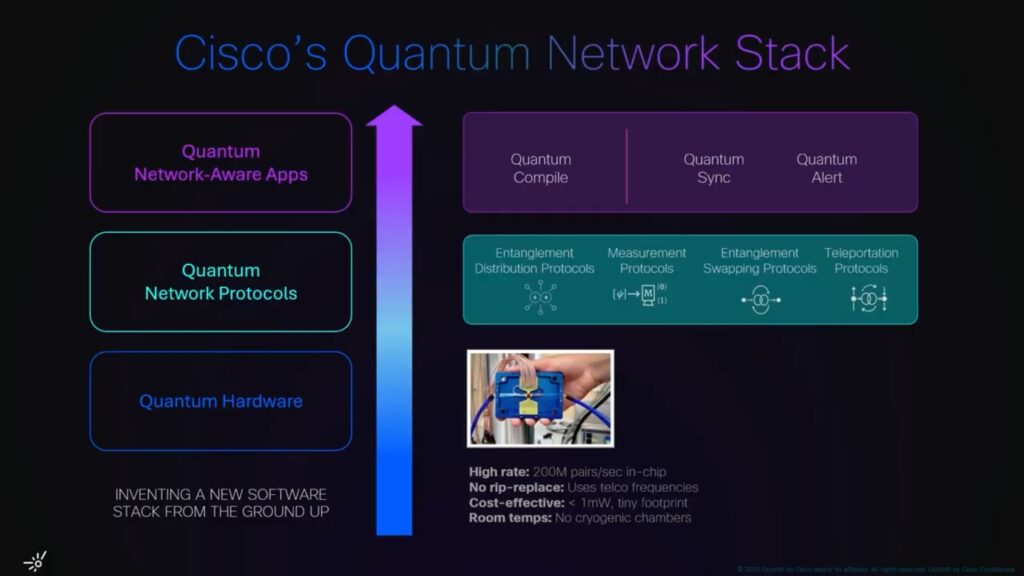
Cisco aims to build quantum networking components that fit into existing telecom infrastructure. These would operate at telecom frequencies, on existing fiber, and (for the networking devices) at room temperature, so that quantum and classical networks can be deployed “side by side” in the same physical footprint.
The Universal Quantum Switch
The “universal” label is tied to the switch’s ability to connect disparate quantum systems and encodings rather than force a single standard or “pick winners” across competing quantum computing technologies.
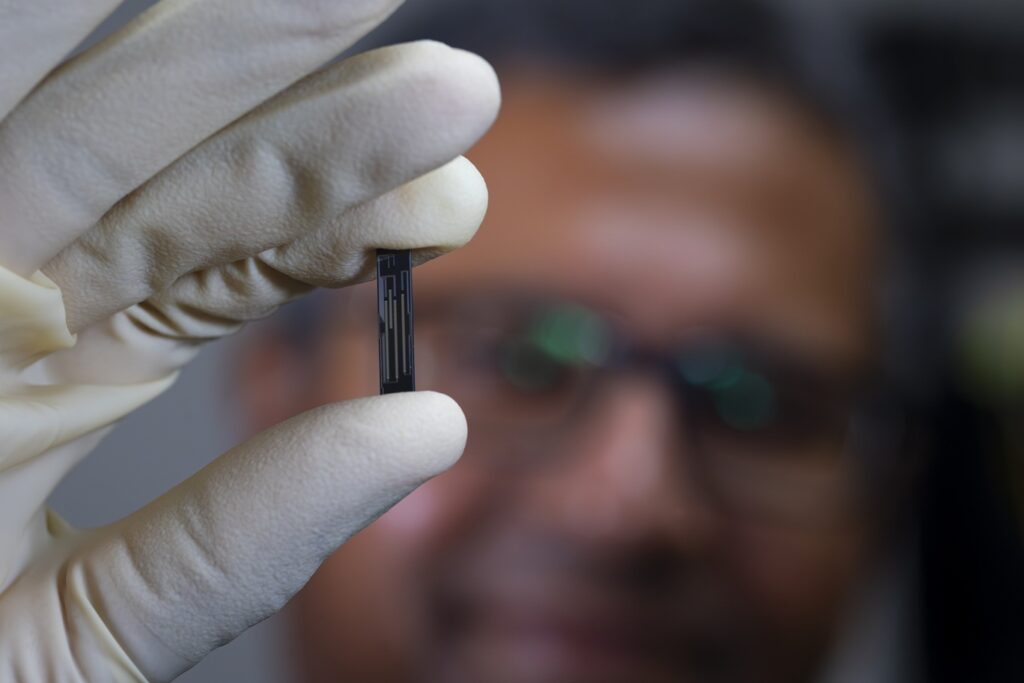
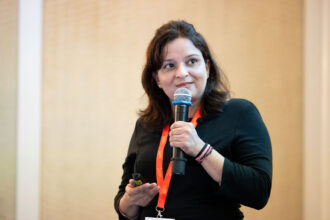
Reza Nejabati, Head of Cisco’s Quantum Research breaks the announcement into three core features:
- Universality (supporting different quantum encodings/modalities and converting between them)
- Switching (dynamic connectivity on demand, scalable beyond point-to-point)
- Quantum preservation (routing quantum information without disturbing/destroying it)
The quantum switch is designed to support all major quantum encoding modalities used to carry information:
- Polarization (the orientation of light waves)
- Time-Bin (the timing of light pulses)
- Frequency-Bin (the color or frequency of light)
- Path (the physical or spatial path)
To date, the quantum switch has been experimentally validated with polarization encoding. Support for time-bin and frequency-bin is built into the design and represents the next step in Cisco’s ongoing validation process.
Dynamic, on-demand connectivity
For distributed quantum computing—whether in a quantum data center or across a network—many quantum computers must be connectable “in arbitrary fashions,” and the connectivity must be reconfigurable based on application needs. Nejabati argues that point-to-point connectivity does not scale, cannot flexibly rewire, and becomes inefficient when you need to connect large numbers of quantum processors dynamically. Cisco’s switch is positioned as the mechanism to build a scalable network fabric for connecting quantum computers on demand.
Nejabati highlights a core technical barrier: ordinary optical switching equipment “messes with the quantum encoding” that maps qubits to photons. In other words, classical optical switches may route light, but they do not preserve fragile quantum states reliably in the ways quantum networking requires. Cisco claims the universal quantum switch preserves quantum information while switching at the photonic layer, routing qubit-carrying photons without measuring or destroying the encoded information.
Quantum computing is at this stage an ecosystem spanning multiple modalities, including superconducting (microwave), neutral atoms, trapped ions, and photonics. Nejabati emphasizes that each modality often uses different methods of encoding and mapping quantum information. Cisco’s stated intent is to avoid forcing every vendor to conform to one modality “compatible” with a network; instead, Cisco claims its switch can accept different entanglement encodings, switch them while preserving quantum information, and convert between modalities/encodings.
Cisco frames this as enabling two strategic advantages:
- Risk reduction for builders: Organizations can build infrastructure now without betting on which modality will “win” the industry.
- Future heterogeneous quantum data centers: Cisco asserts that future quantum data centers may intentionally mix modalities because different modalities may be better suited to different circuit types or algorithms. A universal fabric enables a broader set of applications by allowing heterogeneity rather than forbidding it.
How the switch works
Cisco has provided a step-by-step view of the switch’s internal conceptual flow. A single photon carrying one qubit enters through a standard optical fiber. It arrives encoded in “one of several possible modalities,” including polarization, time-bin, or frequency-bin.
The photon then enters a Quantum State Converter (QSC), which converts the qubit into a format suitable for routing. Next, the converted qubit passes into the switch blocks, where quantum information is routed to a selected output “without being measured or destroyed.” By combining QSC blocks with the switch fabric, the chip is described as fully reconfigurable, able to route quantum information “from any input to any output.”
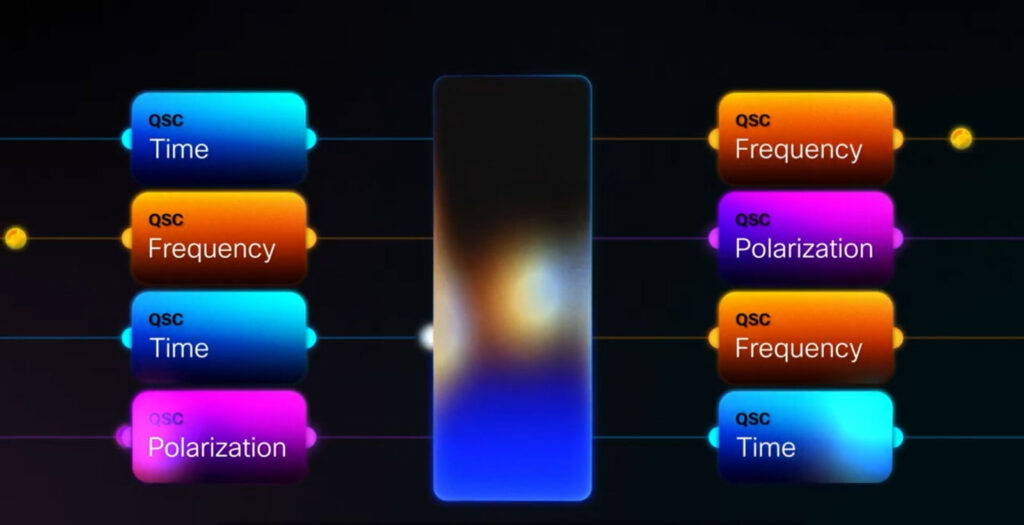
At the output, another QSC converts the information into the desired output encoding, described as independent of the input encoding (an example output encoding given is polarization). The explainer also claims the switch is non-blocking, enabling multiple photons to flow simultaneously—each independently routed—while preserving quantum state. Cisco’s intended outcome is interoperability: bridging quantum computers from “any vendor,” enabling them to communicate, and making heterogeneous scale-out quantum computing possible.
Nejabati provides a summary of the switch’s operational and performance characteristics, framed as key differentiators:
- Photonic switching that preserves entanglement/quantum information during routing.
- Encoding support (current prototype scope):
- polarization encoding entanglement
- time-bin encoding entanglement
- frequency encoding entanglement
- path encoding
- Switching time: claimed ~one nanosecond switching time, described as useful for certain quantum computing applications.
- Port-to-port penalty: described as “less than 4% penalty” on entanglement/quantum features on average (as stated).
- Low power, room-temperature operation, telecom frequencies, enabling deployment in existing network infrastructure.
He also emphasizes operational scaling features beyond raw routing: the switch can enable sharing expensive resources across time and space among multiple sensors and quantum computers. These include measurement devices, detectors, “swapping elements,” and entanglement sources—components described as complex and sometimes requiring cryogenic conditions (e.g., detectors). By sharing these resources, Cisco argues the overall system can become more scalable and efficient.
Tying the hardware to a full end-to-end system
Ramana Kompella, Cisco Fellow and Head of Cisco Research, “ties it back together” by walking through Cisco’s broader quantum networking vision and how the switch fits into a layered stack. At the bottom is quantum hardware, including the previously announced entanglement source. He reiterates the role of entangled photons in practical terms: each entangled photon pair is framed as enabling transfer of “one qubit worth of information.” Higher entanglement-pair rates therefore translate to higher quantum information transfer potential between nodes.
He also adds a scaling note: the entanglement source can be “daisy chained,” with the claim that doing so can reach “billions of photon entangled photon pairs”.
In this view, the entanglement source and the newly announced switch form the physical foundation:
- The entanglement source generates entangled photons.
- The switching technology allows those entangled photons to be directed “from any arbitrary host to any other arbitrary host,” i.e., distributing entanglement among arbitrary quantum processing units (QPUs) as needed.
On top of hardware, Kompella highlights protocols required to connect arbitrary nodes:
- Entanglement distribution protocols
- Entanglement swapping protocols
- Teleportation protocols, enabling quantum information transfer once entanglement is distributed
At the application layer, he returns to Cisco’s network-aware quantum compiler as a key mechanism for distributed quantum computing. The compiler is described as taking a quantum circuit too large to fit on a single processor and breaking it into subcircuits deployable on individual processors. When partial computations complete, the network stack and protocols enable quantum information transfer between processors to stitch the computation together—creating the “illusion of a gigantic quantum computer.”
Classical applications that benefit from quantum networking
Cisco did not only see value for “fully quantum” applications. While Cisco began with the goal of distributed quantum computing, Kompella describes a discovery: there are classical applications that benefit from the presence of a quantum network. Two are named and briefly explained:
Quantum Sync
Cisco describes Quantum Sync (announced previously) as a way for two distant servers (example given: “trading floors” separated by tens of kilometers) to take coordinated actions (like buying or selling) in a way that is not independent. Classical coordination relies on message exchange limited by the speed of light in fiber. Cisco claims that by pre-distributing entanglement, decision strategies can gain a “quantum advantage” compared to classical approaches, using entanglement as part of how decisions are driven.
Quantum Alert
Quantum Alert is described as a technique to detect eavesdroppers on classical optical fiber carrying classical information by “mixing in quantum signals.” If an attacker inserts a tap and interacts with the quantum signals (e.g., absorbing photons), the disturbance can reveal their presence. Ramana Kompella links this to concerns about “harvest now, decrypt later,” described as a quantum-era threat to existing classical cryptography.
Cisco positions these applications as beneficiaries of the same full-stack approach: entanglement source + switch + protocols, enabling capabilities that go beyond purely future-looking quantum compute and into nearer-term operational and security contexts.
A real-fiber deployment in New York
Cisco also emphasizes moving experiments out of controlled laboratory spools and into operational environments. Kompella describes a deployment on “real fiber” in Manhattan, connecting Manhattan and Brooklyn via 60 Hudson, identified as “one of the busiest carrier hotels in the world.” The fiber span is given as 17.6 kilometers, subject to real-world noise and operating conditions.
The experiment is described as focusing on entanglement swapping, and Cisco claims the results were “substantially better” (by a factor of 5000) than prior lab demonstrations. He highlights why this matters: the environment includes real disturbances such as subway/train traffic and temperature variations—yet Cisco reports “pretty good results.”
He also adds a technical qualifier: Cisco’s experiment “does not involve shared lasers,” unlike some prior lab results, and presents that as important for understanding implications for preserving quantum properties in real deployments. He frames this as an early step in a broader plan to conduct more real-environment experiments over time.
Building toward a heterogeneous quantum fabric
Cisco underscores that building a quantum network “takes a village”: the network alone is not enough without endpoint quantum nodes generating and consuming quantum traffic. Kompella describes partnerships with quantum computing companies, naming IBM and Atom Computing. He emphasizes that these partnerships matter specifically because they represent different modalities: IBM is superconducting-transmon-based, while Atom Computing is neutral-atom-based.
This directly supports the universal-switch narrative: Cisco’s goal is not only connecting homogeneous sets of processors but paving the way to interconnect different modalities—precisely the kind of heterogeneity the switch is intended to support.
He also points to “transduction technologies” as part of the interface between quantum computers and the quantum network, and notes that vendors express quantum circuits through their own software stacks. Cisco’s quantum compiler work is described as aligning with vendor software foundations so distributed quantum computing can have broader reach. He further mentions “distributed error correction” that Cisco “pioneered last year” and suggests it would be integrated into network-aware compilation for different modalities.
What “working prototype” means
Pandey addresses what Cisco means by calling the switch a “working research prototype.” He explains that the device packages “a lot of innovation,” and Cisco’s first goal was to ensure the key properties function as intended: preserving quantum information while switching photons, and enabling interconnection across modalities, among other claims highlighted by Reza Nejabati.
He outlines Cisco’s stated near-term plan: with the entanglement source chip, the switch, the protocol stack, and applications in place, Cisco wants to spend the next two years proving out end-to-end use cases with partners. This includes distributed quantum computing with IBM and Atom Computing, as well as design partnerships for Quantum Alert and Quantum Sync. After proving the stack end-to-end with partners and use cases, Cisco says it would then be ready to pursue a “scale out go-to-market motion.”
He also argues Cisco contributes “operability,” noting that a network and switch enable redundancy (analogous to cloud operating models), facilitating upgrades, migrations, and resilience—capabilities that are harder in purely vertical scaling approaches.
The case for distributed quantum as the default
Pandey argues that distributed quantum computing will become the norm, drawing on lessons from classical computing where distributed architectures deliver advantages in availability, scalability, heterogeneity, and operational flexibility. He anticipates two broad deployment patterns:
- Cloud-delivered quantum computing: quantum services accessed through cloud endpoints, where the provider uses quantum networking to scale out.
- On-prem deployments: organizations deploy a quantum network and attach quantum compute nodes, benefiting from a stable, uniform fabric that can connect different modalities, generations of hardware, and enable migration/upgrade paths.
He also emphasizes telecom operators’ role because Cisco’s approach is designed to run on existing fiber and telecom frequencies, with room-temperature networking hardware, reducing the need to rebuild physical infrastructure. The quantum and classical networks are described as distinct (packet-based store-and-forward for classical; qubit/teleportation/entanglement-based for quantum), but co-deployable on the same fiber. He suggests telecoms can start with quantum-network-enabled classical use cases (Quantum Sync and Quantum Alert) while preparing to attach quantum compute nodes of multiple types later.
A switch as the scaling primitive for the quantum era
Cisco’s central claim is architectural: quantum computing’s path to broad utility depends not only on better qubits and better algorithms, but also on the infrastructure that allows many quantum systems to operate together. Cisco positions the Universal Quantum Switch as the missing primitive that enables scalable quantum networking, analogous to the role the classical switch played in enabling the internet to grow beyond point-to-point links.
The switch is described as enabling dynamic, non-blocking routing of photonic qubits while preserving quantum information, supporting multiple encodings (polarization, time-bin, frequency, and path), converting between encodings via QSC blocks, and operating in a deployable form factor aligned with existing telecom infrastructure. It is presented not as a finished product, but as a working prototype within a broader full-stack effort: entanglement sources, protocols for distribution/swapping/teleportation, network-aware compilation, and applications that span both quantum-native and quantum-enhanced-classical domains.