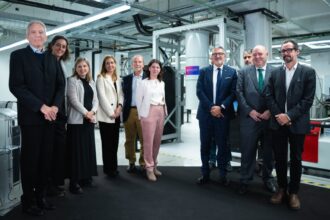



IonQ has signed a memorandum of understanding with Sandia National Laboratories, to explore accelerated co-design of quantum information science technologies in support of United States national security innovation.
Also, the company has been awarded a $28 million contract extension, with an additional option of $30 million through the Defense Advanced Research Projects Agency (DARPA)’s “It’s About Time” program.

IonQ chairman and CEO Niccolo de Masi said partnerships with the government could help shape the future of quantum technology—and play an important role in US economic and national security.
“Our partnership with IonQ leverages the strengths of both organizations to accelerate innovation in quantum computing and networking,” said Toby Townsend, associate laboratories director for deterrence, science and energy. “Together, we aim to translate cutting-edge research into practical solutions that address critical government missions and help maintain US leadership in this transformative field.”
IonQ and Sandia intend to explore a range of technical areas tied to quantum system co-design and mission-relevant use cases. The partnership supports broader research and innovation activities related to system optimization, device development, characterization and testing, and the advancement of quantum capabilities aligned with US economic competitiveness and national security priorities.

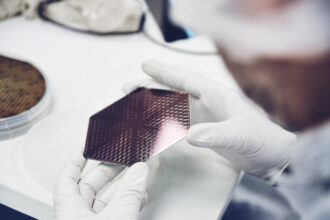
“Sandia fabricated the ion traps that IonQ’s earliest quantum computers were built on, so this collaboration has a historic pedigree,” said Rick Muller, SVP and chief scientist at IonQ Federal.
“What’s new is the scope,” said Muller. “We’re putting our hardware and applications teams alongside Sandia’s expertise in trapped-ion fabrication and silicon photonics. These two areas most directly determine how fast quantum computers scale and how well they connect to one another.”
The Quantum Demonstration Facility is a research and commercialization hub at Sandia National Laboratories established to explore public-private collaboration models that can accelerate innovation in quantum technologies.
The facility offers impartial third-party verification for pathways to utility-scale quantum computers, enhances research and development efforts and effectively communicates findings to US government stakeholders.
IonQ’s participation expands the company’s footprint into New Mexico while supporting a growing ecosystem focused on the development and deployment of next-generation quantum systems.
Meanwhile, under the DARPA program, IonQ will advance its scalable clock production capabilities for its Evergreen-05 optical atomic clocks and deliver 125 units to U.S. government customers. The clocks are designed for mission-critical applications including radar, secure communications, and precision geolocation.
This contract is a modification to its existing DARPA agreement, and will cover manufacturing development and 25 Evergreen-05 clocks.
A further $30 million option, not yet exercised, would cover an additional 100 clocks, for a combined value of up to $58 million.
Originally developed under DARPA’s Robust Optical Clock Network program, IonQ’s Evergreen-05 is a compact, fully integrated optical atomic clock with a 5-liter, shoe box-sized form factor.
The clock delivers timing stability of 50 femtoseconds at one second and nanosecond holdover over 10 days–projecting to a timing error of less than one second over 30 million years.
DARPA’s support for the core Evergreen-05 technology began in 2019, when it funded an initial effort for Vector Atomic, then a year-old startup in Pleasanton, California.
IonQ acquired Vector Atomic in October 2025 to expand its capabilities into quantum position, navigation, and timing.
To support Evergreen-05 delivery, IonQ will invest $15 million in dedicated production space, advanced manufacturing and test equipment, and support staff.