


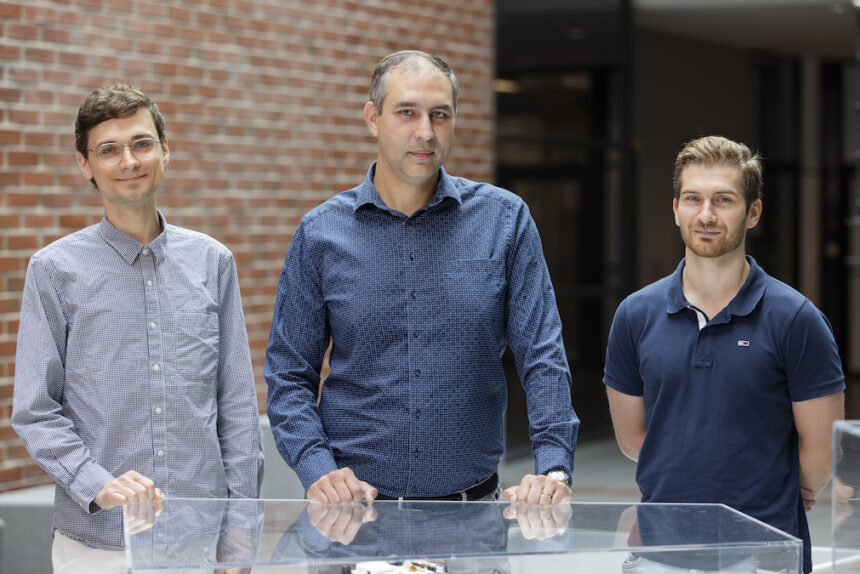
Newly launched Finnish startup S-Transistors, originating from VTT Technical Research Centre of Finland, has raised €2.6 million in pre-seed funding to pioneer a fundamentally new class of integrated circuits based on superconducting transistors.
The technology has several promising applications, from energy-efficient classical computing to spacecraft electronics, but quantum computing, in particular, stands to benefit most.

Today’s cryogenically cooled superconducting quantum computers need a paradigm-changing solution to break the scaling limit of the quantum processing unit (QPU) — the array of quantum bits that, by analogy to a conventional CPU, does the quantum computing. That limit comes from the power-hungry, poorly scalable way quantum processors are controlled today: multiple expensive, bulky cables per qubit, running from the processor inside the cryostat out to room-temperature electronics.
This is where S-Transistors’ superconducting transistor technology, which is already available at wafer scale, offers a solution that is more energy-efficient and compact than existing alternatives.
The funding round was led by Nordic investor Lifeline Ventures and joined by an angel investor.

S-Transistors is going to use the pre-seed funding to develop several product prototypes for cryogenic signal control and handling, set up its own cryogenic laboratory, establish a manufacturing pilot line for its unique integrated circuits based on superconducting transistors, and grow the team.
“The clearest path forward, for superconducting quantum computers in particular, is to bring the classical control and interface hardware down into the cryostat, right next to the quantum chip kept cold to protect its fragile quantum states. The catch is that such integration is extremely demanding in power dissipation, speed, and energy efficiency,” said Heorhii Bohuslavskyi, co-founder and CEO of S-Transistors.
“Superconducting transistors are exactly that missing piece of hardware for large-scale, energy-efficient quantum computing,” added Bohuslavskyi.
Cryogenic quantum computers, including those based on superconducting quantum bits, are considered among the most promising platforms for scaling quantum computing. Unlocking their full potential will require quantum machines with hundreds of thousands of qubits, along with new technologies capable of supporting such computing systems at that scale.
Superconducting transistors offer a promising solution to this very problem. They combine ultra-low power consumption and high-speed performance with compatibility with the quantum processor’s cryogenic environment.
“By combining the transistor functionality, with its unparalleled computing potential, and the superconducting property of near-zero power dissipation in a single device, we can reach a completely new level of energy-efficient cryogenic computing,” said Andrey Generalov, co-founder and CTO of S-Transistors.
“In the near term, this already solves the cryogenic signal routing and delivery problems the superconducting quantum computer, but the real vision is the quantum motherboard: a completely new platform for scaling quantum computers, operating at mK temperatures, and controlling the operation of qubit-based QPU,” said Generalov.
S-Transistors’ first product is a superconducting-transistor-based multiplexer that plugs into existing cryogenic setups and speeds up the development and prototyping of various quantum devices. It will ship to early customers and strategic partners within the company’s first year of operation.
The multiplexer is the first logical step toward the quantum motherboard and, according to prospective customers and collaborators, it addresses one of the most acute pain points in scaling today’s superconducting quantum computers.
The potential reaches well beyond quantum computing and sensing. First theorised in the 1980s, a scalable and reproducible superconducting transistor technology today has strong potential across classical and quantum computing, artificial intelligence and high-performance computing hardware, spacecraft electronics, and fundamental particle detectors. S-Transistors intends to be the one to take that first step toward customer adoption of superconducting transistor technology.
Jyri Engeström, partner at Lifeline Ventures, said that as quantum computers scale from hundreds or thousands of qubits toward commercially useful machines, superconducting transistors can become a critical part of the hardware stack that makes that scaling possible.
“Our strategy at VTT is to shorten the journey from idea to pilot, from pilot to commercial solution. S-Transistors’ superconducting transistor technology will allow us to reach the point where quantum computers finally provide real-world value,” said Erja Turunen, EVP at VTT.