



IonQ, along with Oak Ridge National Laboratory (ORNL), NVIDIA, and the University of Tennessee, Knoxville (UT) have released a research paper showing that a trained generative model can write quantum optimization circuits directly. This eliminates the trial-and-error parameter-tuning loop that has made the most accurate approach too costly to run.
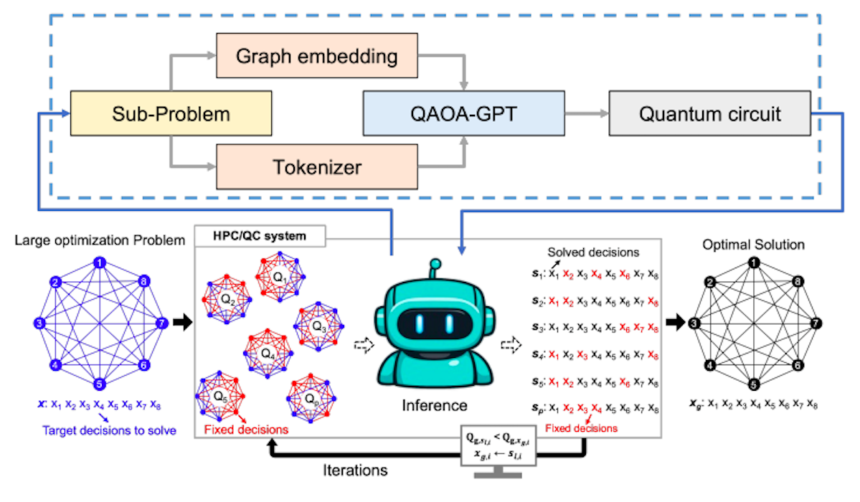
Hybrid quantum optimization breaks a large problem into smaller pieces, solves each one, and recombines the results. Each piece needs a tailored quantum circuit, which traditionally required trial- and-error parameter tuning: run, measure, adjust, and repeat, often hundreds of times. Larger pieces can improve answers, but they also raise tuning costs, limiting the size of problems researchers could solve.
“Better answers in hybrid quantum optimization have traditionally come with a steep tuning tax. In this benchmark, generative AI replaced the iterative tuning loop, and as the quantum subproblems grew the solution quality improved,” said Martin Roetteler, IonQ’s VP of Quantum Applications R&D and a co-author of the paper.

“Take that cost away and you can work at the size where the answer is meaningful. The result provides a potential path toward scaling hybrid quantum optimization, unlocking completely new capabilities and scales that align with IonQ’s existing and future quantum computing hardware generations,” said Roetteler.
To teach the generative model how to tune circuit instructions, the team first showed it what strong results looked like. They ran the conventional trial-and-error method across many sampled problems, kept only the near-optimal circuits, and used those examples to train a transformer, the same class of model behind large language models but trained on circuits instead of text.
The trained model generates candidate quantum circuits directly, without the repetitive parameter-tuning loop used by conventional methods.
In the reported experiments, the model sampled 10 candidate circuits for each subproblem; all 10 were simulated and scored, and the best-scoring candidate was used to update the global solution.
On a dense, higher-order benchmark problem with 100 decision variables, model-generated answer quality roughly doubled as subproblems grew. Under the prior state-of-the-art method, circuit-finding time rose sharply from about 34 seconds on 4 qubits to more than 11 minutes on 12 qubits.
The generative approach held nearly 28 seconds for every size previously tested. Both approaches are quantum methods; the study compares circuit-generation approaches, not quantum against classical solvers.
ORNL led the study. Co-authors span ORNL’s National Center for Computational Sciences and its Materials Science and Technology Division, IonQ, NVIDIA, and UT. Abhinav Rijal, a graduate researcher in the Department of Physics and Astronomy at UT is a co-author of the study.
In-Saeng Suh Seongmin Kim at the National Center for Computational Sciences, ORNL, said this work brings generative AI, quantum computing, and high-performance computing together to tackle large-scale, complex optimization problems.
“AI can become a new computational layer for quantum circuit synthesis, enabling the automatic design and optimization of quantum circuits for increasingly complex problems,” they said.
“We are now extending the framework to real-world scientific and engineering applications and scaling it across larger HPC systems to address problems of even greater scale and complexity,” they added.
Sam Stanwyck, director of quantum product at NVIDIA, said that drawing on accelerated computing and AI to make breakthroughs in quantum algorithms is one of the most promising ways to reach useful quantum applications as quickly as possible.
“By enabling developers to build quantum algorithms architected around AI from the outset, tools like CUDA-Q are laying the foundation for the next generation of advances in quantum computing and its useful application,” said Stanwyck.