


NVIDIA has announced a series of initiatives aimed at advancing quantum computing research and its integration with high-performance computing environments. The announcements include a new quantum-classical codesign collaboration with IBM and Fermilab, advances in quantum error-correction research, and expanded support for quantum processors within the Slurm workload management platform.
Quantum-classical codesign collaboration brings together NVIDIA, IBM and Fermilab
NVIDIA announced plans for a broader collaboration with IBM and the U.S. Department of Energy’s Fermi National Accelerator Laboratory (Fermilab) focused on developing technologies for next-generation quantum computing systems.

Central to the collaboration is a new modular quantum computing codesign platform that combines NVIDIA accelerated computing infrastructure, IBM quantum processors, and Fermilab’s expertise in quantum science and high-energy and nuclear physics. The platform is intended to support research into quantum error correction, decoding algorithms, hybrid quantum-classical applications, and architectures that connect multiple quantum processors.
As part of the initiative, NVIDIA DGX B200 systems will be colocated with IBM quantum computers, including systems powered by IBM’s Quantum Nighthawk processor. Researchers will use the environment to evaluate error-correction strategies and study how classical computing systems can scale alongside modular quantum architectures.
Alongside the collaboration announcement, NVIDIA introduced TCBP-JOBS, a decoding algorithm available through its CUDA-Q QEC library. According to the company, the algorithm can deliver up to a 13,000-fold speedup compared with existing leading approaches used in quantum error-correction research. NVIDIA said the improvement could reduce certain research workloads from approximately 12 weeks to 45 minutes, potentially accelerating investigations into fault-tolerant quantum computing.

The company also highlighted ongoing quantum-classical computing research by IBM and RIKEN, which combines IBM quantum hardware with the ROQUO GPU supercomputer. The project, which was named a finalist for the 2026 ACM Gordon Bell Prize, modeled protein-ligand systems containing up to 12,635 atoms, exceeding previous quantum-classical benchmarks for molecular-scale simulations.
NVIDIA expands Slurm to bring quantum computing into supercomputing
In a separate announcement, NVIDIA detailed new capabilities for the open-source Slurm workload manager aimed at simplifying the integration of quantum processors into supercomputing environments.
According to NVIDIA, deployments of quantum processors at supercomputing centers have increased significantly over the past five years, with nearly 30 facilities worldwide in the process of deploying more than 50 quantum processors. The company said many of these centers already rely on Slurm to manage high-performance computing workloads.
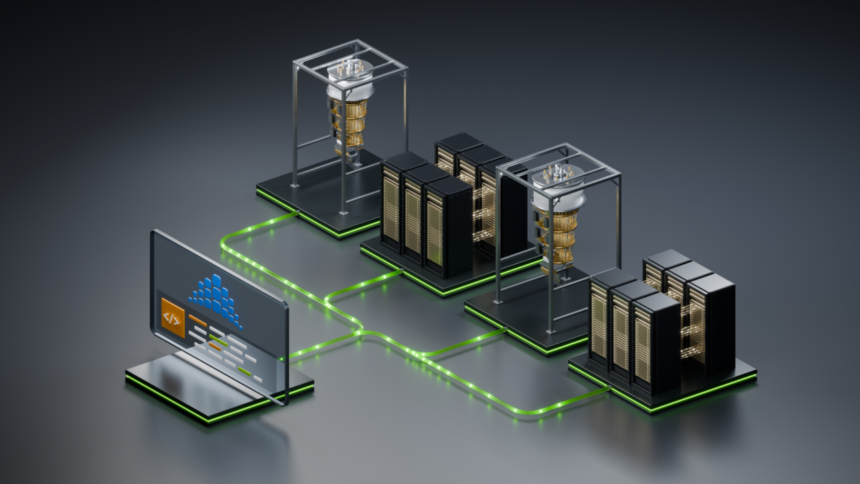
The updated Slurm capabilities are designed to allow quantum processing units (QPUs) to be scheduled alongside CPUs and GPUs using existing resource-management workflows. NVIDIA said the approach builds on industry interfaces such as the Quantum Resource Management Interface (QRMI) and Quantum Device Management Interface (QDMI), enabling hardware providers to create a single integration that can be deployed across multiple supercomputing centers.
The expansion has already been adopted by several organizations, including Alice & Bob, IBM, IQM, Pasqal, Quantinuum and MQSC, according to NVIDIA.
The Slurm enhancements form part of NVIDIA’s broader quantum-GPU computing platform centered on CUDA-Q. At the SC26 conference, NVIDIA also announced updates across its quantum software stack, including CUDA-Q QEC for error-correction research, additional fault-tolerant computing primitives in CUDA-Q, new application-building tools through CUDA-Q Algorithms, and CUDA-Q Pulse for quantum hardware control.
NVIDIA said these developments are intended to make it easier for researchers and supercomputing centers to build and run hybrid quantum-classical applications, while providing a common framework for integrating quantum resources into established HPC infrastructures.