

Thales Alenia Space, the joint venture between Thales (67%) and Leonardo (33%), has signed two contract amendments with the European Space Agency (ESA), the company said. It acts as prime contractor for TeQuantS, a project aimed at developing quantum communication technologies between space and Earth.
TeQuantS stands for “Technological development for space-based Quantum reSource distribution”. The project is part of the Industrial Competitiveness component of ESA’s ARTES (Advanced Research in Telecommunications Systems) program, which is dedicated to the development, validation and demonstration of technologies and products for the satellite telecommunications market. It is supported by the French Space Agency (CNES).

Launched in 2023, TeQuantS aims to develop the space-based quantum technologies required to build a future long-distance quantum internet network. According to Thales Alenia Space, the initial phases enabled the development of a compact ground station prototype and a first engineering model of the quantum communications system.
New laboratory at CNES
Thales Alenia Space and its partners are now entering a new development phase with the creation of a quantum laboratory at CNES. The laboratory will test equipment dedicated to quantum communications, with the aim of establishing quantum links between space and Earth under simulated real-world operating conditions.

The equipment to be tested will include an entangled photon source, time-synchronization systems between satellite and ground stations, and photon analysis and detection systems on the ground.
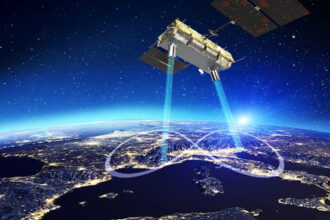
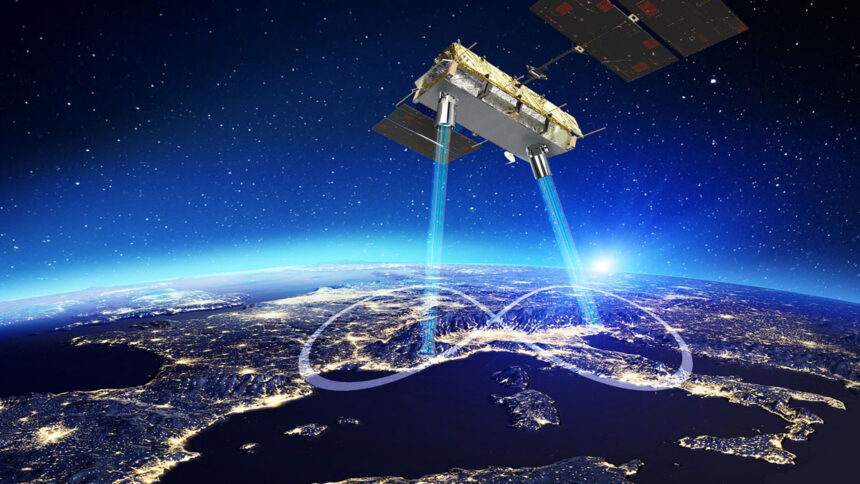
The company said the tests will contribute to the development of the future QINSAT satellite, which is intended to demonstrate the transmission of entangled photons between space and Earth. This, it said, would pave the way for the future interconnection of terrestrial quantum networks across different continents.
Why satellites matter for quantum networks
Quantum information networks are regarded as a major development in information technologies and could enable a new form of internet connecting quantum devices. Satellites are expected to play a role in extending quantum connections over long distances, because terrestrial optical fibres can directly transmit quantum information only up to about 150 kilometres, according to the company.
Thales Alenia Space said future users would include quantum computers that need to exchange photonic qubits to perform distributed quantum computing; quantum sensors that must interoperate to enhance the sensitivity of detection systems; and government operators seeking to exchange end-to-end secure information in a resilient and sovereign manner, protected against attacks from future quantum computers.
Statements
Alcino De Sousa, Senior Vice President Telecommunications at Thales Alenia Space, said: “We are delighted to strengthen our collaboration with our partners to develop quantum technologies that will demonstrate the ability to establish long-distance satellite-based quantum communication links with a clear operational objective, while contributing to European sovereignty in this domain. We would like to thank ESA and CNES for their essential support to this unique project, which addresses both future cybersecurity challenges and the development of quantum internet networks.”
Dr Kasia Balakier, TeQuantS Technical Officer and Optical & Quantum Communication Technology Manager at ESA’s ScyLight Programme, said: “The TeQuantS project has created a unique opportunity for French and European industry to lead the definition and development of a Quantum Information Network for long-distance quantum connectivity. The equipment and test facility at CNES represent major milestones towards deploying satellite-based quantum connectivity.”
Consortium
The new phase of the project draws on the expertise of all consortium partners, the company said. These include Airbus Defence and Space; small and medium-sized enterprises and start-ups AUREA Technology, BERTIN ALPAO, BERTIN TECHNOLOGIES, OGS Technologies and SIGMAWORKS; and two research laboratories, LIP6 (Sorbonne Université) and INPHYNI (Université Côte d’Azur/CNRS). Thales Alenia Space said the project allows all partners to innovate together and advance the field of quantum communications, which it said would help achieve Europe’s strategic objectives.
Partner roles
- Thales Alenia Space: quantum systems
- Airbus Defence and Space: quantum systems
- AUREA Technology: space-qualified entangled photon source
- OGS Technologies: optical ground stations
- BERTIN ALPAO: adaptive optics and optical test bench
- BERTIN TECHNOLOGIES: optomechanical systems for focal-plane assemblies
- SIGMAWORKS: quantum channel time synchronization
- LIP6 – Sorbonne Université: quantum protocols advisory and expertise
- INPHYNI – Université Côte d’Azur/CNRS: quantum systems advisory and expertise
Other quantum communications work by the company
Thales Alenia Space said it has pursued a quantum communications roadmap since 2018, drawing on its expertise in satellite telecommunication systems and optical terminals, and on more than 25 years of quantum technology experience within Thales. It said this supports an integrated approach spanning both the space and ground segments of quantum communications systems.
The company said it is currently leading several projects, including:
- QINSAT, a mission developed to demonstrate space-based Quantum Information Networks (QIN);
- QKD-GEO, which the company describes as the world’s first quantum key distribution system from geostationary orbit, and which it says will allow secure intercontinental communications;
- SAGA, aimed at developing what the company describes as Europe’s first orbital system for generating cryptographic keys securely established through the laws of quantum physics.
The company also takes part in EuroQCI and its associated projects, including FranceQCI, Quantum Italy Deployment and Nostradamus, which it says contribute to Europe’s future quantum communication infrastructure, including its space segment.