



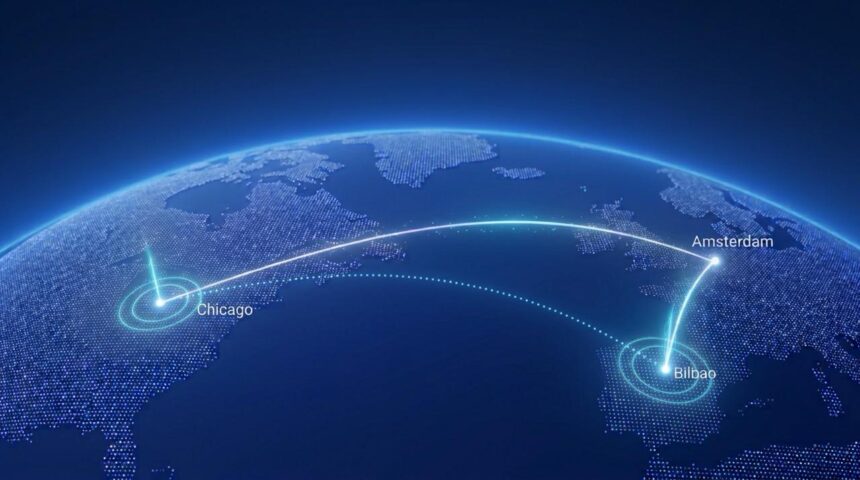
An international consortium of research institutes, network operators, and technology vendors has demonstrated an 8,000-kilometer hybrid quantum-safe network connecting sites across Chicago, Amsterdam, and Bilbao, Spain, at the Supercomputing Conference 2026 (SC26).
The cross-continental infrastructure uses a unified management framework to deploy a multi-layered, defense-in-depth security architecture that protects data against future quantum computing decryption threats across optical, network, and application layers.

The trial was conducted jointly by the University of the Basque Country (EHU), Luxquanta, Ciena, GÉANT, the Poznań Supercomputing and Networking Center (PCSS), RedIRIS, and SURF.
Technical architecture and deployment details of the transatlantic demonstration include:
- Short-haul quantum key distribution (QKD): Deployed over metropolitan fiber links under 100 kilometers—specifically between SC26 exhibition nodes in Chicago and across a 25-kilometer link between EHU sites in Spain. Luxquanta’s Nova lq QKD systems generated physics-based encryption keys coexisting with classical data on single fiber pairs using Ciena high-speed optical transport multiplexers (1.6 Tbps line-rate encryption in Chicago and 800 Gbps in Spain).
- Long-haul post-quantum cryptography (PQC): Applied across extended geographic distances—connecting Bilbao to Amsterdam (1,200 km) and Amsterdam to Chicago (7,000 km). The long-haul segments utilized NIST-standardized ML-KEM algorithms to establish encryption keys over standard internet routing infrastructure.
- Unified orchestration framework: EHU’s proprietary QuLore security orchestrator managed real-time algorithm selection based on link distance and hardware availability, routing keys across vendor-agnostic key management systems (KMS) supplied by Luxquanta, EHU, and SURF’s open-source eduKMS.
- Three-layer encryption: Security was enforced at the optical layer via Ciena hardware, the network layer through IPsec tunnels, and the application layer on live end-to-end video streams.
The demonstration provides a commercial blueprint for research institutions, government agencies, and enterprise network operators seeking to secure legacy cross-border communications before quantum decryption capabilities mature.