


Aqarios GmbH, one of Europe’s leading providers of application-oriented quantum software for optimizing complex industrial problems, has gone public through a SPAC transaction with Fonterelli SPAC 4.
The company is now a wholly owned subsidiary of Fonterelli SPAC 4, which will operate as Aqarios Quantum Technologies AG.

Aqarios said this makes them the first listed pure-play quantum computing company on a German stock exchange.
The firm was founded in 2021 as a spin-off from Ludwig Maximilian University of Munich (LMU) and currently employs 15 people. Its core business is the development of software for optimizing complex problems – from supply chains and energy networks to production plans and investment portfolios.
To this end, Aqarios has developed advanced solutions, particularly software based on quantum computing. Aqarios already boasts successful projects with renowned DAX-listed companies and leading industrial firms such as BASF, E.ON, and MTU Aero Engines.

Since its founding, Aqarios has built its own technology platform, acquired prominent industry and technology partners, and established itself in funded cutting-edge research projects. The company operates across industries in the energy, finance, logistics, aerospace, and manufacturing sectors.
At the heart of the business is the proprietary Luna platform. Luna makes the power of quantum computers practically usable for companies – without requiring them to develop their own quantum expertise.
The platform provides the necessary software and suitable algorithms, enabling optimization tasks such as supply chain, energy grid, or logistics optimization to be solved using quantum computing. Users can then focus entirely on the issues within their area of expertise.
The hardware-agnostic approach is crucial: Aqarios customers are not tied to any single hardware manufacturer and can access a wide variety of different quantum computers via Luna.
Further, Luna combines classical and quantum-based computing, ensuring that the best available technology is used for every problem. Real-world problems can be solved today, and customers don’t have to commit to a single technology early on.
In the collaborative project QuCUN (Quantum Computing User Network), Aqarios, together with partners SAP, BASF, and LMU Munich, is developing an open, sustainable quantum computing ecosystem for Germany. This project, funded by the Federal Ministry for Research, Technology and Space (BMFTR), has a total funding volume of €14.2 million.
Further, Aqarios is active in numerous other initiatives, combining cutting-edge research with real-world applications – from funded research consortia to specific projects with industrial companies.
In parallel, Aqarios is integrating the Luna platform into concrete applications for various industries. Together with the fintech company Divizend, the company is developing a product for the financial sector focused on portfolio optimization, which will soon be launched – a direct vertical application of the Luna platform for institutional and private investors.
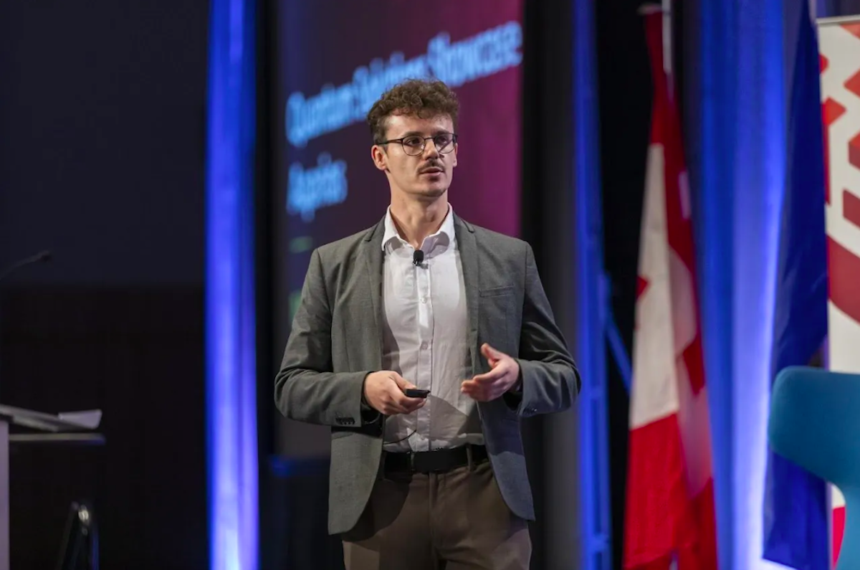
Michael Lachner is the CEO of Aqarios Quantum Technologies. A computer scientist and quantum computing expert trained at LMU and TUM, he is a co-founder of Aqarios and continues to serve as its managing director.
“Quantum computing will be a key factor in determining industrial competitiveness in the coming years – and we want this value creation to take place in Germany and Europe,” said Lachner, who is also managing director of Aqarios.
“As the first publicly listed quantum software company in Germany, we are making this future technology accessible to investors as well as to our industrial customers,” he said. “With Luna, we have demonstrated that quantum computing is already relevant for companies today – hardware-agnostic, application-oriented, and scalable.”