


Scientek and Classiq Technologies have entered into a go-to-market agreement to expand access to Classiq’s hardware-agnostic quantum software platform across Taiwan’s semiconductor, research and academic communities.
Under the partnership agreement, Scientek will introduce Classiq’s platform to semiconductor companies, research institutes, universities, government organizations and other customers within its established network.

The companies also plan to offer enablement and training and explore joint research and development programs involving quantum computing applications.
Scientek distributes semiconductor equipment, scientific and analytical instruments and advanced technology systems to Taiwan’s industrial and research communities.
The company’s experience supporting advanced technology infrastructure, including quantum hardware, positions the company to help customers connect their computing investments with the software required to design, optimize and execute quantum algorithms.

Classiq’s platform allows researchers and technical teams to describe quantum algorithms as high-level functional models.
The platform then automatically creates optimized quantum circuits for the selected hardware or execution environment. This hardware-agnostic approach allows organizations to develop software without committing their algorithms to a single quantum computing architecture.
“Taiwan’s semiconductor companies and research institutions are increasingly evaluating how quantum computing could contribute to areas such as materials research, simulation and optimization,” said Simon Lin, CEO at Scientek.
“Customers need more than access to hardware. They need software, training and development workflows that allow their teams to begin building applications,“ said Lin. “Classiq adds that capability while preserving flexibility across different hardware systems.”
The collaboration is intended to help local organizations establish quantum development capabilities, train researchers and engineers, and evaluate potential applications within existing computing and research environments.
“Our shared objective is to help organizations move from evaluating quantum technology to building and testing applications,” said Nir Minerbi, co-founder and CEO at Classiq.
The two companies expect initial activity to focus on semiconductor-related research, materials and chemical simulation, optimization and advanced computing.
Classiq’s platform can support both quantum-only and hybrid quantum-classical development workflows, allowing users to evaluate algorithms across available hardware, simulators and cloud services.
Taiwan’s semiconductor and research ecosystem offers a natural setting for quantum application development. Many of the scientific and engineering challenges being explored for quantum computing, including materials behavior, process optimization and complex simulation, are relevant to organizations operating across the semiconductor value chain.
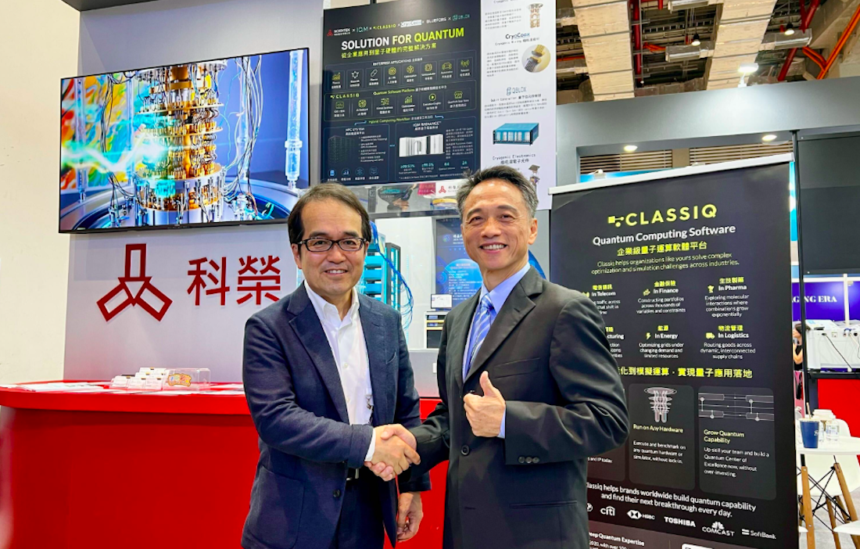
Also, Classiq entered into a market development partnership with quantum computing software firm Kensho to expand access to the Classiq quantum software platform in Taiwan.
Kensho will leverage its existing customer network to introduce the platform to government agencies, research institutions and enterprises, while providing local support and training, and exploring joint R&D initiatives.
The initial focus of the partnership will be on chemical and materials companies, defense organizations, and organizations evaluating quantum computing to address simulation and optimization challenges.
Kensho has extensive experience in the distribution of advanced semiconductor equipment and automation systems, providing a strong local foundation for introducing advanced quantum algorithm capabilities.
Classiq’s hardware-independent platform automatically converts high-level functional models into optimized, hardware-executable quantum circuits, enabling organizations to flexibly deploy quantum applications across different quantum hardware and cloud environments.
Fu-Hsin Hsiao, chairman of Kensho, said Taiwan is gradually gaining access to more quantum hardware, but hardware alone is not enough to build practical applications.
“Classiq provides the software layer needed to transform domain expertise into quantum programs, enabling us to offer customers a complete path from technology evaluation to application development,” said Hsiao.
The Classiq CEO said Taiwan has strong semiconductor expertise, advanced research capabilities, and a growing demand for new computing technologies.
“Kensho understands the local technology environment, and together we will provide trusted local support to help customers develop quantum software with cross-platform portability,” he said.
The two companies expect to support organizations in building internal quantum capabilities and identifying optimal use cases in areas such as materials research and complex optimization.