


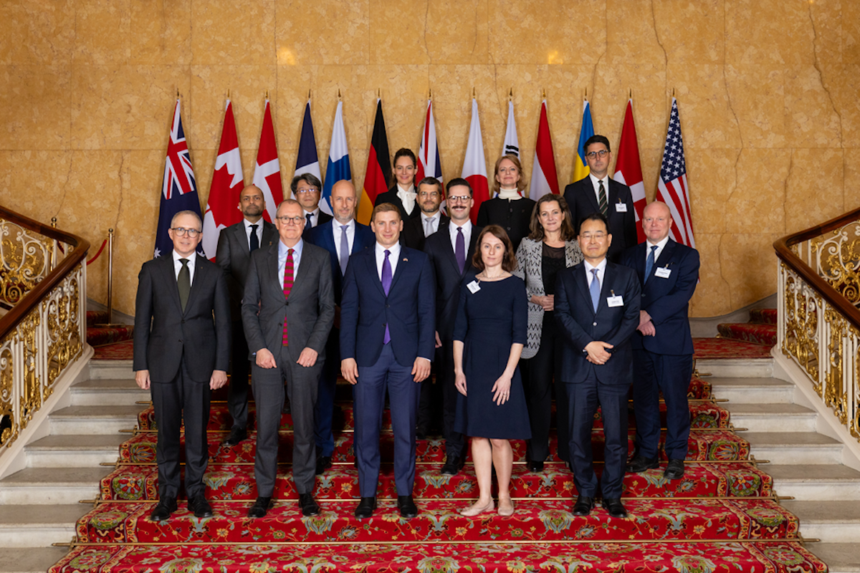
Nations leading the development of quantum technologies have committed to deepening cooperation that drives the cutting-edge technology forward securely, and supports companies to scale up, following a summit hosted by the United Kingdom.
The UK’s Science Secretary Liz Kendall hosted the fifth meeting of the Quantum Development Group (QDG) on 30 March to 1 April. This was a forum of 13 like-minded countries working together to advance the secure and responsible development of quantum technologies and brought together 70 senior leaders and officials in London.

QDG membership include, Australia, Canada, Denmark, Finland, France, Germany, Japan, Korea, Netherlands, Sweden, Switzerland, the UK and the United States.
Following the two-day meeting, members agreed to deepen cooperation across three priority areas.
One is research security, investment security, and supply chain resilience, to support trusted and impactful international collaboration alongside the safe and sustainable development of quantum technology.

Another is fostering a more supportive investment environment for scaling quantum companies. This will include deeper engagement between governments and investors to support commercialisation and expand access to the capital required for companies to achieve sustainable global growth.
The third is strategic priorities for international quantum standards development, focusing on shared priorities that will support industrial adoption, interoperability and the development of open global markets.
This QDG meeting came shortly after the UK Government’s recent £2-billion commitment to quantum and the launch of a world-leading procurement programme announced 17 March. It underlined the UK’s intent to back ambition with long-term investment and practical deployment.
Kendall said quantum has the potential to be one of the most exciting and defining technologies of the coming years, with the power to transform healthcare, energy, defence and transport.
“But progress in quantum technology is not something we can do alone. It will mean working hand‑in‑hand with our trusted partners, harnessing world‑class science and backing the businesses turning brilliant ideas into real‑world solutions,” said Kendall.
“In the UK we are matching that ambition with action – including a world‑leading quantum computing procurement programme as part of a £2 billion investment. This will create high‑skilled jobs, grow our economy, and help the British innovators developing quantum technologies that lead to medical breakthroughs and cleaner energy,” she added.
The QDG met in London to strengthen international cooperation on the responsible development and commercialisation of quantum technologies.
Participants reaffirmed their shared commitment to ensuring that quantum technologies develop in ways that are secure, trustworthy and beneficial to global economic prosperity.
As quantum technologies transition from research towards early deployment, members concurred that international cooperation is essential to maximise innovation, enhance supply-chain resilience, and ensure open, interoperable markets.
The event provided an opportunity to strengthen collaboration between policymakers and the organisations developing and deploying quantum technologies and ensure that international cooperation continues to translate into real-world innovation, investment and economic opportunity across QDG countries.