


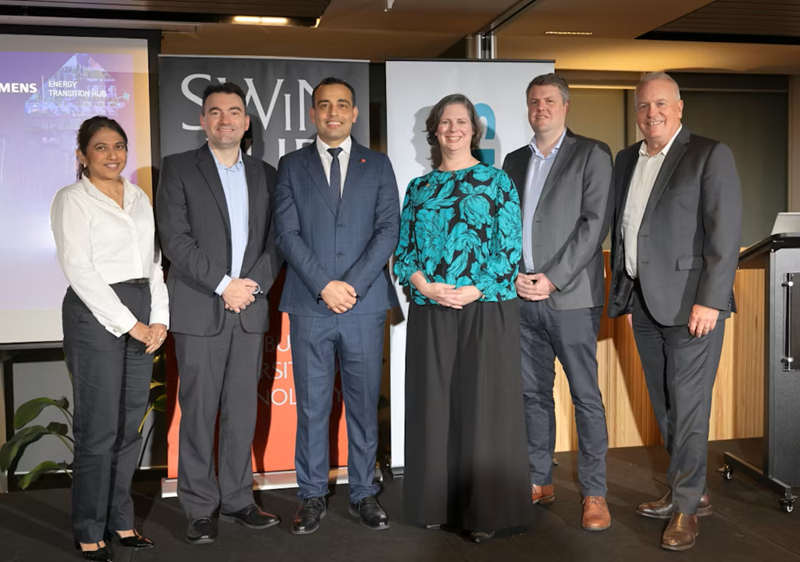
Swinburne University of Technology and Siemens are partnering in Australia to conduct research on how quantum-enhanced timing can help future-proof the energy grid and increase grid stability.
To do this, they will use Australian quantum sensing company QuantX Labs’ quantum clock and quantum-secured time transfer capabilities, along with Siemen’s PSS®E technology and the Siemens Swinburne Energy Transition Hub, a real-time digital twin of Australia’s energy system; Swinburne will use the PSS®E to simulate grid scenarios using quantum timing technology.

This comes as Australia’s energy mix continues to shift toward renewables, distributed energy resources and inverter-dominated networks that place greater pressure on ensuring regular flow of energy.
Speaking on this announcement at an event with some of the country’s leading grid planners and operators, Peter Halliday, CEO of Siemens Australia and New Zealand said, “Siemens has been helping Australia grow and keep the lights on for over 150 years.
Leading technology and innovation only make a difference when combined with people and collaboration. This joint research with Swinburne University challenges the status-quo and helps build our electricity grid’s resilience with a much more complex energy mix.”
Today, grid functions rely on satellite-based timing signals, including Global Navigation Satellite Systems (GNSS), which can be vulnerable to disruption, interference or cyber threats. As the power grid becomes more decentralised and complex, precise timing is increasingly critical for system protection, monitoring, and continuous power supply. This research will examine how quantum-enabled timing technologies could provide a more resilient approach for future grid architectures and a reliable alternative to current satellite-based timing technologies.
Jose Moreira, head of Grid Software for Siemens in the region said, “The research sits at the intersection of next-generation quantum technologies and future energy systems. It explores how ultra-precise timing can shape the future grid. By combining Siemens’ leadership in grid simulation with Swinburne’s energy industry research capability, we are helping the industry address today’s challenges while preparing for the next generation of energy networks.”
Swinburne’s Professor Mehdi Seyedmahmoudian, Director of the Siemens–Swinburne Energy Transition (SSET) Hub, welcomed the collaboration, saying, “This research is exploring an area that is still largely uncharted globally. As power systems become more distributed, dynamic and complex, precise and resilient timing will play an increasingly important role in maintaining stability. Through our collaboration with Siemens, we are investigating how emerging quantum technologies can support next-generation energy networks, while also demonstrating how the SSET Hub translates ideas into real-world impact.”
Professor Allison Kealy, another key expert from Swinburne’s team of researchers, added, “Advancements in quantum technologies will bring greater confidence in precision, timing and trust in critical infrastructure, including energy systems.”