


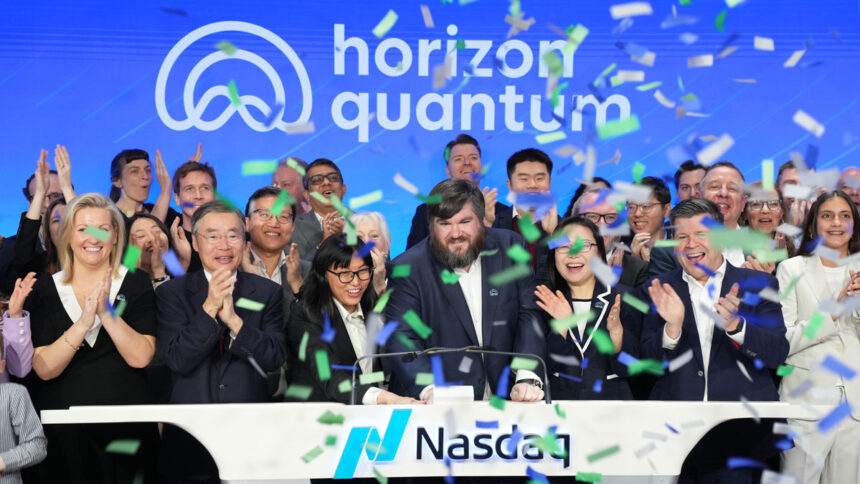
We talk to Horizon Quantum founder and CEO Dr Joe Fitzsimons on his path from theoretical physics to building a quantum software company in Singapore and taking it public. He traces how his early interest in living through a technology revolution led him into quantum computing, why his research on blind and verifiable quantum computing shaped his view of secure computation, and how work on algorithms, complexity theory and machine-learning acceleration eventually pointed toward Horizon Quantum.
The Q&A follows the company’s evolution from academic insight to commercial platform, the broader wave of quantum companies entering public markets or consolidating, and what that says about the maturity of the industry.

From theoretical physics to quantum computing
Your background is in theoretical physics. How did you get started in quantum computing?
I think most people in quantum computing, certainly when I entered the field, came from physics. That is not surprising, because quantum physics underlies the whole effort. Within physics, people working on the theory side are probably more naturally drawn toward software, error correction and related areas, although there is also theory connected to processors.
For a company started by theorists, it is most natural to go toward the software side. As for what got me into quantum computing, I thought it would be cool to live through a technology revolution from the inside.

It would have been fascinating to be involved in the early days of the internet, computers, personal computers, flight or similar technological shifts. I thought quantum computing was probably my best bet to experience something like that.”
I may have misjudged the timelines a little, but it seemed like the best chance to see that kind of revolution from the inside.
You say you may have misjudged the timelines, but it feels as if the timelines are being compressed now.
They are, but I am 44 now, and I got started in this when I was 22. When I entered quantum computing, I thought it would not be that long before we saw quantum computers. I have a picture I like to show with the number of qubits over time, along with little cartoons of me depicting my emotional state during that journey, and my changing clothes from graduate student to professor.
I was very enthusiastic early on. During my doctorate, I worked quite a lot on hardware architectures and hoped we would see systems fairly soon. By the time I graduated, became a junior research fellow at Merton College in Oxford, and then came to Singapore, things seemed to be moving more slowly – or at least it seemed they were. By around 2016, 2017 and 2018, things started to move again, and I have been enthusiastic since.
What made you move to Singapore?
I had been a fellow at Merton College in Oxford and was coming to the end of that three-year appointment. I was looking for a job that would let me continue in quantum computing and start a research group. Artur Ekert, the founding director of the Centre for Quantum Technologies, was also a Fellow at Merton and had been one of my PhD examiners. He suggested I apply to CQT.
I had already visited Singapore twice while I was in Oxford, because CQT was really getting off the ground from around 2007 onward. I graduated with my PhD in 2007, and during the next three years, while I was a fellow in Oxford, things were taking off at the Centre. It seemed like a good fit. Fortunately, they hired me, and I came over first as a Senior Research Fellow. Later I received a National Research Foundation fellowship, moved to SUTD, and set up a research group there. That is what brought me here.
Blind quantum computing and verifiability
You also came up with universal blind quantum computing. What is it, and when did you develop it?
Blind quantum computing is a way to hide a computation on a quantum computer that you do not trust. You can imagine an analogue with conventional computing today: suppose you want to use a powerful GPU system, but you do not have one yourself, so you access it through the cloud. How do you know, when you run a job on it, that your data is private? Maybe you are training a machine learning model and do not have enough GPUs yourself, so you log into a public cloud system. What if you do not trust the cloud vendor?
That challenge is part of the foundation of areas such as confidential computing. You can try to use cryptography to hide the computation. Around the same year that we came up with blind quantum computing, fully homomorphic encryption was discovered, which is a classical technique for encrypting data in such a way that it can be processed without being decrypted.
The big difference is that blind quantum computing is provably secure — there are no computational assumptions, and the overhead is low.”
You can run a computation on a system you do not trust and be absolutely certain that the party running that system, or whoever built it, cannot tell what you did. They cannot tell what your computation is.
The only thing they can learn is a maximum amount of time used and a maximum amount of memory used, and you can always pad those. You can take longer than you need to, or take up more space than you need to, if you want to hide that information.
You can then use blind quantum computing to build other things. For example, you can include traps in the computation: small parts of the calculation where you know the answers. You can hide them in random places because the computation is completely hidden, and that allows you to verify the result. So you can run code on a system you do not trust, be sure no one learned anything about your code, and also be sure your code was correctly executed. We call that verifiable quantum computing, and the two sets of protocols are closely linked.
Is the security dependent on the principles of quantum mechanics itself?
Yes. That is why I say it is provably secure. There are no computational assumptions. Homomorphic encryption protocols are generally based on the assumption that certain lattice problems are hard, for example. We do not actually know that those lattice problems are hard; we simply do not have good algorithms for them, so people tend to think they are hard.
That is not the case here. You are fundamentally using quantum mechanics to guarantee that there is no information in the quantum states you send to the server when you trace out your secret. There literally is no information in that state.
From research to Horizon Quantum
How did you go from that work to starting Horizon Quantum?
Over the course of a career, you do not do just one thing. You do hundreds of things. Blind quantum computing was certainly a big part of my career. The first protocol, which is now heavily cited, came at the end of my PhD with two others, Anne Broadbent and Elham Kashefi. It is now widely seen as a key application for networked quantum computing. It appears in the US Department of Energy quantum internet blueprint and in a number of Internet Research Task Force RFCs.
At CQT and SUTD, my research group worked on secure computing and other protocols in that area, including software that can only be run once. We worked on algorithms and complexity theory, which is much more aligned with how you actually solve a real problem on a quantum computer rather than just using it for cryptographic reasons.
We had worked on a particular machine learning problem called Gaussian Process Regression (GPR), and came up with a quantum algorithm for it that runs exponentially faster on a quantum computer than on a conventional computer. It turns out that many of the tricks we used can be used to accelerate other kinds of classical machine learning algorithms. Rather than write separate research papers on different models, we thought we should formulate this as a compilation problem: can you go from a description of the model to a fast quantum algorithm? That means coming up with recipes for accelerating matrix algebra on quantum computers.
We put out a paper on that not long before I started Horizon. Horizon really came from extending that insight, rather than simply asking whether we could accelerate one particular type of computation. The question became: can we do that in general?
Going public and the quantum ecosystem
Quantum companies seem to be merging, coalescing or going public, including Horizon. Why go public at this time, and why do you think this trend is happening across the industry?
It depends on how you phrase the trend. You mentioned companies merging and coalescing as well as going public, and I would say these are the two outcomes that are not failure.
If you start a company, several things can happen: you can run out of money, the business can collapse, you can give up or return money to investors, there can be a sale or merger, or you can take the company public.
Being a large private company is not usually the terminal state for most technology companies. They either go public, are sold, or merge at some point. What you are describing is healthy dynamics within the ecosystem.
As for why more companies are going public now, part of it is that quantum computing is maturing. It is getting closer to the point where quantum computers create real value for end users. I would not say it is quite there today; there are still many question marks about whether real quantum advantage is being achieved. But it is clearly getting much closer.
As quantum computing gets closer to reality, the companies that are increasingly important in the space tend to increase in valuation and go through levels of transformation. You either move toward becoming a public company, grow as a private company, or see more trade sales and fewer failures.
If we had been trying to do this 10 years ago, quantum computing would have been very far away, and it would have been very hard to sustain a company for that duration or grow one to the size of some public quantum companies today.”
Some of them now have very substantial market capitalisations, and I think that is fundamentally because we are much closer to seeing a real quantum advantage now than we were five or 10 years ago. The fact that it is very much on the horizon — apologies for the pun — is what is driving everything forward.
In terms of why companies are going public early, revenues are still low. I think Quantinuum will be the first true IPO in the space. Horizon and other quantum computing companies — at least Rigetti, D-Wave, IonQ, Xanadu and Infleqtion — have gone public through SPAC business combinations. That offers a faster path to public markets and can be done at an earlier stage than a traditional IPO, which I think is well suited to the quantum computing industry at its current stage.
When should enterprises take quantum seriously?
Quantum computing is increasingly touching enterprise technology. When does it become a viable part of enterprise strategy? Are we there already?
I don’t think anyone knows the real answer. It depends on what kind of enterprise you mean. Some very large enterprises are deeply engaged in quantum computing themselves — Google, for example, is building its own quantum computers, as is IBM. You also see engagement from other large firms. JPMorgan, for example, has a very large quantum team and is deeply engaged.
There are different levels of engagement. Some efforts are focused on getting to real production advantage that will affect the business in the years to come, perhaps by affecting profitability or the bottom line. Other efforts are more about dipping a toe in the water. You see many proof-of-concept experiments that are not necessarily part of a single, concerted push toward a particular goal.
Some players are very focused on particular outcomes and are trying to solve all the gaps needed to get there. Others are exploring what is possible without as clear a focus on assembling the full chain for production use, perhaps because they see it as further off.
Has life changed since going public?
Absolutely it has.
I had never imagined there would be so many lawyers in my life. It has been an interesting process.”
We have a subsidiary in Ireland, we are in Singapore, and we are listed in the US, so there are many jurisdictions. Going public involves a lot of paperwork. It has been a very interesting journey.