
QuEra, which is building neutral atom quantum computers, has announced the successful use of Anthropic’s Claude to keep the laser system on target in one of its quantum computers. According to QuEra, Claude developed and validated the control logic for the laser system, recovering it in seconds versus an expert needing minutes, and holding it steadier than a specialist’s manual tune. QuEra plans to extend the approach to other subsystems.
This development comes as a result of QuEra’s participation in Anthropic’s in the Model Hardware Standard (MHS) research preview, a shared specification for AI agents to safely operate physical devices. In this pilot, says QuEra, Claude wrote and validated its own control software and now recovers the system in seconds with no manual intervention, obviating the need for manual work that previously required a specialist on site.

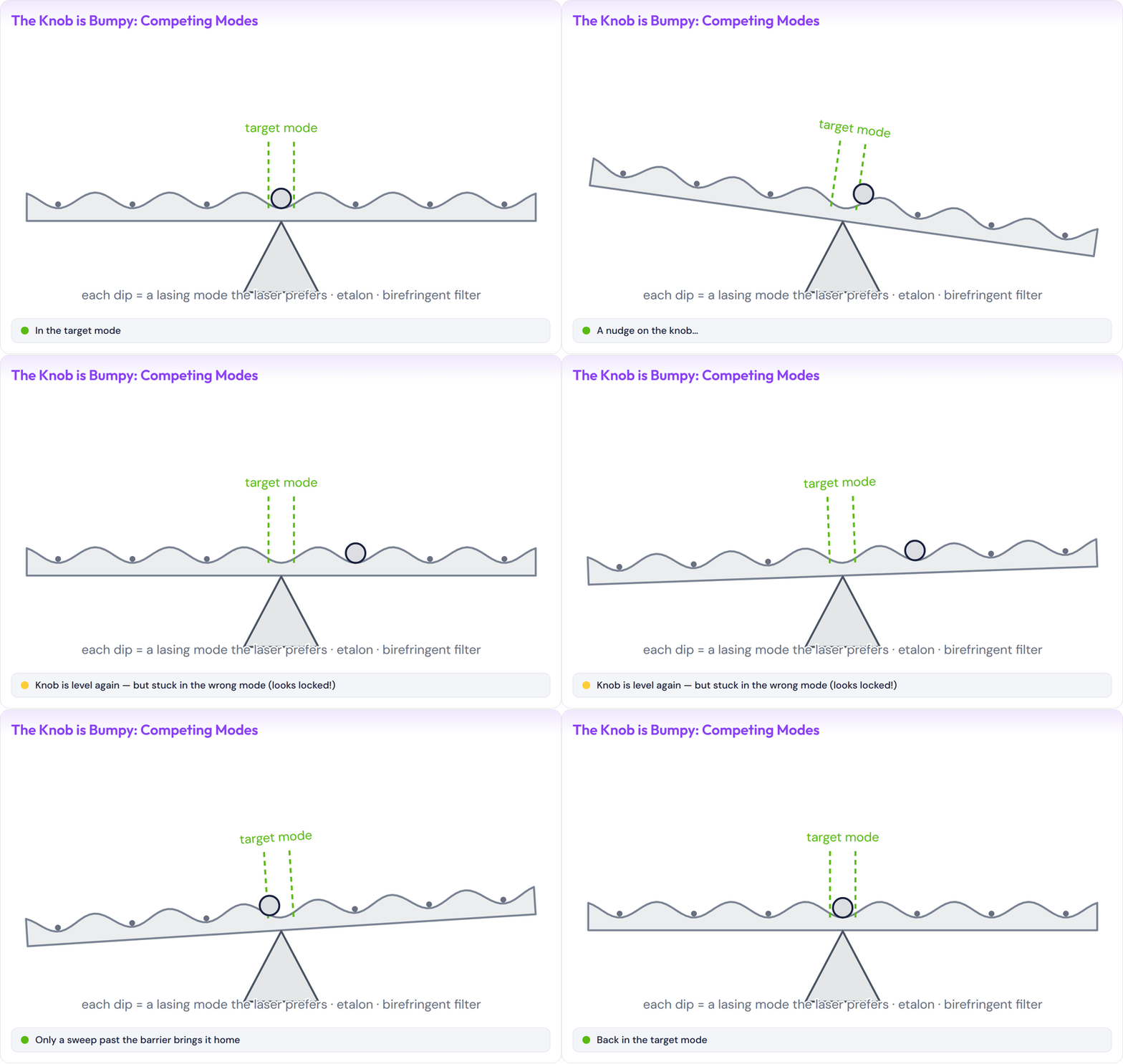
According to QuEra, its quantum computing systems use lasers held at precise frequencies to control atomic qubits. Those lasers drift, and when one drifts far enough the machine stops until someone with deep and specific expertise brings it back. Every generation of machine carries more lasers than the last, and every machine at a customer site sits further from the engineers who know them best.
QuEra says this demonstration is a step towards allowing customers to buy and operate their own quantum computers, which depends less on physics than on whether a machine runs reliably without the people who built it standing next to it.
Automating a Critical Subsystem

A QuEra team of four specialists spent two to three weeks writing a recovery script by hand, building on QuEra’s previous experience in automated recovery from common laser disturbances. The team then gave the same problem to Claude, working through the MHS, a new standard for AI agents to safely operate physical equipment in scientific research and advanced manufacturing.
MHS started as a collaboration between Anthropic and HHMI Janelia Research Campus and is currently in a limited research preview, in which QuEra is a participant. MHS let the agent run its own experiments on a dedicated testbed and propose a fix, try it, read the result, refine. It ran that loop continuously, including overnight, covering hundreds of failure cases that no team of specialists would have time to work through by hand.
Engineers set the scope, reviewed every step, and decided what counted as proof of success. The software the agent produced is a conventional, fully inspectable program, not a model making decisions at runtime. And the work stayed safe by design: devices declare bounds, interlocks, and emergency stops in the standard itself, and AI agents inherit and operate within them by default.
What the Pilot Proved
- It recovered reliably. Given no information about what had gone wrong, the controller returned the system to target in 695 of 700 timed trials across seven fault types, and never reported success when it had not succeeded. The five misses traced to a rig condition rather than the software.
- It recovered in seconds. Most faults cleared in under six seconds and the hardest in roughly 10 to 14 seconds, against five to 10 minutes for an expert.
- It handled real faults, not only test cases. The testbed sits in a working lab with ordinary foot traffic and real environmental sources of error. Over the pilot the AI agent recovered every time without help, regardless of the cause.
- It improved on expert tuning. Asked to improve the quality of the lock rather than recover it, the AI agent cut residual noise by a factor of five and stopped the system dropping out during unattended runs. Measured afterward on an independent instrument it could not influence, its settings matched an experienced specialist’s manual tune and corrected a flaw the manual tune had left behind.
- It transferred. Pointed at a second laser wavelength, the AI agent worked out the settings from scratch in one unattended overnight run, a job that normally takes weeks of hands-on commissioning.
Why It Matters for Deployment
Prior to this pilot, every laser used to carry a standing claim on scarce human expert time. On-site recovery was required at any hour, taking up to half an hour per tuning session, and commissioning a new operating point took weeks. Given the increased number of lasers per computer and additional deployments in the field, manual expert labor becomes a limit on how many systems can be deployed and properly supported, and a barrier to fault-tolerant quantum computing at scale.
“For years the hardest part of scaling quantum computers wasn’t the physics, it was the people driving at 2 am to fix a laser lock. We built a solution using the Model Hardware Standard to fix that: the lock recovers itself in seconds, verified every time, catching noise that’s easy to miss by hand. We’re building quantum computers that fix themselves,” said Sergio H. Cantu, Vice President of Quantum Systems, QuEra Computing.
After the pilot, little or no expert guidance is required. For an HPC center or national laboratory installing a system on-premises, that is the difference between needing a resident neutral-atom laser specialist and needing very little of one’s time.
“We are among the best in the world at developing and operating quantum computers, and even for us, the cost of keeping these machines at peak performance is high,” said Takuya Kitagawa, President of QuEra. “A customer expects the entire computer, and thus every subsystem, to hold itself together without a specialist in the room. This is why the results from the MHS research preview and Anthropic’s frontier AI models are so meaningful. We are making it far easier and cheaper to keep our computers running at their best.”
Read the technical writeup here.