


QunaSys, a Tokyo-based company specializing in the development of quantum computing algorithms and software, said its quantum software development kit “QURI SDK Enterprise” has been officially adopted for RIKEN’s Quantum-HPC Hybrid Platform as part of the “JHPC-quantum” project.
The JHPC-quantum is a project commissioned by the New Energy and Industrial Technology Development Organization under the jurisdiction of the Ministry of Economy, Trade and Industry.
The project has developed a JHPC-quantum platform for quantum-HPC hybrid applications by linking the supercomputer Fugaku and the IBM Quantum System Two “ibm_kobe” at the RIKEN Center for Computational Science in Kobe with the trapped-ion quantum computer “Reimei” or Quantinuum System Model H2 at RIKEN’s Wako campus in Saitama.

With this adoption, JHPC-quantum users will be able to access quantum devices from Fugaku’s compute and pre/post nodes through QURI SDK Enterprise.
The SDK incorporates quantum-HPC hybrid algorithm libraries, including QSCI (Quantum Selected Configuration Interaction) and ADAPT-QSCI, supporting computation in fields such as quantum chemistry, materials science, and Computer-Aided Engineering, with a view to future practical applications. Comprehensive documentation, sample code, and toolchains enable researchers to begin development quickly.
QURI SDK Enterprise supports both the IBM Quantum System Two and the Quantinuum System Model H2, helping researchers build computational workflows that leverage the characteristics of each quantum device.
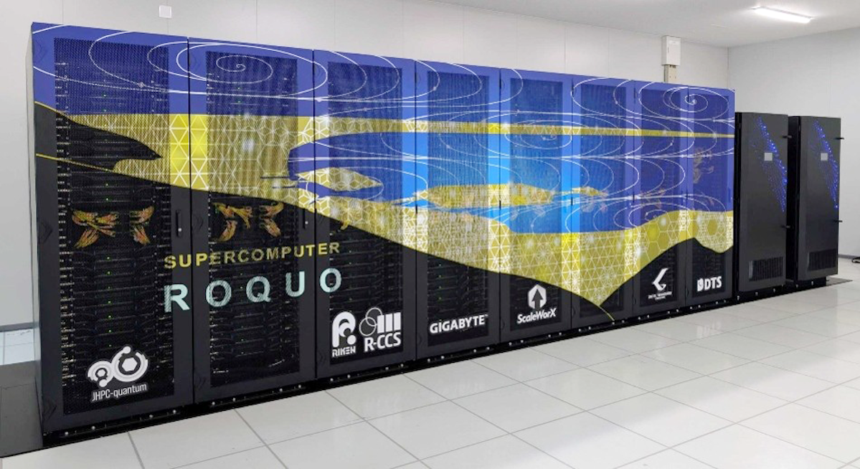
On the HPC side, it supports Fugaku (compute and pre/post nodes) and JHPC-quantum GPU supercomputer “ROQUO”, the NVIDIA GB200 NVL4-based cluster. In both environments, quantum circuit simulation can be run with MPIbased distributed parallelism, using mpiQulacs as the simulator on Fugaku’s compute nodes and a cuQuantum-based backend on ROQUO.
Parallel computation spanning multiple nodes and processors makes it possible to simulate quantum circuits at scales beyond the reach of a single node. QunaSys will continue to expand this environment step by step toward utility-scale quantum-HPC hybrid computing.
Building on this milestone, QunaSys will continue to deepen its collaboration with RIKEN. By expanding the functionality of QURI SDK Enterprise and its support for additional devices and HPC environments.
Through collaboration with RIKEN and other research institutions and industry both in Japan and abroad, QunaSys intends to drive the real-world deployment of quantum-HPC hybrid technology and contribute to the development of Japan’s quantum industry.
“The Test User Program, which JHPC-quantum Project is also running, has likewise shown strong demand for QURI SDK Enterprise, which is why we decided to adopt it this time,” said Mitsuhisa Sato, division director of Quantum-HPC Hybrid Platform Division at the RIKEN Center for Computational Science.
Tennin Yan, CEO of QunaSys, said that QSCI is now one of the most widely used approaches to quantum-HPC hybrid computing worldwide, and has led to a wide range of research advances, including work to optimize the algorithm for Fugaku and other supercomputers.
“For quantum computing to deliver practical value, it is essential that these advances be readily accessible to all users, including those in industry,” he said. “QURI SDK Enterprise brings together algorithms such as QSCI with an easy-to-use environment that lets anyone work across Fugaku, ‘ROQUO,’ and quantum computers.”