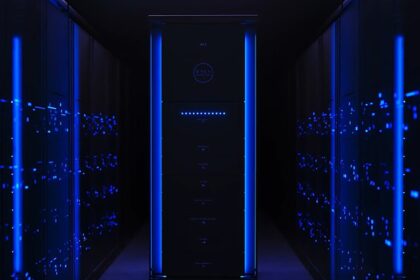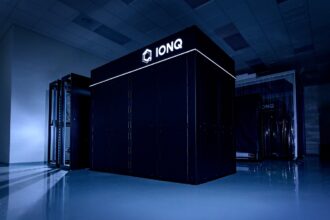
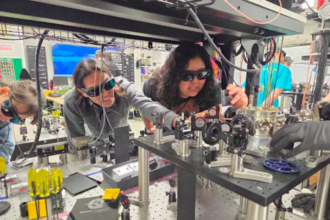



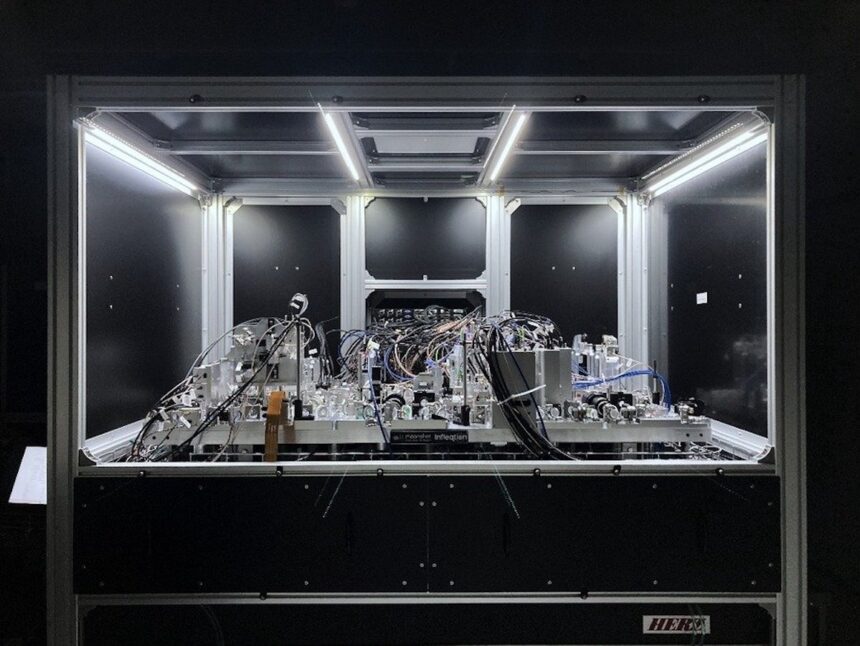
The Institute for Molecular Science (IMS), under the National Institutes of Natural Sciences in Japan, has unveiled the country’s first full-stack neutral-atom quantum computer dubbed “Shunkai.”
Developed by a research team led by Professor Kenji, Shunkai became operational on August 24.

Quantum computers are being developed in various modalities worldwide. However, there remain challenges to address for their practical applications, such as scalability and error correction during computation.
Anticipated to overcome those challenges, neutral-atom quantum computing has been rapidly attracting attention from industry, academia, and governments worldwide, as a groundbreaking new modality.
Ohmori noted that neutral atom-based quantum computers have recently been rapidly attracting attention around the world as a new modality that could exceed the limits of the superconducting modality, which started its development earlier.

“We expect that the external use of our full-stack machine Shunkai, for example, by the theory and software researchers for the development of error-correction technologies, and by the corporate researchers toward practical applications would lead to ripple effects on various fields in industry, academia, and government around the world,” said Ohmori.
“It is also expected that Shunkai will be integrated with the existing shared supercomputer facility at the IMS to develop into a quantum-GPU hybrid computing center,” he added.
The quantum computer is named after Harumi Shibukawa — whose given name “Harumi” is also pronounced as ‘Shunkai’ — an Edo-period (1603-1867) astronomer who established the first original calendar system in Japan.
Calculations of celestial motion on the celestial sphere evoke the precise control of quantum states on the “Bloch sphere,” which represents the state of a qubit in the physics expert community.
Inside Shunkai, atomic qubits are captured in an array using “optical tweezers*” generated by tightly focusing laser light with an objective lens. Quantum calculations are performed by irradiating the atoms with microwaves or laser light.
The computational results are interpreted by observing the fluorescence from each individual atom with a camera. The IMS has taken the lead developing this full-stack quantum computer, leveraging a strong industry-academia collaboration within the Ohmori Moonshot Project with Hitachi for the software stack and with Infleqtion for the Quantum Processing Unit (QPU) stack.
Infleqtion was also the only foreign quantum partner selected by the Japan Science and Technology Agency (JST) for its Quantum Moonshot program.
“This milestone marks a pivotal moment for Japan’s quantum ambitions as well as Infleqtion’s role in advancing production-ready quantum platforms at scale,” said Pranav Gokhale, CTO. “Bringing a full-stack quantum system into production operation is a meaningful step toward fault-tolerant quantum computing that also serves as strong validation of neutral-atom architecture.”
Shunkai will use approximately 50 qubits in its early stage, and will expand its scale to approximately 500 qubits. The system will be partially open to external users for the development of its applications and the demonstration and improvement of quantum error correction).
Plans also include collaboration with Yaqumo, where Ohmori serves as a founder and executive advisor, from the viewpoint of the social implementation and upgrade of the quantum computer.
In the second stage of the Ohmori Moonshot Project Neutral atom-based fault-tolerant quantum computer that has just started last April, the team will operate this full-stack quantum computer to further develop and improve the integration and control technologies, upgrade the system toward fault tolerance and larger scales, and enable high stability and high-fidelity quantum computation for extended periods of time.
By March 2031, at the end of the second stage, the goal is to realize a large-scale, high-performance neutral-atom fault-tolerant quantum computer, with 10,000 physical qubits and quantum error detection and correction capabilities, available to external users.