



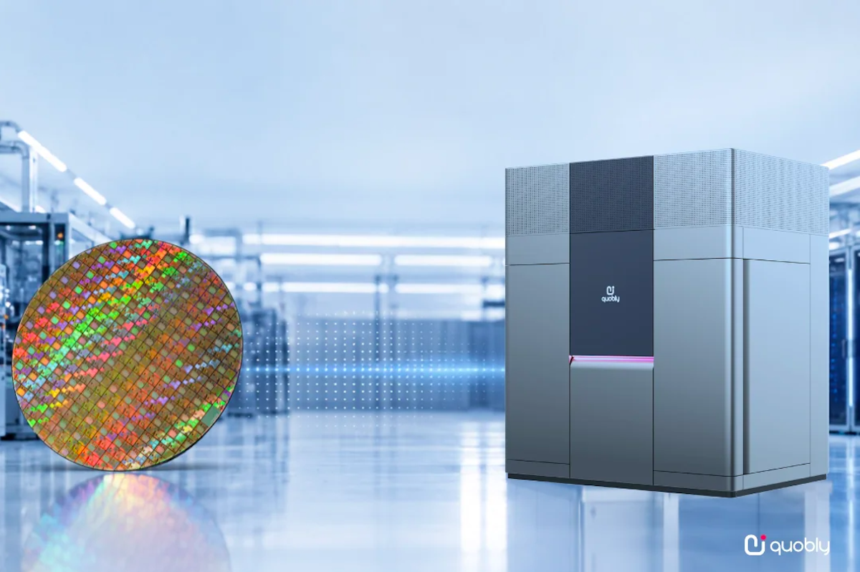
Quobly, a French quantum computing company developing industrially scalable quantum computers based on silicon spin qubits, said new results showed qubit readout, single-qubit gates and two-qubit gates on a single quantum chip fabricated on its proprietary QSOI technology.
The results were obtained on QSOI devices fabricated in STMicroelectronics’ commercial 300 mm manufacturing facilities in Crolles — in Grenoble, France — using FD-SOI CMOS technology.
This demonstrates that key quantum operations can be performed on devices manufactured through an industrial semiconductor production process, providing an initial validation of the technology path toward repeatable and scalable quantum processor manufacturing.

Quobly has demonstrated key quantum operations on QSOI devices fabricated in STMicroelectronics’ commercial 300 mm manufacturing facilities in Crolles, using FD-SOI CMOS technology.
QSOI is built on the FD-SOI semiconductor platform and combines silicon spin qubits with FD-SOI transistors for co-integrated control electronics. It was developed from the outset with industrial manufacturing and large-scale integration in mind, including the use of enriched silicon-28.
Quobly is partnering with STMicroelectronics to transfer its proprietary designs and process flows into an industrial semiconductor manufacturing environment, while developing the cryogenic control, readout and integration technologies required for increasingly large quantum processors.
The results provide an initial validation of this technology transfer: key quantum operations can be demonstrated on devices produced through an industrial semiconductor manufacturing process.
The ability to reproduce this sequence of technological steps reliably across the manufacturing process is critical to ultimately manufacturing quantum processors with millions of qubits.
Using an established semiconductor manufacturing platform is central to Quobly’s industrialization strategy: it is designed to support repeatable fabrication of quantum devices, controlled manufacturing costs and the production of increasingly large numbers of processors as the technology scales.
The latest experiments demonstrate one- and two-qubit gates, together with qubit readout – the three basic operations required to operate a silicon spin-qubit quantum computer.
All three operations were demonstrated on a single QSOI quantum chip, bringing the core functions needed to control and read out silicon spin qubits together on the same device.
Tristan Meunier, chief scientific officer and co-founder of Quobly, said having these three basic operations demonstrated on a single QSOI chip is an important step.
“They were achieved on devices manufactured through the 300 mm semiconductor process we are developing with STMicroelectronics,” said Meunier. “This validates key elements of the technology transfer and gives us a solid basis for further integration and scaling.”
Quobly has also demonstrated co-integration of quantum and cryogenic circuits on the same chip and developed a cryogenic process design kit (PDK) to support further integration.
These results are part of Quobly’s transition from quantum technology development toward its Alloy product roadmap. Alloy Pioneer, Quobly’s first quantum computer, is planned for cloud access by the end of 2026 for early users in high-performance computing and research.
The Alloy roadmap then targets progressively larger systems, with the longer-term objective of reaching one million qubits by 2032.
Quobly’s approach is based on the principles of very large-scale integration (VLSI) that transformed classical computing: increasing computing capacity through semiconductor integration without proportionally increasing physical infrastructure.
The objective is to deliver million-qubit quantum computers that can be deployed within existing computing infrastructure, with system size, manufacturing and operating requirements that can be planned as the technology scales.
“We are building QSOI and our Alloy systems to deliver high-performance, large-scale quantum computers that can integrate seamlessly into existing data-center infrastructure and provide a predictable path to scale and return on investment,” said Maud Vinet, CEO and co-founder of Quobly.
Daniel Loss, president of Quobly’s Scientific Advisory Board, said that when we proposed spin qubits in quantum dots in 1998, the open question was never whether one qubit could work; it was whether millions of identical ones could be made.
“That is a manufacturing question, and it can only be answered on a production line. Readout, single-qubit and two-qubit gates on one chip from a 300 mm FD-SOI process is the step that moves the spin qubit from the laboratory into the process flow. Reproducing it wafer after wafer is now the task, and it is the right task,” said Loss.