


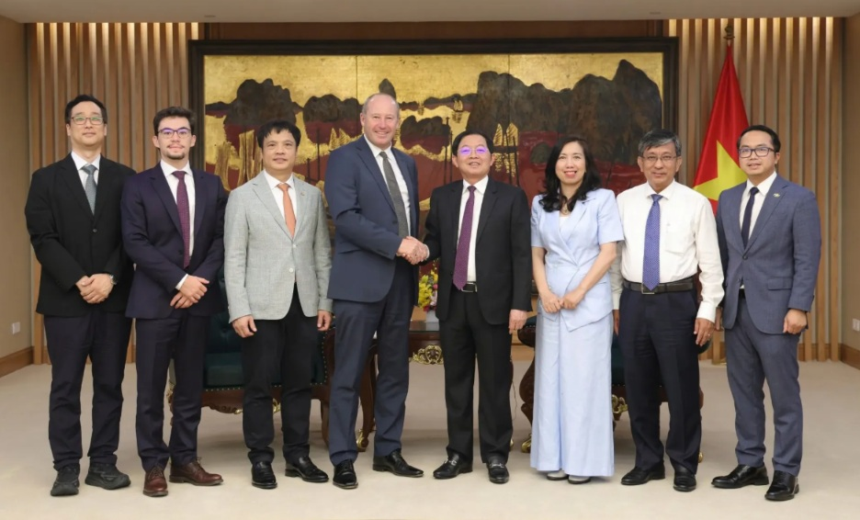
Vietnam’s largest private tech company FPT Corporation and neutral atom quantum company Pasqal have proposed a partnership to bring quantum computers to Vietnam for education, research, and technology application development. The proposal was presented during a meeting with Deputy Prime Minister Ho Quoc Dung, with the aim of progressively building Vietnam’s quantum computing capabilities and developing a skilled workforce.
In addition to Mark Armstrong, Chief Commercial Officer for Europe, the Middle East, Africa, and Asia-Pacific at Pasqal and Nguyen Van Khoa, CEO of FPT, the meeting was also attended by representatives from Vietnam’s public sector, namely: Tran Trung Tinh, Deputy Minister of Science and Technology; Le Thi Thu Hang, Deputy Minister of Foreign Affairs.

As part of this proposal, the two companies are discussing a strategic roadmap to bring quantum computing capabilities to Vietnamese universities, research institutes, and enterprises, with the longer-term goal of establishing quantum computing infrastructure in Vietnam.
Key areas of potential cooperation include joint research on quantum computing algorithms and applications; collaboration on the development and manufacturing of quantum computers; specialized workforce training; and business cooperation.
Pasqal said it is particularly interested in recruiting talent in Vietnam, training lecturers, scientists, and engineers, transferring technical expertise, and promoting industrial applications of quantum technology.

FPT has already started investing in quantum technologies, having established the Quantum AI & Cyber Security Institute (QACI) in December 2025. The company also announced a commitment to invest US$ 100 million in research and development across quantum technology, artificial intelligence, and cybersecurity, alongside high-tech workforce development. By 2041, QACI aims to train 100 PhD graduates, develop and upskill 2,000 technology specialists, and produce 500 research publications, patents, and other intellectual property.
Government support in Vietname
During the meeting, Vietnam’s Deputy Prime Minister Ho Quoc Dung emphasized that Vietnam has identified quantum technology as a strategic field under the implementation of Resolution No. 57-NQ/TW. He added that quantum technology is closely linked to national priorities in security, national data, semiconductors, artificial intelligence, and space technology. He stressed that quantum technology development must address practical challenges, deliver measurable results, and avoid fragmented investment.
Welcoming the proposals from FPT and Pasqal, Deputy Prime Minister Ho urged both companies to promptly translate their cooperation plans into concrete initiatives, with clear commitments on resources and implementation timelines.
He reaffirmed that the Vietnamese government encourages global tech companies to cooperate in research, technology development, workforce training, and innovation in Vietnam. The government, he said, stands ready to support and facilitate cooperation between FPT and Pasqal within the legal framework, ensuring that the partnership delivers practical and effective outcomes..
Vietnam-France partnership
The proposal comes as Vietnam and France aim to strengthen cooperation in science and technology following the official visit to France by General Secretary and State President To Lam in September 2026.
The Vietnam–France Joint Statement, made during the visit, highlights cooperation in quantum technology education, research, and development. This follows the Vietnam and European Union (EU) Comprehensive Strategic Partnership signed in January 2026, which identifies science, technology, and innovation identified as a key pillar of cooperation.
These long-term objectives are designed to build a strong research and technology talent base capable of addressing major national challenges in artificial intelligence, quantum computing, and information security and cybersecurity.