

A recent industry roundtable examined the integration of processors, cryogenic systems, control hardware and software in quantum computers. The discussion covered qubit counts, coherence times and error rates, as well as the requirements for operating these components together.
- From component showcase to integrated machine
- Control is a second processor problem
- Cooling is deployable and still extraordinary
- Beyond the qubit count
- Where near-term advantage may emerge
- Software needs its own modularity
- Testbeds as market infrastructure
- Helium supply may become a constraint in the distant future
- Collaboration across borders
The participants were:

- Corban Tillemann-Dick, Chief Executive Officer of Maybell;
- David Rivas, Chief Operating Officer of Rigetti;
- Joe Fitzsimons, Chief Executive Officer of Horizon Quantum;
- and Itamar Sivan, Chief Executive Officer of Quantum Machines.
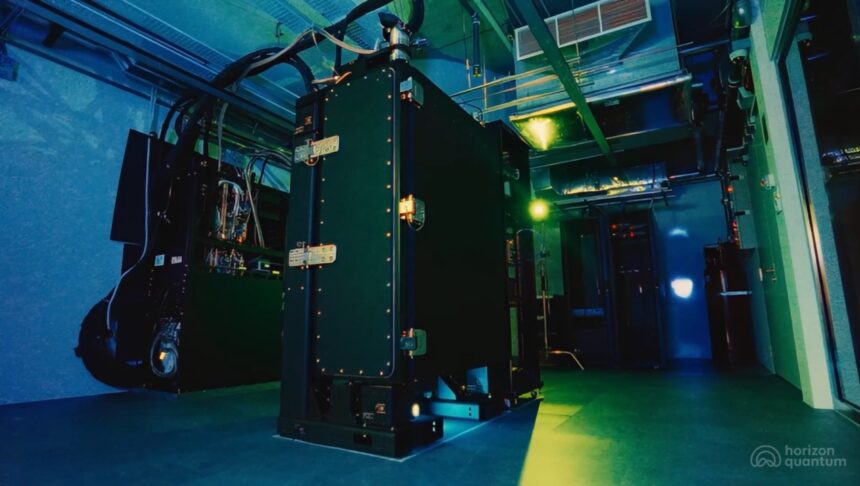
They discussed their companies’ contributions to Horizon Quantum’s Ember-1 testbed, which combines components and software from all four companies. The system combines a Rigetti Novera quantum processing unit, a Maybell dilution refrigerator, Quantum Machines control technology and Horizon’s programming and execution software. Ember-1 has nine qubits and is presented as an open platform for learning how a complete system behaves, rather than as a machine promising near-term commercial advantage.
The discussion extended beyond the testbed to quantum computing supply chains, the availability of helium-3 and helium-4 for cooling, technology sovereignty and international collaboration. It also covered the role of shared testbeds in benchmarking, workforce training and access for algorithm developers.
From component showcase to integrated machine
Fitzsimons described the processor as the place where quantum information is stored during computation. In Ember-1, that processor must be cooled to within a tiny fraction of a degree of absolute zero and connected through a wiring tree that carries signals from room temperature through successive temperature stages. Microwave pulses then manipulate individual qubits and the couplers used for multi-qubit gates. Horizon’s contribution sits above this physical layer: programming languages, compilers and an execution environment that can run directly on the control system in real time.

That description can sound like plug-and-play integration. Fitzsimons said it is closer to that ideal than it would have been several years ago, while warning that the remaining details are unforgiving. “Everything you might not even think of becomes difficult,” he said. Qubits need to be tuned and retuned while a system is operating. Filters and cables must be installed correctly. The refrigerator itself is heavy enough to make building engineering part of the computing problem. Horizon’s system is on the fifth floor of an office building, which required structural reviews before the team could begin cooling hardware. Even delivery equipment mattered: a trolley with smaller wheels than expected broke floor tiles as the refrigerator was moved in.
Fitzsimons said the most surprising fact was that this collaborative model works at all: a software company can acquire a processor, refrigerator and control stack, assemble them into a system and begin programming it.
What’s really surprising about this whole thing is that it’s even possible.”
The achievement is modest beside the industry’s largest promises, yet consequential. “Building the runtime to execute our code on the Quantum Machines control systems looks a lot like programming a very early computer,” he added. Quantum computers will need to become integrated, operable machines before they can fulfil the transformative ambitions attached to them.
For Tillemann-Dick, Ember-1 illustrates a structural change in the sector. Earlier quantum laboratories commonly built vertically integrated systems because there was no mature market for specialised components. Now, he said, developers can focus on a differentiating layer and source other parts from specialist suppliers. “Today quantum is starting to look more and more like classical computing,” he said, pointing to collaboration among companies responsible for the processor, control stack, refrigerator and software. The comparison has limits, but modularity can shorten development cycles and expose interfaces that the industry will need to standardise.
Control is a second processor problem
Sivan argued that a quantum computer requires two critical processors. Alongside the quantum processing unit, or QPU, he placed the pulse processing unit, or PPU. “The main role of the QPU is to hold the quantum state, or if you wish the quantum data,” he said. “The pulse processing unit’s role is that of orchestrating the algorithm.” Quantum Machines packages that control and orchestration technology in server-like systems designed to work across superconducting, silicon spin, trapped-ion and neutral-atom platforms.
The importance of control becomes clearer as attention shifts from laboratory component metrics to computing outcomes. Fidelity and coherence help explain a device; users ultimately care about what computation was performed, the quality of the result and how long it took. “If we look at computing outcome, the first question is: what type of computing did I manage to perform?” Sivan said. “Then it’s: what was the quality of the result, and how long did it take me?” He said the control layer affects the variety of executable algorithms, their speed and the resulting quality. He also pointed to the scale of the surrounding market, saying Quantum Machines serves about 500 customers, including technology companies, national laboratories and universities.
Scaling this layer will require more than duplicating today’s instruments. Sivan framed the engineering objective as reducing price, power consumption and physical size while increasing performance and quality. For control systems, that means specialised semiconductor development, including application-specific integrated circuits tailored to quantum workloads. He also expects artificial intelligence to be used more deeply in orchestration and calibration, while researchers investigate how quantum computation might eventually contribute to advanced AI models. He characterised the latter direction as non-obvious and still a community-wide research problem rather than a settled product path.
Cooling is deployable and still extraordinary
Ember-1 operates at temperatures a few thousandths of a degree above absolute zero, a regime reached by exploiting the properties of helium isotopes in a dilution refrigerator. “Ember-1 runs at temperatures a few hundred times colder than deep space,” Tillemann-Dick said. Cryogenic equipment has become much easier to deploy: in Maybell’s view, most data centres can now incorporate quantum cryogenics without wholesale infrastructure changes. Nevertheless, the environment remains exceptional, and warmer quantum operation is not automatically simpler.
“People often run into issues of unit conversion here, where there’s a system that runs 500 times warmer but needs a million times more cooling power to support that higher temperature operation. Regardless of your modality, your background noise, the cryogenic environment needs to sit a few orders of magnitude below the energy of your activated qubit,” he said.
For a customer, the intended workload comes first. The qubit modality, qubit count, signal path and noise-management strategy together determine a thermal budget. The cryogenic system and its input-output wiring can then be sized around that budget.
Our goal with any Maybell system is that you can roll it through a door, plug it in, turn it on, and it’ll work.”
Maybell wants the fridge to be “the least interesting part” of a deployment: a unit connected to electricity and cooling water, switched on and then largely left alone. Tillemann-Dick acknowledged that the industry has not fully reached that point.
Reliability becomes more important as systems move beyond experiments. Maybell’s next-generation Cold Cloud platform, launched in March according to Tillemann-Dick, is intended to provide better than 99.9% uptime, cooldowns measured in hours rather than days and substantially more cooling power than legacy cryostats. The discussion did not independently assess those company claims. They nevertheless indicate where commercial requirements are moving: towards long-duration operation, faster maintenance cycles and sufficient thermal capacity for denser wiring and larger machines.
Beyond the qubit count
Rivas said error rates across leading platforms are converging towards the order of one error in a thousand operations, although not every system has reached that level. Rigetti, he said, is around 99.5% fidelity on its 36-qubit systems and has roughly halved error rates each year. As differences in fidelity narrow, other properties become more visible — the architecture must explain how it can move from hundreds of qubits to tens or hundreds of thousands. Rigetti’s approach uses chiplets and established semiconductor techniques, while superconducting processors also offer fast fundamental gate operations.
Speed, Rivas argued, deserves a central place in the comparison. He put superconducting gate operations at roughly 1,000 to 10,000 times faster than those of some competing modalities and said that advantage can offset connectivity constraints through swap operations and architectural changes. “After all, these things are computers,” he said. The broader point was that a computer should be assessed by work completed rather than an isolated headline number. “We should all be counting operations now,” he added, arguing that operations per second matters as much as the total operation count.
That approach also complicates the common customer question of how many qubits are needed. The answer depends on the algorithm, the quality of the hardware and whether error mitigation or full error correction is required. Rivas argued that physical qubits can contribute useful results before fault-tolerant logical qubits arrive, particularly when paired with stronger software. Resource-estimation tools can map an algorithm to the operations, runtime and physical resources it needs. He cited the UK government’s focus on a target of one million quantum operations as a more concrete framing than an undefined promise of fault tolerance or a bare logical-qubit figure.
Rivas also cautioned against aggressive timelines. Large public and private funding programmes can create incentives to describe fault-tolerant machines as only a few years away, sometimes by changing what the term means.
Perhaps if you redefine what it means to be fully fault tolerant, you might be able to get there.”
His historical analogy placed the industry closer to classical computing in the 1940s or early 1950s than to the mature computer industry of the 1980s or 1990s. “These are all systems that are essentially bespoke,” he said. Manufacturing is limited and each new system demands extensive integration. Progress is faster than it was in the early classical era, he added, while the field remains early.
Where near-term advantage may emerge
Asked which algorithms might outperform digital alternatives on noisy, intermediate-scale quantum (NISQ) hardware, Fitzsimons drew a clear line between demonstration and advantage. “Ember-1 has nine qubits, so you’re not going to see an advantage for pretty much anything,” he said. He suggested that an advantage becomes conceivable only beyond roughly 40 sufficiently low-noise qubits, because smaller systems can generally be simulated on a laptop. Even above that line, possibility is no guarantee: performance will depend on circuit depth, noise and the structure of the problem.
Variational algorithms are among the most frequently explored approaches. They begin with a parameterised quantum circuit and adjust its parameters, using an optimisation loop analogous to training a neural network. Researchers have applied the method to optimisation, chemistry and machine learning. “It’s very, very hard to prove in advance what kinds of problems this will work for and what kinds of ones it will fail for,” Fitzsimons said. Large advantages are already known for structured problems such as integer factorisation, although the required machine would need thousands of qubits and extremely low logical error rates.
Before full error correction, Fitzsimons sees chemistry and materials science as plausible early application areas. Molecular processes already occur in variable environments, so some modelling tasks concern distributions of configurations rather than a single perfectly isolated state. That can create a noise budget, although it does not mean arbitrary hardware errors are useful. The challenge is to understand and shape noise so that it aligns with the physical ensemble being modelled. Rivas similarly highlighted physical simulation, selected portfolio-optimisation and time-series problems, and machine-learning preprocessing. Rigetti has reported percentage-point improvements on small experiments, he said, while expecting larger effects on systems with hundreds of qubits; those expectations remain to be tested as hardware scales.
Software needs its own modularity
Hardware access is one constraint on algorithm development. Conventional simulators, according to Fitzsimons, can handle several tens of qubits in general cases, while specialised tensor-network techniques can go further only for restricted, shallow circuits. That leaves a large experimental space inaccessible without real quantum hardware.
“System availability is a critical issue here,” Rivas said. He called for more machines in government programmes, supercomputing centres and commercial partnerships, as well as greater funding for companies devoted to algorithms. In his view, systems with hundreds to around a thousand physical qubits could mark an important practical inflection even before full error correction.
A thousand qubits, even physical qubits un-error-corrected, is a computational resource more powerful than anything that’s ever been built before for a certain class of problems.”
Fitzsimons also argued that quantum software itself needs to become modular. “Most quantum algorithms to date are basically monolithic,” he said, with developers assembling an entire solution and then analysing or testing it as a whole. Horizon is pursuing a more object-oriented model in which quantum data structures, classes and reusable libraries can be combined. “You don’t really have that ability to compound speed-ups or compound tricks that lead to real quantum advantage” when developers are merely piecing together circuit fragments, he said. The aspiration is to let developers build on one another’s techniques rather than repeatedly reconstructing full algorithms from low-level components. Fitzsimons compared building Horizon’s runtime to programming an early computer, where memory budgets and machine constraints are impossible to ignore.
Testbeds as market infrastructure
National and regional quantum hubs can do more than display hardware. Rivas pointed to independent benchmarking, proofs of concept and access for algorithm developers as early benefits. “You’re starting to get benchmarking happening in a way that isn’t just very vendor specific, which I think is tremendously important,” he said. As machines become available to academic and industrial users, he expects hubs to expand the population able to test ideas on hardware and, ultimately, stimulate demand.
If there is one thing this industry is missing right now, is that there are not enough people doing algorithm development, period.”
The value depends on access rules and technical support as well as the presence of a machine.
Tillemann-Dick described two additional effects. Through Elevate Quantum and other programmes, Maybell has helped develop training in vacuum systems, leak checking and thin-wall stainless-steel welding—skills rarely found together in standard curricula—and has hired from that pipeline. The company also used the Quantum Commons campus in Colorado to obtain permitting for an early Cold Cloud installation in less than 48 hours, compared with what he described as a typical six-to-nine-month process. “That’s a huge difference,” he said. “It directly and immediately accelerated our ability to bring this system first to prototype and now to market.” In this example, a cluster accelerated commercialisation through workforce and regulatory infrastructure as well as research support.
Sivan said shared testbeds can also provide a neutral framework for partnerships that would otherwise be difficult to organise. Quantum Machines operates centres in Chicago and Tel Aviv where component makers can test hardware without building a full laboratory. Some customers send components for evaluation; others provide QPUs that the centre makes accessible through the cloud. The model lowers the threshold for a supplier with one strong component to participate in a complete system and receive data about how it performs in context.
Helium supply may become a constraint in the distant future
Dilution refrigeration depends on helium-3 and helium-4, raising questions about whether isotope supply can support large fleets of machines. Tillemann-Dick’s concise answer was: “Not yet, and eventually, yes.” He said current US helium-3 supply, largely associated with tritium decay in the nuclear stockpile, could support roughly 30 million qubits a year under Maybell’s assumptions. “That’s an awful lot more than anybody’s building right now,” he said. Potential recovery from Canadian CANDU reactors and US natural-gas processing could raise the accessible supply to more than 100 million qubits annually. These estimates were presented in the roundtable and have not been independently verified.
If demand eventually exceeded those sources, dedicated production reactors or more speculative extraterrestrial extraction could be considered. Tillemann-Dick argued that available terrestrial sources are unlikely to be the first barrier to useful quantum computers. “It’s not something that is going to be the first thing that keeps us from building useful quantum computers,” he said.
We will be living in a world fundamentally transformed by quantum computing before we’re in a world where helium-three becomes the limiting factor.”
The claim assumes substantial improvements in qubit density and cryogenic efficiency, and it places supply planning on a much longer horizon than current deployment challenges.
Collaboration across borders
The panel’s final theme was the tension between national capability and international supply chains. Sivan argued that European and US programmes can become less effective when “sovereign” technology is interpreted as requiring every component to be domestic. “What I think is most important is relying on the most advanced technology there is within the partners,” he said. He cited the US Defense Advanced Research Projects Agency’s (DARPA’s) Quantum Benchmarking Initiative (QBI) as a comparatively thorough assessment process that has considered international providers. “No government process can be perfect,” he added, while describing it as the most careful government examination of providers that he had seen.
Rivas distinguished between national strategy and what he called a nativist approach. “There’s national and then there’s nativist,” he said. A national strategy can assemble international partnerships in service of security and economic goals; a nativist one focuses narrowly on where each component is made.
I don’t think the nativist view ends up being very useful in terms of building out the systems.”
Rigetti depends on partners in Europe and the UK while retaining fabrication elsewhere. He also said the company intended to invest US$100 million in the UK, presenting the commitment as evidence that public programmes can attract foreign suppliers while developing local capability.
Fitzsimons offered Horizon itself as another cross-border example: a Singapore-headquartered company listed on Nasdaq with an engineering centre in Dublin. “In the private sector, you certainly see quite a lot of that working across both Europe and the US,” he said. Such structures still raise legitimate questions about resilience, intellectual property and strategic dependence. They also show that commercial quantum development already spans jurisdictions. The integrated nature of the technology makes complete self-sufficiency difficult: processors, cryogenics, control electronics, software, fabrication tools and specialist skills form a supply chain too broad for most organisations—and perhaps most countries—to reproduce alone.