

Denmark has launched a quantum‑secure communications network developed under the Danish Quantum Communication Infrastructure (QCI.DK) initiative. The system connects ten strategically selected sites, including the Ministry of Foreign Affairs, Ministry of Defence, Ministry of Business and Competitiveness, and the Ministry of Science, Higher Education and Digital Affairs.
Officials describe the deployment as a pivotal advancement in Denmark’s long‑term strategy to safeguard critical communications against escalating cyber threats and the future capabilities of quantum computing.

Christina Egelund, Minister of Science, Higher Education and Digital Affairs, said: “Denmark is among the global leaders in quantum research, and we are starting to see the full impact of our massive investment in this field. With the quantum network, we are making an important advancement in enhancing the security of the infrastructure and communications that are essential to a well-functioning society. The quantum network represents a step into the future and will, in the long term, provide us with an advantage in the fight against increasingly sophisticated cyber threats.”
The initiative addresses the growing concern that encrypted data harvested today may be decrypted once large‑scale quantum computers become operational—a threat often described as “harvest now, decrypt later.” To counter this, the new network employs Quantum Key Distribution (QKD), generating cryptographic keys from quantum states of light. Its continuous‑variable implementation allows the technology to run over existing fiber infrastructure, providing quantum‑resistant security without requiring physical network upgrades.
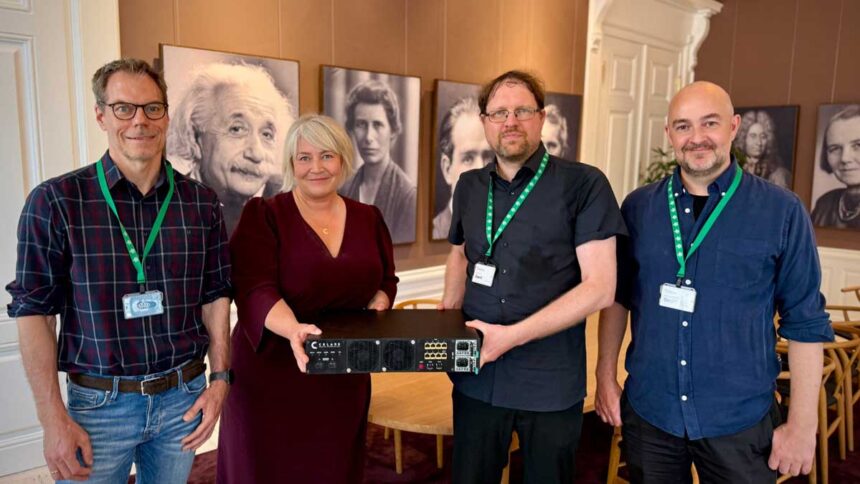
The project was led by researchers at the Technical University of Denmark (DTU). Tobias Gehring, who heads the initiative, said: “Our collaboration with partners and participation in the QCI project has allowed us to transform research into real quantum products at a much faster pace. This has led us to a new stage where we can truly make a difference for secure communications, as demonstrated by the new secure network.”

Gehring and colleagues have founded Celare Quantum Communications, a DTU spin‑out focused on commercializing the technology behind the network.
Denmark will next expand its quantum‑secure capabilities through the European EuroQCI program, beginning with cross‑border links to Sweden and Poland.
Two ministers whose institutions are connected to the network underscored its strategic relevance.
Martin Lidegaard, Minister of Business and Competitiveness, stated: “Digital threats demand innovation and decisive action, which is why it is more important than ever to secure Danish engagement and the advancement of new technologies. As quantum computers are developed, the threat posed by digital attacks increases. The new network based on quantum technology represents a significant step towards future-proofing our most sensitive communications. It demonstrates that quantum technology is already making a difference in our society, and that Denmark is transforming research into tangible solutions with both commercial and security-related potential.”
Minister of Defence Jeppe Bruus added: “We find ourselves in a security policy context where new technologies are of crucial importance to the Armed Forces and to our ability to protect Denmark. The collaboration on the new quantum communications network is a good example of how partnerships between industry and universities can help strengthen Denmark’s and the Armed Forces’ digital security.”