



Fujitsu has released global and as open-source its quantum application development software, Open Quantum Application Research Package or OpenQARP.
The software offers over 100 software components, including Fujitsu-developed quantum algorithms. These components can be combined to significantly streamline quantum application development.
Also, the software is compatible with various execution environments, such as Fujitsu’s quantum simulator built on a large-scale HPC environment and the NVIDIA CUDA-Q platform for hybrid quantum-classical computing.

Prior to its public release, Fujitsu has provided a beta version of the software to over 80 organizations since February 2026 through joint research and the Quantum Simulator Challenge, and it has already been used to generate numerous research and development results in quantum applications.
By publicly releasing the software, which includes Fujitsu-developed algorithms, as open-source software, Fujitsu aims to accelerate the practical adoption of quantum software and contribute to addressing societal challenges through quantum technology.
Quantum computing is expected to provide one approach to solving complex problems that conventional computers cannot address in various societal domains, such as materials development, financial optimization, healthcare, and drug discovery.
Fujitsu has been engaged in the development of specific quantum applications through joint demonstrations with customers across various industries and joint research with universities and research institutions.
To accelerate the practical adoption of quantum technology, it is crucial that cutting-edge algorithms are widely reusable rather than being custom-built for specific problems.
Thus, Fujitsu developed OpenQARP, a quantum application development software that implements versatile quantum algorithms as components to promote their use in quantum algorithm development across various industries.
To further expand the adoption of quantum technology, Fujitsu is now publicly releasing the software as open-source software on GitHub.
OpeanQARP features streamlined implementation through the provision of versatile software components. It provides over 70 composable building blocks, from state preparation and ansatz layers to the Quantum Fourier Transform.
The package also provides over 20 ready-to-run algorithms built from these blocks, including Subspace-Search Variational Quantum Eigensolver for Noisy Intermediate-Scale Quantum devices and quantum phase estimation for fault-tolerant quantum computing. Users can combine these components according to their objectives to develop quantum applications, thereby reducing software implementation efforts.
Also, OpenQARP features efficient quantum computation through Fujitsu-developed advanced algorithms.
These include the Unitary pair Coupled Cluster Doubles algorithm, which leverages pre-computation results from classical computers to reduce the number of quantum gate layers (circuit depth) required for initial state preparation in quantum chemical calculations, and Density of States Quantum Phase Estimation, which reduces the burden of preparing complex input states required for quantum phase estimation and efficiently obtains information about energy spectra.
Further, OpenQARP can be easily installed and used by anyone in a standard PC environment that supports Python. It can also integrate with NVIDIA CUDA-Q as a backend via a source build, enabling quantum circuit execution in open GPU-accelerated environments.
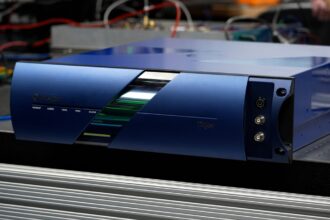
The package can be used in Fujitsu’s 40-qubit state-vector quantum simulator environment, which is composed of 1,024 FUJITSU Supercomputer PRIMEHPC FX700 units, each equipped with Fujitsu’s “A64FX” [6] processor.
This supercomputing environment has been made available to more than 80 organizations through the Quantum Simulator Challenge, and the pre-released beta version of the software has been used to perform a variety of quantum computations.
Fujitsu also plans to sequentially support simulation environments based on the STAR architecture for quantum computing that it is researching.
“Providing the open tools and resources to accelerate quantum application development is one of the most important ways to accelerate the journey to useful quantum computing,” said Sam Stanwyck, director of quantum product at NVIDIA.
“Fujitsu’s use of CUDA-Q in OpenQARP shows how the right open tools, with access to GPU-acceleration, are empowering developers to build and scale toward quantum utility,” said Stanwyck.