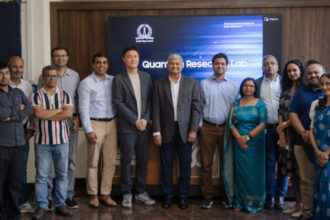


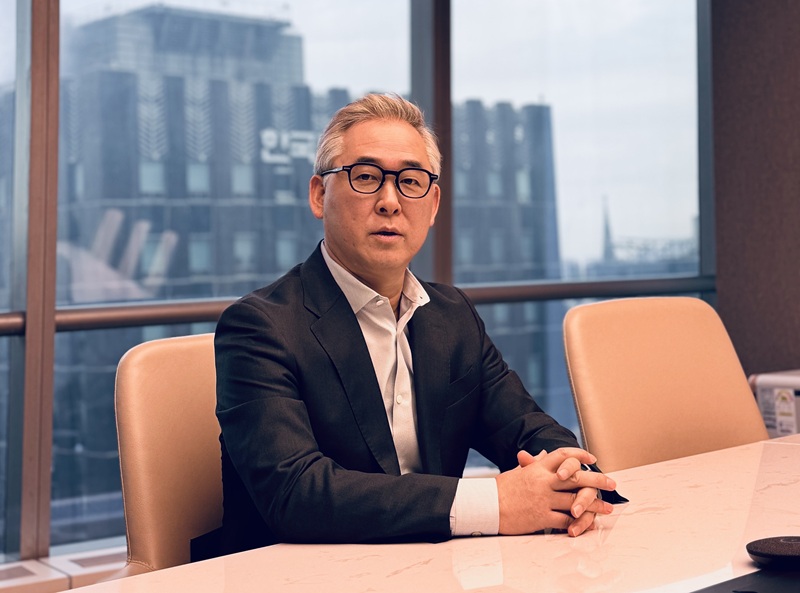
Dr. Brad Kim is Vice President of the Korea Quantum Industry Association (KQIA), where he also served as Founding Chairman, and a Member of the National Quantum Strategy Committee. He is also Chief Quantum Officer at MegazoneCloud, a leading South Korea-based cloud managed service provider (MSP).
In Part 1 of this Q&A with Dr. Kim, conducted on the sidelines of LEAP East in Hong Kong, Dr. Kim discusses how he transitioned from classical to quantum, Korea’s role in the global quantum economy, and the future of the quantum industry.

From classical to quantum
Your career spans semiconductors, AI, cloud computing, advanced manufacturing, and now quantum computing. Looking back, what inspired you to move into quantum, and how has that journey shaped your vision for the future of computing?
My journey into quantum computing did not begin with quantum mechanics. It began with a simple engineering question: “How can we continue advancing computing when the traditional path reaches its limits?”
Early in my career at Intel, I worked on one of my first CPU development projects. Technically, the processor performed well, but the project was ultimately discontinued because of excessive power consumption. As a young engineer, it was disappointing. Looking back, however, it became one of the most valuable lessons of my career. It taught me that the future of computing would not simply depend on making processors faster. Efficiency matters just as much as performance.

That lesson stayed with me throughout my years at LG Electronics, where I spent more than a decade developing mobile application processors. Our challenge was always the same: deliver higher performance while consuming less power. But as semiconductor technology approached sub-10-nanometer processes, it became increasingly clear that transistor scaling alone could no longer sustain the pace of innovation. We were approaching both physical and economic limits.
Around that time, I had the opportunity to participate in an LG Group initiative exploring emerging technologies that could shape the next generation of computing. That was the first time I seriously encountered quantum computing. To be honest, it still felt like science fiction. It was intellectually fascinating, but I believed it was still far from industrial reality.
Then, in 2019, Google published its landmark paper on Quantum Supremacy. Whether every technical claim in that paper would ultimately stand the test of time was not what mattered most to me. What mattered was that one of the world’s leading technology companies had demonstrated that quantum computing was beginning to move beyond theoretical physics and into the realm of engineering. For the first time, I began to believe that quantum computing was no longer a question of if. It had become a question of when. Even then, I wasn’t ready to change my career.
The decisive turning point came with the emergence of foundation models. Almost overnight, AI transformed the scale of computational demand. The performance gains that the semiconductor industry had spent decades achieving were suddenly being consumed at an unprecedented pace.
Watching that happen, I found myself asking a very different question: “Will building better processors alone be enough for the future?” I realized the answer was no.
The future would not simply belong to faster processors. It would belong to more efficient—and ultimately different—ways of computing.
Shortly afterward, my own career expanded beyond semiconductor engineering. At POSCO Holdings, I moved from the technology supply side to the technology demand side. Instead of building computing platforms, I began working directly with scientists and engineers trying to discover new battery materials, optimize manufacturing processes, and solve increasingly complex industrial challenges.
That experience fundamentally changed my perspective. I realized that many of the industry’s most valuable problems were growing faster than classical computing could efficiently solve them. The challenge was no longer building a slightly better processor. It was rethinking computation itself. At that point, moving into quantum computing no longer felt like changing careers. It felt like the natural continuation of the same journey I had been on for decades.
Today, my mission is not simply to promote quantum computing. It is to help transform quantum from an extraordinary scientific achievement into practical industrial infrastructure that creates measurable business value. Ultimately, I don’t believe success will be measured by how many qubits we build. It will be measured by how many meaningful problems we solve—and how many lives we improve through better computing.
Korea Quantum Industry Association
The Korea Quantum Industry Association (KQIA) was established in 2022. What gap did Korea’s quantum ecosystem have at the time, and what role is KQIA playing today?
When KQIA was established in 2022, Korea already possessed many of the essential ingredients needed to become a global leader in quantum technologies. We have world-leading semiconductor manufacturing, globally competitive electronics companies, advanced cloud infrastructure, outstanding universities, excellent research institutes, and a government that recognizes quantum technology as a national strategic priority.
What Korea lacked was not technology. It lacked an integrated industrial ecosystem. Researchers were producing world-class science. Global quantum companies were beginning to enter Korea. Large enterprises were exploring how quantum technologies could create future business value. Government investment was steadily increasing. However, these activities were largely progressing in parallel rather than as one coordinated ecosystem. KQIA was established to bring those pieces together.
I had the privilege of serving as KQIA’s founding Chairman, working alongside industry leaders who shared the belief that Korea needed an industry-led platform to connect government, academia, research institutes, startups, large enterprises, and global technology partners.
We began with approximately 32 founding member companies. Today, KQIA has grown to around 112 member organizations, representing virtually every part of Korea’s quantum ecosystem—from startups and SMEs to large enterprises, cloud providers, universities, research institutes, and international partners. To me, this growth represents much more than an increase in membership. It reflects a fundamental shift in how industry views quantum computing. Just a few years ago, quantum was largely regarded as a scientific research topic. Today, it is increasingly recognized as a strategic industrial technology and a long-term business opportunity.
Today, I continue to support the association as Vice Chairman, with a strong focus on helping build a collaborative and sustainable quantum ecosystem. Our role is not to conduct quantum research ourselves. Rather, it is to connect research with industry, industry with markets, and innovation with sustainable economic value by building a strong and collaborative quantum ecosystem. To achieve this, we work closely with industry, academia, government, and international partners to accelerate commercialization, stimulate industrial demand, strengthen supply chains, support startups, facilitate global partnerships, and contribute to Korea’s national quantum strategy.
Perhaps our most important mission is building trust. Quantum computing is not a technology that any single company, university, or country can develop alone.
Its success depends on collaboration among governments, academia, cloud providers, hardware developers, software companies, investors, system integrators, and, most importantly, the industries that will ultimately use these technologies to solve real-world problems.
This philosophy also shapes our international engagement. As Vice Chairman of KQIA, one of my priorities is strengthening global collaboration. KQIA is an Executive Member of the International Council of Quantum Industry Associations (ICQIA), where we work closely with leading quantum industry organizations around the world to promote international cooperation and support the responsible growth of the global quantum ecosystem.
I believe every country will develop different strengths. Some will lead in quantum hardware. Others will lead in software, algorithms, manufacturing, cloud platforms, or industrial applications. Korea’s greatest opportunity is not necessarily to develop every quantum technology ourselves. Our opportunity is to become one of the world’s leading hubs for quantum commercialization—connecting the world’s best quantum technologies with one of the world’s strongest industrial ecosystems. Korea has repeatedly demonstrated its ability to transform breakthrough technologies into globally competitive industries. We did this in semiconductors, consumer electronics, displays, batteries, and advanced manufacturing. I believe quantum computing represents the next opportunity to do the same. If we succeed, Korea’s greatest contribution to the global quantum ecosystem will not simply be developing quantum technologies. It will be demonstrating how quantum technologies can create real industrial, economic, and societal value.
Korea’s National Quantum Strategy
Korea unveiled its National Quantum Strategy in 2023. What does it ultimately hope to achieve?
The Quantum Act established a strong legal and policy foundation for Korea’s long-term strategy. The first phase naturally focused on research, talent development, infrastructure, and core technologies. Those investments remain absolutely essential. However, I believe the next decade will be defined by commercialization. The conversation will gradually shift from “Can we build quantum computers?” to “How do quantum technologies improve industries, businesses, and people’s lives?”
This transition requires much stronger collaboration between government and industry. Public investment should continue supporting frontier research. At the same time, it should increasingly encourage industrial testbeds, enterprise adoption, startup growth, international collaboration, and practical use-case development.
Another defining trend will be convergence. Future competitiveness will not come from optimizing one technology in isolation. It will come from orchestrating all of them together.
Quantum computing will not evolve independently. It will become deeply integrated with AI, cloud computing, HPC, semiconductors, and advanced digital infrastructure.
Korea is uniquely positioned to achieve this. Our strengths in semiconductors, manufacturing, AI, cloud, and industrial digital transformation provide an exceptional foundation for quantum commercialization. If Korea succeeds, I believe it can become one of the first countries to demonstrate how an integrated AI-cloud-HPC-quantum ecosystem creates sustainable industrial competitiveness. Ultimately, I hope Korea becomes recognized not simply as a country that developed quantum technology, but as a country that successfully transformed quantum research into industrial innovation.
Ultimately, quantum computing is not the destination. It is another tool that expands humanity’s ability to solve meaningful problems. If, twenty years from now, quantum computing quietly becomes part of everyday industrial infrastructure—improving healthcare, enabling sustainable industries, strengthening economies, and solving challenges we cannot yet imagine—I believe Korea will have played an important role in making that future possible.
Advice for aspiring quantum professionals
Finally, if you could deliver one message to young engineers, entrepreneurs, and policymakers who are considering a career in quantum technologies, what would it be?
Every generation is given the opportunity to help shape the next era of computing. Previous generations built semiconductors. They connected the world through the Internet. They transformed computing through the cloud. And more recently, they unlocked entirely new possibilities with artificial intelligence. I believe our generation has a similar opportunity—and a similar responsibility. Not simply to build quantum computers, but to help build the quantum economy. Quantum computing is not about making computers incrementally faster. It is about expanding humanity’s ability to solve problems that have remained beyond our reach.
When I look back at my own career, I realize that the most meaningful opportunities were never the ones that felt safe or familiar. They were the ones that challenged my assumptions and forced me to learn something entirely new. That is why my advice is simple. Don’t wait for quantum computing to become mature. Grow with it, be curious, experiment, challenge conventional thinking. And above all, focus on solving real problems. Technology, by itself, has never changed the world. People do. The next generation of industry leaders will not necessarily be those who own the best quantum computers. They will be those who know how to combine quantum, AI, cloud, and human creativity to solve problems that truly matter.
The same is true for countries. Nations that focus only on what they already do well may continue to succeed for a while, but the future belongs to those willing to invest in technologies that will define tomorrow, not yesterday. I hope the next generation chooses to be bold. Not because success is guaranteed, but because meaningful progress has always required people willing to pursue what once seemed impossible. Perhaps that is the most exciting part of quantum computing. We are not simply witnessing the beginning of a new computing era. We have the opportunity to help build it.