


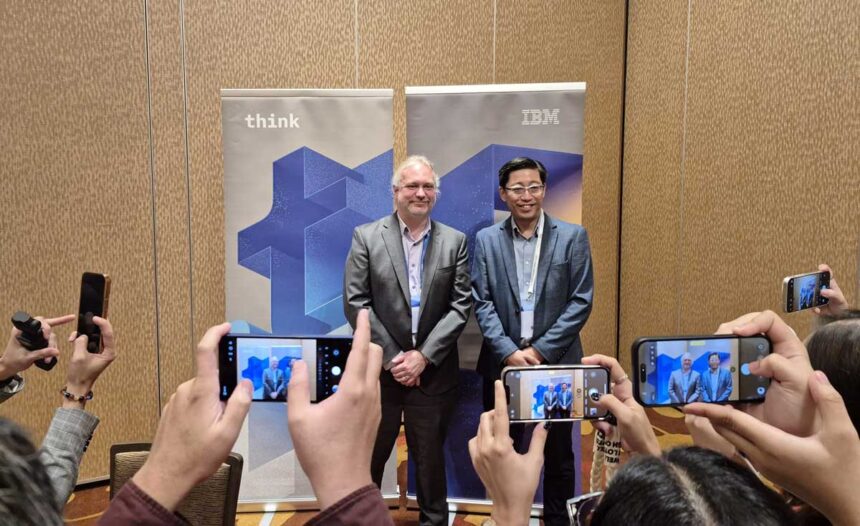
IBM’s message at its Singapore press conference was direct: quantum computing has moved beyond being a distant scientific curiosity. It is becoming an engineering race, and Southeast Asia is being urged to take its place on the grid.
Julian Tan, IBM Quantum Business Development Executive, opened by placing the announcement in the context of IBM’s long-running collaboration with the National University of Singapore. Since 2020, IBM has worked with NUS to build regional quantum capability, with the partnership increasingly acting as a gateway for other ASEAN institutions interested in joining the IBM Quantum ecosystem. The recent involvement of Chiang Mai University and growing interest from regional government bodies, he said, showed that the network was expanding beyond a single-country initiative.

For IBM Fellow and Vice-President for Quantum Systems Oliver Dial, the near-term story is quantum advantage. Dial said IBM expects to see multiple examples of quantum advantage before the end of the year, with researchers now tracking the contest between quantum and classical methods problem by problem. The race, he explained, is close: quantum systems have at times pulled ahead, only for classical approaches to improve in response. But IBM remains confident that verified quantum advantage will be recorded soon.
Dial was careful to distinguish that milestone from immediate enterprise transformation. Many of the first advantage demonstrations, he said, are deliberately designed to be hard for classical computers yet still verifiable, but practical workloads are a different question. On that front, he pointed to sample-based quantum diagonalization, or SQD, as one of IBM’s most promising advances in chemistry simulation. Work with Cleveland Clinic has already produced a simulation of a protein-ligand system involving more than 12,000 atoms, a result Dial described as far more accurate than previous quantum-centric molecular simulations, though not yet superior to the best classical methods.
Quantum advantage is a scientific threshold, while useful quantum workloads are an industrial one, and IBM’s argument is that the two are moving closer together.

In Asia-Pacific, Dial said adoption has been unusually energetic. NUS was home to IBM’s first Quantum Innovation Center, and many users already access IBM quantum computers through the cloud. IBM maintains quantum data centres in North America and Europe, but its physical deployments in Asia — including systems associated with institutions such as Yonsei University and planned activity in India — indicate a growing regional concentration of quantum infrastructure.
ASEAN governments, Tan said, are beginning to think collectively about quantum readiness, especially around quantum-safe cryptography. While quantum computing promises breakthroughs in areas such as simulation and optimization, it also threatens existing encryption systems. That makes the shift to quantum-safe standards a policy priority just as much as a technical one.
Tan framed the issue with a Formula One analogy: countries do not need to be leading the race immediately, he suggested, but they do need to be on the track. Those that remain spectators may miss the economic upside of quantum computing while also exposing themselves to future cybersecurity risks.
That urgency is being sharpened by the region’s economic profile. Tan noted that global estimates from firms such as McKinsey, Boston Consulting Group and IDC point to large long-term economic value from quantum technologies by the mid-2030s. If ASEAN is on track to become one of the world’s largest digital regions, with a young and digitally native population, he argued, the implications could be significant.
The opportunity, however, will not arrive automatically. Tan said governments must invest in education, workforce development and access to technology so that researchers and industries can explore applications suited to their own economies. Rather than simply chasing global leaders in artificial intelligence, semiconductors or electric vehicles, ASEAN could look for distinctive use cases in areas such as green energy grid optimization, commodities and agriculture — sectors where the region has its own strengths.
Dial took an even broader view of readiness. Because quantum computers can be accessed through the cloud, he said, countries do not need local machines to begin experimenting. IBM’s Qiskit software development kit is open source, and IBM has made educational materials available globally. For Dial, the key requirement is not infrastructure alone but intent: someone inside a country, company or university must want to start now rather than wait for the technology to fully mature.
That impatience also shaped IBM’s response to fears about quantum disruption. Dial acknowledged the concern that future quantum computers could run Shor’s algorithm and threaten much of today’s internet encryption. But he argued that the risk is often overstated because quantum-safe algorithms already exist, with standards approved by the National Institute of Standards and Technology (NIST) and support emerging in modern security protocols.
The upside, he said, is far larger: better chemistry and materials simulation, optimization, logistics, machine learning, cleaner fuels, stronger materials and more efficient vehicles. The danger lies not in quantum computing itself, he suggested, but in failing to adopt new encryption standards with enough urgency before cryptographically relevant machines arrive. IBM’s own roadmap places that capability beyond 2035, even as it aims to release Starling, a fault-tolerant quantum computer with 200 logical qubits and capacity for about 100 million operations, in 2029.
Indonesia emerged as a particular example of the regional opportunity. Tan said IBM was “deeply excited” about the country’s potential, citing its large population, young workforce and strong developer base. The question, he said, is how government, enterprises, state-owned companies and universities coordinate investment and capability-building. Singapore, Korea, Japan and Taiwan have spent years developing quantum programmes; Indonesia’s challenge is deciding how to start. Even so, Tan said the opportunity was “tremendous”, not only because of Indonesia’s scale but because its economic strengths differ from those of more established technology markets.