



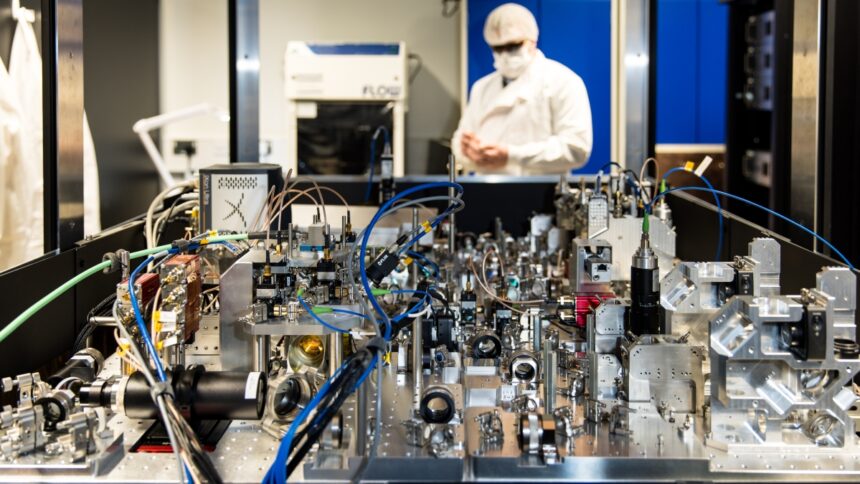
Infleqtion has delivered the United Kingdom’s only operational 100-physical-qubit quantum computing system at the National Quantum Computing Centre (NQCC) with its Sqale platform. This achieved a milestone the NQCC identified as a critical objective for the UK’s quantum strategy.
Achieved in December 2025, the milestone creates foundational infrastructure that will enable researchers and industry to begin working with large-scale quantum systems.
“Infleqtion’s progress is a significant milestone, helping move the UK beyond research toward real-world uses,” said Lord Vallance, Minister of State for Science, Research and Innovation. “These sorts of advances are vital in paving the way for us to be able to use quantum computers to deliver tangible benefits,” the Minister said. “With the talent and research expertise that we have on offer in the UK, this is an encouraging next step which helps cement our position as a world leader in one of the defining technologies of our generation.”
Matthew Kinsella, CEO of Infleqtion, said NQCC’s quantum computing testbed is among the first of its kind, advancing innovation at a global level.
“This latest achievement with Sqale reflects the progress and potential of our neutral-atom architecture and marks an important step toward larger-scale quantum systems,” said Kinsella.
Reaching the 100-physical-qubit level represents an important step beyond laboratory prototypes toward quantum computers that can run more complex algorithms, test error-correction approaches and support practical solutions.
At this scale, quantum systems begin to support experimentation that connects more directly to real-world challenges. Researchers can begin probing applications in areas such as advanced materials, energy systems and complex optimisation.
Sqale is the first neutral-atom platform of this scale deployed in an operational national facility, reinforcing its position at the forefront of quantum hardware development.
The NQCC’s installation of the Sqale platform is part of its broader Quantum Computing Testbed Initiative. With Sqale, researchers will be able to evaluate performance, benchmark applications, and study how neutral‑atom systems scale.
The platform is also designed to accelerate skills development, supply‑chain readiness and application exploration across the UK quantum ecosystem.
“Having a system of this scale available through the NQCC is a significant step for the UK quantum community,” said Michael Cuthbert, director of the NQCC. “It allows researchers to move beyond small demonstrations and begin learning what it really takes to operate and scale quantum computers in practice.”
Colin Sullivan, managing director of Infleqtion UK, said achieving this milestone has been a key goal for the UK’s quantum efforts.
Infleqtion is aiming to exceed 30 logical qubits in 2026 and deliver more than 100 logical qubits in 2028, advancing toward fully fault-tolerant architectures. Because it takes anywhere from 10 to more than 1,000 physical qubits to encode a single reliable logical qubit, physical-qubit performance becomes a key limiting factor.
Infleqtion’s 99.73% two-qubit gate fidelity delivers industry-leading performance on the metric that matters most in quantum computing. Higher fidelity means fewer physical qubits per logical qubit, delivering a significant scalability and efficiency advantage.
Neutral-atom architecture offers one of the clearest paths to scalable quantum computing and future commercial advantage due to its scalability, reconfigurability and strong coherence properties.
Infleqtion’s approach benefits from having already delivered neutral-atom systems in operational environments beyond the laboratory. Unlike many quantum computing efforts that remain confined to research settings, Infleqtion has already translated neutral-atom technology into multiple demonstrations and fielded systems.
These include pioneering quantum flight trials demonstrating real-world operation; first materials science application on logical qubits; deployment of a quantum optical atomic clock on an underwater autonomous vehicle; the UK’s largest neutral-atom array and; collaboration on efforts to deploy a quantum gravity sensor in space.
Together, these efforts underscore Infleqtion’s ability to turn neutral-atom research into fielded products, providing a foundation for developing scalable quantum technologies that move beyond the laboratory and into practical use.