


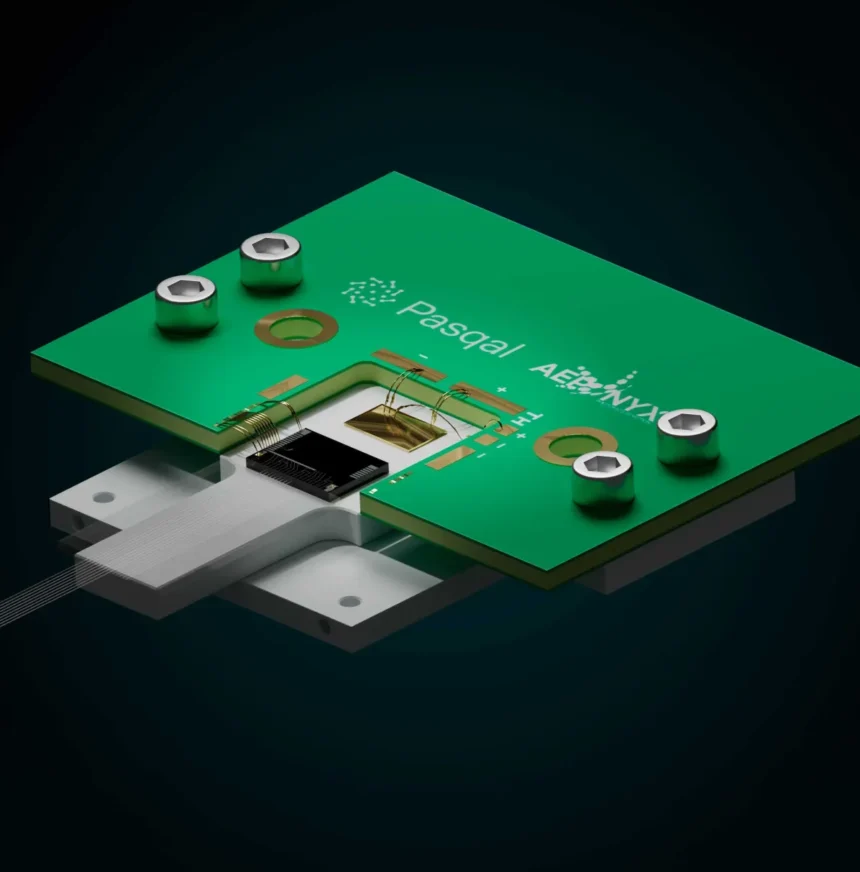
Neutral atom quantum computing company Pasqal announced it has succeeded in trapping individual atoms using laser light generated by a photonic integrated circuit (PIC) – something the company believes to be a world’s first. The company said it has achieved this through Aeponyx, a Canadian PIC company it acquired last year.
This breakthrough, said Pasqal, demonstrates a new scalable approach to qubit control. Neutral-atom quantum computers rely on highly focused laser beams, known as optical tweezers, to trap and control individual atoms that serve as qubits. As Pasqal pursues machines with more than 10,000 atoms and 100 logical qubits, one of the primary engineering challenges is the growing complexity of optical hardware, which today often requires large free-space optical benches. This advancement addresses this challenge by moving critical optical functions onto a photonic chip.

“Building quantum computers that excel commercially means building hardware that delivers industry leading performance and can be manufactured in a scalable way,” said Wasiq Bokhari, Chief Executive Officer, Pasqal. “By moving qubit control onto a photonic chip, we removed what we believe to be one of the biggest barriers to scale – and we did it within 18 months of acquiring Aeponyx. We are very proud of our team for achieving this milestone”
In the demonstration, Pasqal generated four optical traps through a single photonic chip and used them to hold four individual rubidium atoms inside a quantum processing unit (QPU), which Pasqal believes is the first time trapped light delivered from a photonic chip has held atoms on a neutral-atom quantum computer. The work is part of a broader development program to generate, route and control laser light directly on-chip.
In testing, the photonic-chip architecture reproduced atom trapping with performance in line with Pasqal’s existing bulk-optics systems, including atom lifetimes of approximately 27.5 seconds. Pasqal believes the result validates integrated photonics as a viable building block for future neutral-atom processors, without sacrificing the quality of qubit control.

Co-developed with Aeponyx’s silicon-nitride photonics expertise, the platform is designed to shrink the optical footprint of future processors by as much as 50 times and to open a practical route to large-scale manufacturing, an expected advantage as the industry moves from prototypes to production.
Pasqal said it is working to scale the photonic architecture toward the compact systems required for fault-tolerant, industrial-scale quantum computing, with a long-term target of more than 10,000 atoms and 100 logical qubits.