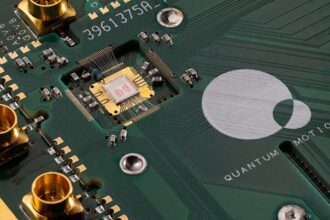



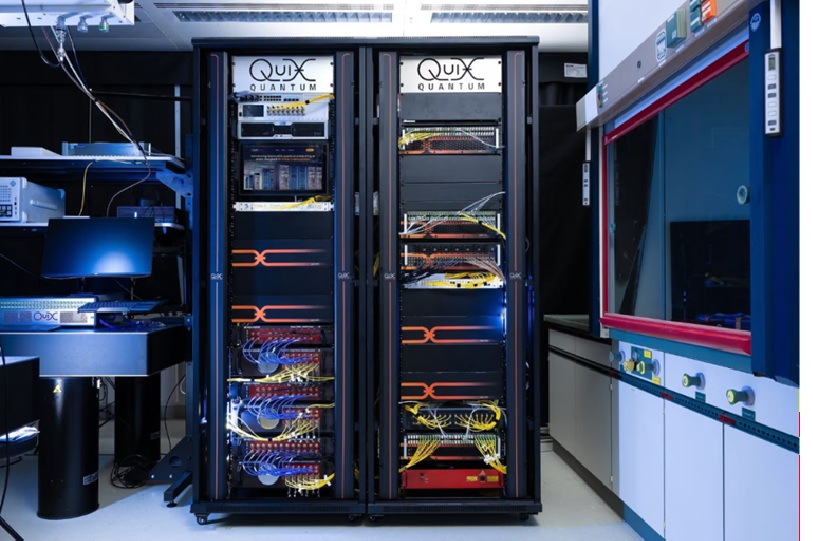
QuiX Quantum, a Netherlands-based company building photonic quantum computers, has launched its photonic quantum computing architecture Carina. The system was originally developed as part of the Universal Photonic Quantum Computer (UPQC) project of the the German Aerospace Center’s DLR Quantum Computing Initiative (DLR QCI), funded by the German Federal Minister of Research, Technology and Space.
Carina’s core hardware platform and important hardware elements were delivered to DLR QCI yesterday, when QuiX also officially launched the system and made the full white paper, Carina – Universal Photonic Quantum Computing Built for Customer Deployment, publicly available.
Carina’s architecture
According to Quix, Carina is the world’s first universal photonic quantum computing architecture designed for deployment in customer data center environments. It uses single photons as physical qubits, and integrates the critical technologies required for measurement-based photonic quantum computing into a single stack. Operational at room temperature, the system is designed to be integrated with classical high-performance computing, AI and data center infrastructure.
Carina is based on measurement-based photonic quantum computing. In this architecture, computation is performed through measurements on entangled photonic states, supported by real-time feed-forward. This technology was described the first time in a Nature paper in 2001 by Emanuel Knill, Raymond Laflamme, and Gerard Milburn and demonstrated by Robert Prevedel, Philip Walther, Anton Zeilinger, and their team at the University of Vienna in 2006.
QuiX said in its announcement that unlike previous special-purpose photonic systems built around narrow computational models such as boson samplers, Carina is designed to implement a universal gate-set to perform any gate-based quantum algorithm. The system combines photon generation, multiplexing, state generation, measurement, photonic assembly control and fast feed-forward control, in a modular design that uses two major standard building blocks: the Photonic Assembly Control Unit and the Feed-forward Control Unit. The Carina platform, said QuiX, establishes the physical qubit foundation for the company’s next-generation Dedalo architecture.
“When Manny Knill, Raymond Laflamme and I published our linear optics quantum computing scheme in 2001, the central question was whether the probabilistic nature of photon-photon interactions could be tamed into something computationally universal. The answer was yes in principle — but the engineering path looked formidable,” said Prof. Gerard J. Milburn, University of Queensland. “What QuiX Quantum is showing with Carina and its measurement-based approach is that this path is not only tractable but navigable with integrated photonics. The combination of on-chip single-photon generation, feed-forward control and cluster-state generation in a system designed for deployment outside the laboratory is precisely the kind of milestone the field awaits. It moves the conversation from whether photonic quantum computing can be universal to how quickly it can be scaled.”
“Quantum photonics aims to bring quantum technologies to a broader audience by leveraging the remarkable capabilities of the semiconductor fabrication industry. The launch of Carina from QuiX marks an exciting milestone in this journey: the first system designed both to generate on-chip cluster states, the fundamental resource for measurement-based quantum computing, and for commercial deployment ” said Prof. Andrew G. White, University of Queensland. “To ensure robust and reliable operation, QuiX has integrated photon generation and detection, real-time feedforward, and control electronics into a platform designed for end users rather than exclusively for laboratory research. Congratulations to the whole QuiX team: I can’t wait to see what the next few years bring for photonic quantum computing.”

“Carina marks a major milestone for QuiX and the photonic quantum computing industry towards deploying utility-scale quantum systems at customer sites,” said Dr.-Ing. Stefan Hengesbach, CEO of QuiX Quantum. “The field has been split between systems that could be commercialized quickly but were not built for universal, fault-tolerant computing, and architectures with long-term scalability potential that remained difficult to deploy. Carina is bringing those two requirements together into a universal architecture for installation into real customer environments.”
Delivery to DLR QCI
Over the next months, the delivered Carina subsystems will undergo further integration, testing and measurement at DLR QCI. This phase will validate integration quality, system performance and operational readiness, and will provide critical input for QuiX Quantum’s roadmap.
“We want to thank DLR QCI for their trust and close collaboration throughout this project. Together,” added Dr. Carina Mieth, Managing Director, QuiX Quantum GmbH, “Their commitment helps accelerate one of Europe’s most promising routes toward universal and ultimately fault-tolerant quantum computing. This is a proud moment for our team, and we congratulate DLR QCI on this achievement.”