


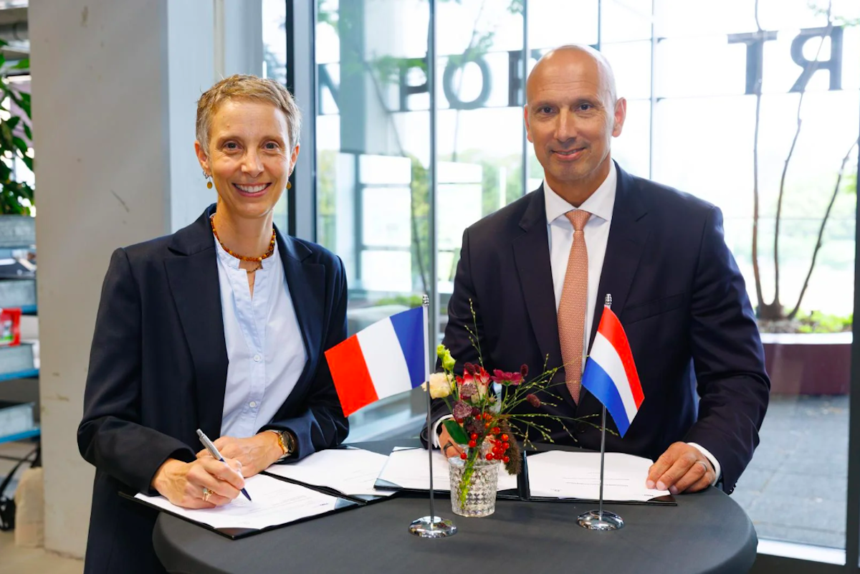
Quobly, a French quantum computing company developing industrially scalable quantum computers based on silicon spin qubits, and TNO, the Netherlands Organisation for Applied Scientific Research, have partnered to strengthen their technical cooperation on the development and industrialization of silicon spin qubit technology.
The agreement builds on the collaboration initiated between the two organizations in 2025, focused on materials research and device characterization for silicon spin qubits.

The new MoU establishes a framework to further develop this cooperation, combining Quobly’s manufacturable 300 mm FD-SOI platform with TNO’s expertise and infrastructure in device characterization, materials analysis and systems engineering and supporting the development of the measurement and integration capabilities required for industrial-scale quantum hardware.
Silicon spin qubits offer a distinctive route to scalable quantum computing because they can leverage the tools, substrates and process-control capabilities of advanced semiconductor manufacturing.
Europe already has world-class capabilities across this value chain, from engineered substrates and advanced foundries to metrology. Quobly is building on this industrial base through its 300 mm FD-SOI platform and its collaborations with CEA-Leti, STMicroelectronics and Soitec.

TNO contributes complementary expertise in quantum device characterization and materials-driven phenomena, supported by dedicated research and test infrastructure in the Netherlands.
The cooperation will enable the partners to investigate how material properties and device characteristics influence qubit performance, process variability and manufacturability. As quantum hardware scales, high-throughput characterization will be increasingly important for reproducible manufacturing and faster development cycles.
For Quobly, the objective is to scale faster by combining its own device and architecture expertise with capabilities already established across Europe.
The work with TNO will help address the technical challenges that emerge as silicon spin qubits move from device development toward larger-scale integration.
The cooperation will include access to measurement data and device simulation data, as well as stack integration expertise. The partners will work toward the high-throughput characterization and metrology capabilities needed to evaluate device performance, identify sources of variability and support the transition toward industrial-scale manufacturing.
“We are building quantum computers for industrial scale. That means solving the engineering challenges behind the qubit as seriously as we solve the qubit itself,” said Maud Vinet, CEO and co-founder of Quobly.
Vinet said their cooperation with TNO strengthens this approach by bringing together complementary European expertise in materials, devices and industrialization.
“By combining TNO’s testing and characterization capabilities with Quobly’s industrial quantum platform, we can help accelerate the development of silicon spin qubits toward commercial applications,” said Tjark Tjin-A-Tsoi, CEO of TNO.
Also, Quobly is working with Orange Quantum Systems (OrangeQS), a company based in Delft specializing in automated diagnostics and high-throughput test systems for solid-state quantum chips, on the characterization and testing of silicon spin qubit devices at scale.
The cooperation combines Quobly’s silicon spin qubit technology, developed on a manufacturable 300 mm FD-SOI platform, with OrangeQS’s expertise in diagnostics, measurement protocols and automated test systems for solid-state quantum chips.
The two firms will work together to develop the measurement methodologies and test capabilities needed as silicon spin qubits move toward industrial manufacturing.
Also, the cooperation will focus on developing the characterization methodologies and testing capabilities required to support the industrialization of silicon spin qubits.
OrangeQS brings expertise in automated diagnostics and high-throughput test systems for solid-state quantum chips. Quobly contributes its silicon spin qubit technology, device specifications and test wafers.
The partners will work toward an automated, high-throughput test environment for the characterization and screening of silicon spin qubit devices.
For Quobly, this is a practical part of building the infrastructure required to industrialize its quantum processors. Manufacturing at 300 mm requires testing and characterization capabilities that can operate at a comparable level of throughput and reproducibility.
These capabilities will enable Quobly to evaluate device performance, identify sources of variability and support the development of larger quantum processors
For OrangeQS, this intended collaboration brings a partner with a shared vision on the industrialization of quantum computing, together with in-depth expertise and a proven track record in high-end silicon spin qubit technology.
Access to Quobly’s device specifications, test wafers and industrial-scale roadmap strengthens OrangeQS’s ability to build and validate testing solutions for the next generation of spin qubit devices.
“The rapid advances in spin qubit technology have moved the industry to a point where automated testing is no longer a future requirement but an immediate necessity,” said Garrelt Alberts, Executive Director of Orange Quantum Systems.
“Through our collaboration with Quobly, we can ensure that OrangeQS MAX is optimally aligned with the needs of spin qubit developers and manufacturers,” added Alberts.