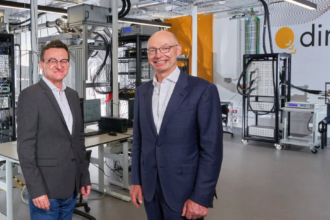
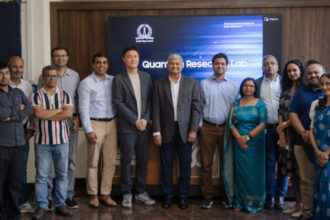




The University of California, Berkeley, on behalf of its Department of Physics and the Roger Herst Quantum Nexus, and QuantrolOx. have entered into a memorandum of understanding (MOU) establishing a five-year framework for collaboration on the end-to-end industrialisation of quantum computing.
This advances the technology from bespoke, laboratory-scale experimentation toward standardised, automated, and manufacturable systems for real-world applications.

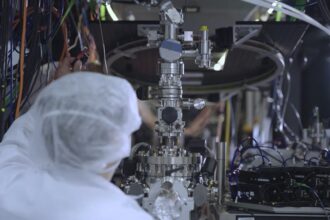
The collaboration brings together UC Berkeley’s superconducting quantum research at the UC Berkeley Department of Physics and the Roger Herst Quantum Nexus, with QuantrolOx’s expertise in hardware-agnostic, machine-learning-based software for automated qubit characterisation, calibration, and control.
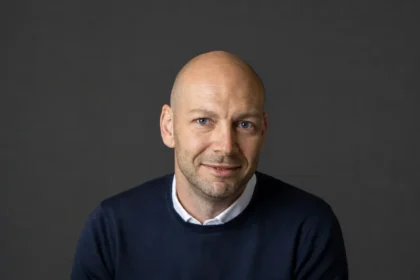
Irfan Siddiqi, professor at the Department of Physics at the University of California, Berkeley, said that bringing the strengths of academia together within an open collaboration with industry is by far the most efficient path to a quantum computer relevant to real-world applications.
“The white-box superconducting qubit platform we have here at Berkeley is an ideal test environment for developing QuantrolOx’s commercial tools for design, characterization, calibration, and control of quantum devices,” said Siddiqi.

“Rather than working in physically separated remote teams, we will use the new Roger Herst Quantum Nexus as a collaboration space to facilitate rapid progress, efficient workforce training, and contribute to the public dialogue on quantum computing,” he added.
Vishal Chatrath, CEO of QuantrolOx, said that quantum computing will not scale on laboratory heroics alone.
“Industrialisation requires common tools, automated workflows, shared data architectures, and a skilled workforce – and this collaboration with UC Berkeley, home to one of the world’s foremost superconducting quantum programs, gives us the opportunity to advance all four,” said Chatrath. “Together we intend to help define how quantum processors are built, tested, and operated at industrial scale.”
According to the agreement, the parties recognise the value of educational, cultural, and scientific exchanges between academia and industry, noting a shared interest in overcoming scalability bottlenecks in quantum computing.
Key areas of interest for the collaboration include end-to-end industrialisation. This spans materials research, quantum-enabled PDK/EDA development, QPU development, testing and quality assurance, failure analysis, and operational runtime – moving each stage from manual, bespoke laboratory practice toward standardised, automated, and reproducible workflows.
Central to this vision is a common data architecture that serves as the connective layer across the lifecycle and the integration point for machine learning and agentic AI.
Another area is integrated quantum control solutions. Integrating control hardware and software, including low-latency connections between instruments and classical computing resources, the use of cryogenic electronics, and solutions for scalability bottlenecks such as crosstalk compensation and parallelisation.
Also, collaboration on AI in calibration involves researching the use of AI technologies, such as agentic systems, to automate quantum control, deliver fast, high-accuracy calibration, and provide physics-aware AI assistance for skilled quantum engineers.
The agreement also covers training and workforce development. This involves developing methods to train experimentalists and quantum hardware engineers at scale, meeting the workforce needs of both scientific research laboratories and the emerging quantum industry.
On scientific and community engagement, the will share non-confidential scientific knowledge through seminars, technical workshops, reciprocal visits, and community convenings hosted at the Roger Herst Quantum Nexus.
The MOU establishes a non-binding, five-year framework for these activities. Specific initiatives, including any research or commercial engagements, will be defined through separate agreements between the participants.