
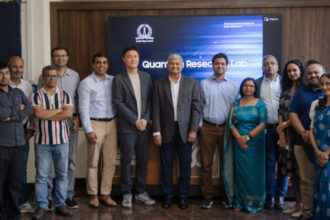




SEALSQ has reached a final, binding agreement with Kaynes SemiCon to establish SEALKAYNESQ, a joint venture (JV) in India.
The company focuses on developing and selling semiconductors, PKI, and post-quantum technology hardware and software products. It is a subsidiary of WISeKey International.

The JV is being formed with the objective of developing, personalizing, and deploying a sovereign Indian post-quantum semiconductor platform. This is fully aligned with India’s national digital sovereignty and security priorities. It is developed in direct dialogue with India’s Ministry of Electronics and Information Technology (MeitY), the central authority responsible for India’s electronics, IT, cybersecurity, and emerging-technology strategy.
SEALKAYNESQ plans to establish a secure semiconductor design, test, and on-shore personalization center in India, with the goal of moving well beyond a conventional OSAT model to create a high-assurance industrial platform dedicated to quantum-resistant and security-critical semiconductor technologies.
The JV intends to focus on sectors where national security, data sovereignty, and regulatory compliance are paramount, including government, defense, finance, healthcare, critical infrastructure, and large-scale loT ecosystems operating under Indian national security regulations.

The JV aims to deploy an Outsourced Semiconductor Test & Personalization (OSTP) facility within Kaynes SemiCon’s manufacturing campus in India, integrating advanced wafer and final test capabilities compliant with Common Criteria (CC) standards, secure PKI-based lifecycle key management, and native Post-Quantum Cryptography (PQC) embedded directly at the silicon level.
A key milestone target of the collaboration will be the localized deployment of SEALSQ’s Quantum Shield semiconductor architecture in India, providing a foundational layer of long-term quantum resilience for Indian digital infrastructure and critical systems.
Under the agreed structure, SEALSQ will hold 51% of JV’s share capital, while Kaynes SemiCon will hold 49%, with governance shared through a five-member board.
Core intellectual property from SEALSQ and WiSeKey is intended to be licensed exclusively to the JV for the Indian market, while any new intellectual property developed within the JV would be owned by SEALKAYNESQ, reinforcing India’s long-term technological sovereignty and domestic capability building.
SEALSQ’s contribution is central to advancing india’s Post-Quantum readiness. Through its portfolio of PQC-ready secure elements, cryptographic processors, Vaultic secure hardware, INes PKI lifecycle management platforms, QS7001 Quantum Shield technology, and QVault-TPM post-quantum secure processors, SEALSO will aim to enable India’s work to future-proof critical digital systems against the cryptographic risks posed by quantum computing.
By embedding post-quantum cryptography directly into Indian-manufactured semiconductors, the JV would ensure that connected devices remain secure well beyond the advent of practical quantum computers, strengthening India’s digital sovereignty, resilience, and global competitiveness.
Carlos Moreira, CEO of SEALSQ, said that the JV is not merely an industrial collaboration but a strategic sovereign initiative aligned with India’s national digital and security priorities and developed in direct dialogue with MeitY.
“By combining SEALSO’s post-quantum semiconductor and security expertise with Kaynes SemiCon’s rapidly expanding manufacturing capabilities, the partners are building an Indian Post-Quantum semiconductor platform designed to protect critical national infrastructure for decades to come,” said Moreira.
Raghu Panicker, CEO of Kaynes SemiCon, said that the integration of quantum-resilient technologies into Kaynes SemiCon’s platform directly supports India’s ambition for semiconductor self-reliance and global leadership in trusted electronics manufacturing.”
The JV should also be eligible to benefit from the Swiss-India Free Trade Agreement (FTA) under the European Free Trade Association (EFTA) framework. This significantly reduces customs duties on advanced semiconductor equipment and technology imports, enhancing cost efficiency and facilitating smoother bilateral trade and technology transfer between Switzerland and India.
This trade environment strengthens the competitiveness and scalability of the JV’s operations in India.