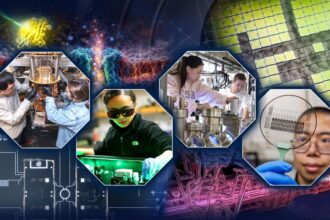


To enable Singapore’s quantum ambitions, the National Quantum Federated Foundry (NQFF) was launched in 2022, focusing on the development of quantum hardware and device components essential for quantum technologies. The foundry operates in the areas of ion traps, integrated photonics, superconducting qubits and devices, cryogenic interconnects and packaging, cryo-electronics, engineered dopant arrays, and quantum hardware characterisation.
- How did your journey in quantum computing begin?
- How large is your team at NQFF? Could you share some of your day-to-day activities?
- Is the fabrication lab itself within A*STAR premises or the foundry?
- Are there any overlaps in terms of the fabrication methods or equipment across the platforms?
- Do you also work directly with any of the commercial foundries in the country?
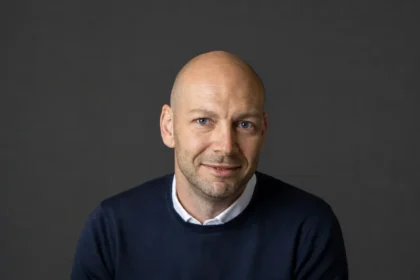
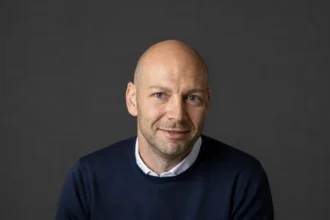
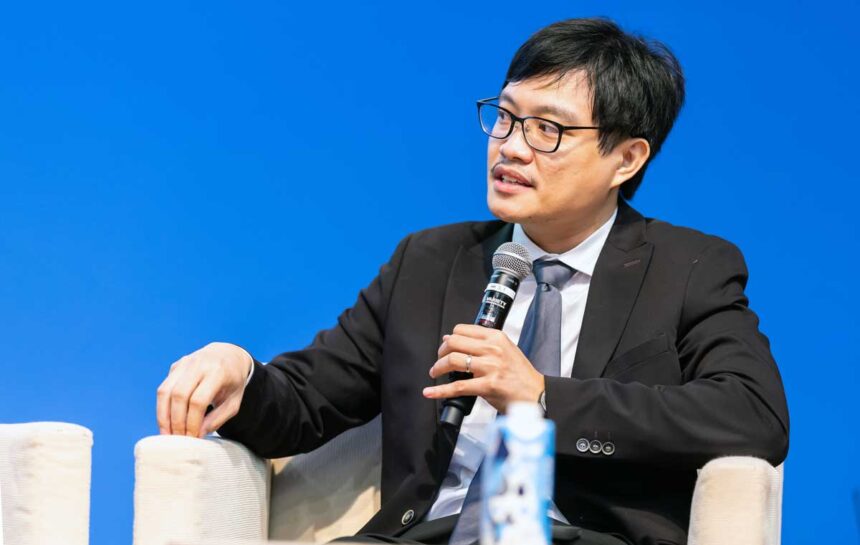
In a conversation with Quantum Spectator, Dr Victor Leong, NQFF Director, shared his journey coming into the foundry, what the foundry actually does, and how the organisation functions within Singapore’s quantum ecosystem.

How did your journey in quantum computing begin?
Even back during my PhD, during my work on cold atoms, that was already leading into quantum because my cold atom PhD was with CQT (Centre for Quantum Technologies), and I was working on neutral atoms. We weren’t building a full stack quantum computer back in those days, but we were investigating certain aspects of neutral atom quantum technology. After that, I came to A*STAR, which I was tied to by a scholarship bond.
You can think of cold atoms as working with actual atoms suspended in space. Back then, there wasn’t anyone doing cold atoms within A*STAR, but there were people working on solid state quantum emitters. I joined an existing project on solid state quantum emitters, and then from thereon, I branched out into some of the photonics projects in A*STAR. Along the way, I got involved in the foundry program, which I now lead.
How large is your team at NQFF? Could you share some of your day-to-day activities?
What we focus on is basically hardware development. We develop different types of hardware depending on which of the quantum technology platforms we are supporting. For instance, for the trapped-ion platform, there is a national level quantum programme, which is the National Quantum Processor Initiative that is building up a trapped-ion quantum processor.

How the foundry programme gets involved is that we take over the fabrication of certain critical components. In this case, it is a segmented blade electrode that is a key part of the current generation of the trapped-ion quantum processors that we’re developing. For the other platforms, Qolab for example, we announced that we’re working on some of these coplanar waveguide lowpass filters that work at cryogenic temperatures. This is a critical component within the full stack. We are not developing a full stack, but we find our niche. We find our impact by focusing on certain key and critical components where NQFF has strengths, and indeed we have strengths in this area, largely focusing on device nano fabrication and device characterisation, especially at cryogenic temperatures.
Is the fabrication lab itself within A*STAR premises or the foundry?
The program as a whole is officially hosted within A*STAR, but as the word federated in our name suggests, we actually have access to the federation of clean rooms, both at A*STAR and publicly funded universities in Singapore. We do not do all our operations in one single place, but we basically want to tap into the best tools, the best people, and the best processes that are available so they can get the job done.
We have efforts supporting various multiple quantum technology hardware platforms. But our efforts in each of these platforms are very much aligned to the national quantum strategy, because our role is also to support the various national network programs in this space. I brought up a previous example for the National Quantum Processor Initiative, where we contribute by taking over the fabrication of certain critical ion trap components.
Are there any overlaps in terms of the fabrication methods or equipment across the platforms?
This is quite platform-specific. The segmented blade electrodes for the ion traps, for example, are quite specific to the ion trap platform only. But if you talk about device nano fabrication in general — which are the tools and the clean-room infrastructure that we use — these were also not originally built for quantum. Many of these tools find applicability in quantum, but in many other fields as well.
In each of these platforms or projects that we undertake, we will usually look at what the device nano fabrication needs are, and we match them against the tools and the capabilities that we have, and we find the best solution to fulfill that requirement.
Do you also work directly with any of the commercial foundries in the country?
The whole picture is that we are very much focused on the business of doing technology translation. These are the emerging technologies that are coming out from the labs we want. We take over, we validate these processes, these ideas on industrially relevant processes. We show that we can do it, that they work, and that they have good performance.
Then, when the process and the product are sufficiently mature, perhaps the commercial foundries can come in. When a commercial foundry looks at a device manufacturing need or a problem, probably the first question they will ask is, ‘how many wafers a month?’ If you are still in a lower Technology Readiness Levels (TRL) process development phase, you’re not ready to answer that question yet. This is where a research foundry program like NQFF, comes in.