


Quandela, which is building photonic quantum computers, today announced the signing of two separate partnerships – a joint research project with aerospace firm Safran, and a tripartite MOU with KAIST (Korea Advanced Institute of Science and Technology) and KRISS (Korea Research Institute of Standards and Science).
Partnership with Safran

Quandela and Safran Tech, Safran’s research and technology centre, have launched a new research project to develop quantum algorithms for modelling fluid flows. Known as AQeFLU, this project focuses on simulation of airflow around aerodynamic profiles, which is currently a key challenge in optimising aircraft performance. At present, such studies rely on large-scale numerical calculations and lengthy, costly wind tunnel tests.
The AQeFLU project explores how quantum approaches can complement conventional methods to:
- Increase the share of numerical simulation and reduce the need for physical testing
- Multiply the number of configurations tested during the design phase with greater accuracy
- Accelerate the development cycles of future engines and energy systems.
This project is supported by the PAQ Quantique programme, funded by the Île-de-France Region, with Quandela contributing its photonic technology and software expertise, and Safran Tech contributing its knowledge of fluid mechanics and reference computational methods.

Together, the teams will first test the algorithms on standardised academic cases before moving on to advanced industrial applications, particularly in the field of combustion and propulsion systems.
MOU with KAIST, KRISS
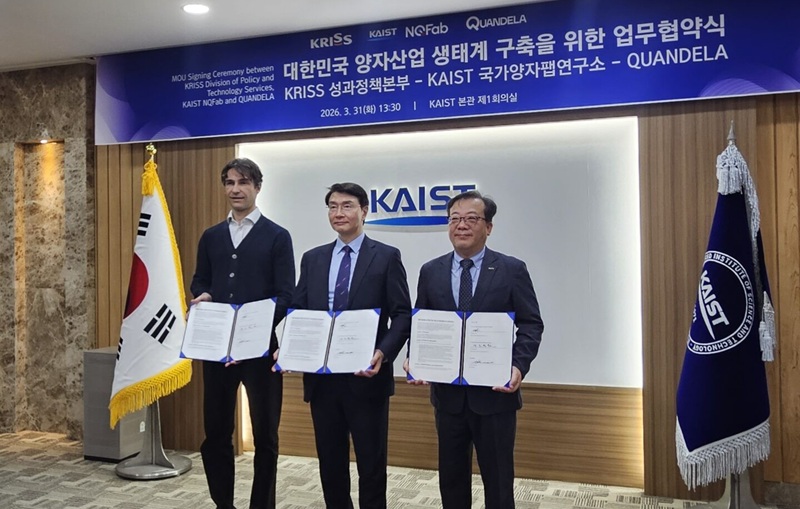
Quandela, KAIST (Korea Advanced Institute of Science and Technology), and KRISS (Korea Research Institute of Standards and Science) have signed a tripartite MOU to accelerate photonic quantum computing in South Korea. This strategic collaboration brings together research, precision metrology, and commercial quantum technologies to establish a fully integrated value chain from fundamental research to industrial deployment.
Photonic quantum computing is emerging as one of the most promising approaches to scalable quantum systems, offering strong compatibility with existing semiconductor infrastructure. However, translating laboratory breakthroughs into deployable technologies requires close coordination across research institutions, standards bodies, and industry.
Against this backdrop, KAIST, KRISS, and Quandela have formed a partnership to advance Korea’s quantum capabilities. The collaboration is meant to connect complementary strengths across the ecosystem:
- KAIST’s open National Quantum Fab
- KRISS’s expertise in precision metrology and standards
- Quandela’s commercial photonic quantum computing platforms and cloud services
Together, the partners aim to accelerate the transition from R&D to real-world applications while strengthening Korea’s role in global quantum supply chains.
The partnership will focus on three core areas:
- Co-development of quantum systems
Leveraging KAIST’s Quantum Fab and QX Scale-up Valley infrastructure - Joint research and technology transfer
Advancing photonic quantum computing and quantum communication - Talent and ecosystem development
Establishing training programs and fostering industry–academia collaboration for international applications
The KAIST–KRISS–Quandela partnership represents a concrete step toward establishing a scalable photonic quantum ecosystem in Korea. By linking research, standards, and commercial deployment, the collaboration is designed to accelerate adoption and integration into global quantum value chains.