



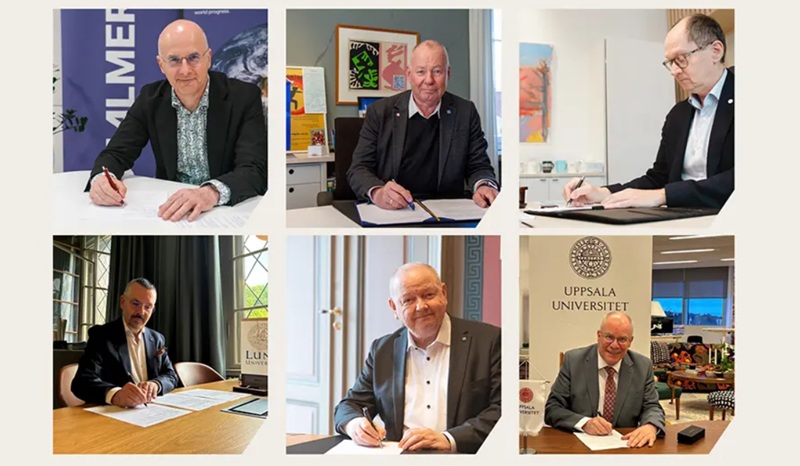
Six Swedish universities – KTH Royal Institute of Technology, Chalmers University of Technology, Lund University, Stockholm University, Linköping University, and Uppsala University – have signed a joint Memorandum of Understanding (MoU) to establish the Swedish Center for Quantum Technology.
The Swedish Center for Quantum Technology aims to be a national hub for research, innovation, education, and capacity building in quantum technology. The initiative will be coordinated at Chalmers University of Technology and aims to strengthen Sweden’s international competitiveness and serve as a driving force for the development and application of quantum technologies.

The reason for this initiative, said the universities in their announcements, is that national coordination is currently lacking in Sweden. This is in spite of the fact that Sweden hosts strong fundamental research and internationally leading environments in quantum technology, including the country’s most extensive quantum research programme, the Wallenberg Centre for Quantum Technology, and has active industry engagement, with key support from funding bodies such as the Knut and Alice Wallenberg Foundation.
The lack of national coordination, said the universities, may mean that new government initiatives risk creating fragmentation if they are not properly aligned. Through this MOU, the universities hope to focus on coordination and long-term capacity building, and help position Sweden for the rapid developments expected in the coming decades.
“To be internationally competitive, we need to collaborate. The center provides an important opportunity to strengthen and expand the Swedish quantum science and technology community, building on the broad participation from many universities and Sweden’s existing strengths in research, education, and innovation,” says Jens Bardarson, Professor in Theoretical Physics and Head of the Department of Physics at KTH.

The universities also remarked that quantum technology is currently at a critical global turning point, with major investments being made in both research and infrastructure.
“We are in the middle of a rapid transition – quantum technology is advancing quickly, with strong environments emerging in countries such as the United States, China, the United Kingdom, and Germany. We expect it to break through on a broad scale within 10–15 years, and the decisions we take today will have a major impact on the future,” says Göran Johansson, Professor of Applied Quantum Physics at Chalmers University of Technology.
Together, the universities will contribute across the full value chain – from fundamental research to early-stage industrial and societal applications – covering research, education, infrastructure, and innovation. By improving coordination of expertise, infrastructure, and funding, the initiative aims to strengthen Sweden’s role as an attractive partner in both the Nordic region and Europe.
”The formation of a national quantum centre allows us to take advantage of the breadth and expertise that exists in the area at our universities. We are gathering breadth and developing cutting-edge in quantum technology,” said Stockholm University President Hans Adolfsson.