
As demand for compute and secure data storage continues to grow, attention is turning to a once far-fetched idea: space-based data centres. Advances in launch technology, satellite systems, and space-based power generation are making it increasingly feasible to place computing infrastructure in orbit, with companies like SpaceX and Google already planning orbital computing infrastructure.
Singapore-based startup SpaceComputer is one of the companies operating in this sector, and is working on providing security to data centres in space. In 2025, SpaceComputer raised US$10 million in a seed round led by Maven11 and Lattice, with participation from other institutional and individual investors.

In October this year, the company will launch its first space mission, where it will deploy two payloads. These will run tests of their solution Space Fabric, which is a hardware-and-software security architecture that includes features such as on-orbit key generation. Ultimately, SpaceComputer aims to provide a security layer that will enable space data centres to easily communicate with other satellites, enable interoperability across different constellations, and ensure security.
SpaceComputer’s architecture has been designed to be quantum-safe by replacing traditional RSS/ECC protocols with those approved by the U.S. National Institute of Standards and Technology (NIST). In this interview, co-founders Daniel Bar and Filip Rezabek discuss why PQC is a necessary consideration when building space-based data centres, which algorithms they’re using, and the future of quantum computing in space.
Space-based data centres as the next stage of the internet
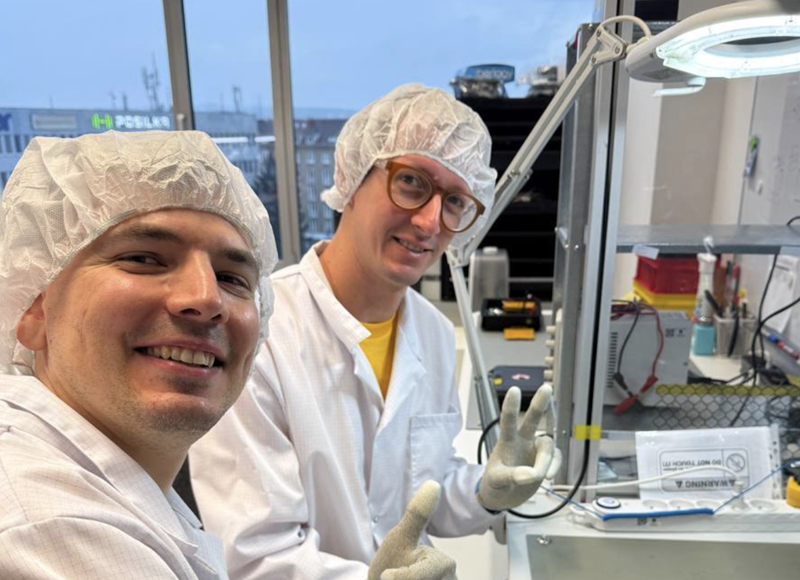
SpaceComputer was founded based on the shared beliefs of Bar, a semiconductor physicist, and Rezabek, a distributed‑network cybersecurity researcher, who both see space-based data centres as representing “the next evolution of the internet”.

Orbital data centres, they said, will “unlock the unique advantages that only the space environment can offer: passive thermal cooling, uninterrupted solar energy, vacuum-speed data transmission, and physical security beyond any terrestrial threat model.”
Such data centres will connect Earth-based applications to space-based compute resources that will put it out of reach of physical tampering, bringing maximum security. This, according to the founders, will complement PQC, which the founders say will be necessary but insufficient.
“A post‑quantum secure satellite as a compute platform is a novel building block of what we believe will be unfolding as the next evolution of the internet,” they explained.
The importance of quantum-safe satellites
When developing Space Fabric, the company noticed that “there’s a rather fragmented approach toward both post‑quantum cryptography as well as space as the most strategic future digital frontier…we can look at the Internet in a holistic way and integrate post quantum cryptographic schemes with the provided physical isolation that operating in orbit.”
The need for post-quantum security is especially urgent when it comes to the space industry in general and, more specifically, satellites. Like all industries, it is susceptible to the Harvest Now Decrypt Later (HDNL) threat, in which encrypted data is stolen today in hopes of using a quantum computer to decrypt it in future. And as space is critical to the defense and communications infrastructure the world relies on, such HNDL attacks may prove deadly in future.
“Many critical applications rely on space communications,” said Bar and Rezabek, “and it is crucial to protect those asap”.
They continued, “As more and more compute and comms move to space, they include critical and often defense-related communication. For such applications, it is important to consider PQC and to design for current and especially future threats.”
In addition to that, satellites have a long design life, which means they will likely still be operational when the cryptographically relevant quantum computer (CRQC) becomes a reality. Google’s recent PQC migration timeline, for example, brings the date forward to 2029; this is far shorter than the lifespans of most satellites launched today.
“The development of satellites and its lifecycle goes beyond that [2029], so we need to be prepared for that,” said Bar and Rezabek.
Space Fabric: Making orbital compute verifiable
SpaceComputer’s inaugural launch in October will implement their architecture, Space Fabric, across two payloads tugged by a satellite in geostationary orbit. The mission will demonstrate a verifiable trust layer for secure computation in orbit, proving that a workload is running on a specific satellite through ground station verification.This will require two secure computing chips from different manufacturers to agree on the compute workload’s output.
Said Bar and Rezabek, “Space Fabric is the first architecture to make orbital computing cryptographically verifiable: proof that a workload ran on a specific satellite, not just inside some server claiming to be secure.”
At its core, Space Fabric is built with post-quantum security and cryptographic agility (crypto-agility) and interoperability in mind.
“We find interoperability crucial, and building on top of tested standards is important,” said Bar and Rezabek.
The architecture’s features include on-orbit key generation (where cryptographic keys are generated in space), and digital signatures – both of which are major concerns in PQC. In order to address this, SpaceComputer has replaced RSA/ECC protocols with NIST’s first PQC standards: ML‑KEM for key establishment and ML‑DSA for signatures.
Key Establishment using ML-KEM
For secure exchange of encryption keys, SpaceComputer is utilizing ML-KEM (FIPS 203), a module-lattice-based key encapsulation mechanism derived from the CRYSTALS-Kyber family. This is designed to replace RSA and Diffie-Hellman and is, according to SpaceComputer, “crucial for mitigating harvest-now-decrypt-later attacks”. However, like most PQC algorithms, ML-KEM requires much larger key sizes and higher memory requirements, both of which are challenges given the limits of satellites.
To solve this, SpaceComputer has implemented a hybrid encryption scheme, where ML-KEM is restricted to on-orbit key negotiation (i.e., key agreement), with classical algorithms securing the rest of the communication.
Said Bar and Rezabek, when describing the limitations of ML-KEM, “The impact is not as significant — just the key negotiation is expensive. The successive communication relies on traditional symmetric cryptography.”
ML-DSA for digital signatures
For signatures, SpaceComputer is implementing ML-DSA (FIPS 204), which provides lattice-based digital signatures for identity authentication and data integrity in software, firmware, and communications. Like ML-KEM, this also requires more space, which SpaceComputer is mitigating through a hybrid approach.
Said Bar and Rezabek, “There is a larger overhead, but as of now, we are focusing on a hybrid approach where the main root of trust is PQC, but the majority of comms (which are short-lived) are using classical cryptography. Once the time is right, we can then easily switch to fully PQC. In the meantime, the comms will get better, although even now we don’t see major issues in comms overhead. In terms of computational cost, PQC schemes can be even faster.”
The future of quantum computing in space-based data centres
Looking ahead, SpaceComputer envisions a world where data centres in orbit are not isolated curiosities but integral components of the global computing fabric. However, they warn that without the surrounding infrastructure — power, connectivity, logistics, interoperability — orbital compute will remain inaccessible at scale. Their mission is to build the “rails” that make space‑based computing practical. Quantum computing, said Bar and Rezabek, will accelerate this process.
Concluding, they said, “Quantum computing will dramatically accelerate this need. It will destabilize current cryptographic standards, demand new architectures for secure key management, and push the limits of classical ground-based infrastructure. Space-based systems — already physically hardened and naturally isolated — are uniquely positioned to host post-quantum cryptographic infrastructure and, eventually, quantum processors themselves. The question is no longer whether space will play a central role in the future of computing, but how fast we can build the foundational layer that makes it viable at a civilizational scale.”