


Japan’s quantum ecosystem is undergoing a period of rapid expansion. Between 2020 and 2024, the government invested approximately ¥332.8 billion (app US$2.84 billion) on quantum, and the 2025-2030 budget will likely top that1. Just this June, the Takaichi administration announced a growth strategy targeting ¥370 trillion (app. US$2.3 trillion) in combined public and private sector investment into 17 key strategic areas, including quantum, by the year 2040.
But quantum in Japan is not all government-led. Rather, national strategy has been shaped by close collaboration between government, industry, and academia. At the centre of this is the Quantum STrategic industry Alliance for Revolution (Q-STAR), a consortium that works to “create new industries and business opportunities based on quantum technology”.

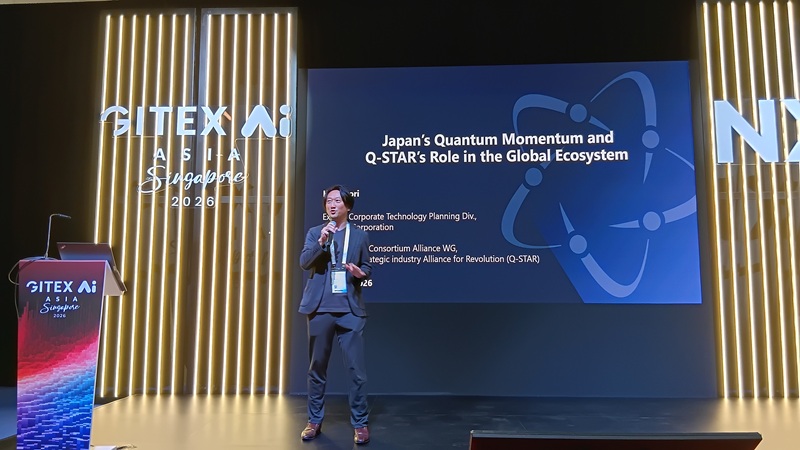
At GITEX AI Asia 2026 in Singapore, Hiro Mori, Chair of Q‑STAR’s Global Consortium Alliances Working Group and Expert, Planning Group, Strategic Tech Planning Office, Corporate Tech Planning Division at Toshiba, outlined how Japan is positioning itself for the next decade of quantum development. In his presentation, Mori provided a detailed view of the country’s strategic posture, the role of industry alliances, and the importance of international partnerships in shaping Japan’s trajectory.
Quantum as a strategic growth priority in Japan
Quantum technologies first became part of the Japanese government’s plans in 2020, when the Cabinet Office published the Quantum Technology and Innovation Strategy. This was part of the broader Integrated Innovation Strategy 2020, and gave rise to the 2022 Vision of Quantum Future Society, the document which first outlined Japan’s quantum roadmap.
The 2022 Vision, which has shaped Japan’s approach to quantum, set 2030 as the target year to achieve 3 specific milestones: (1) 10 million users of quantum technology, (2) a quantum production economy worth ¥50 trillion yen (app $310 billion), and (3) the creation of quantum unicorns. These targets then guided the 2023 Strategy of Quantum Future Industry Development, which articulates the concrete steps to be taken to industrialise quantum technology in Japan.

Said Mori in his presentation, “By 2030, we want to create 10 million quantum technology users..almost 10% of the Japanese population. Once the number of users reaches that 10%, applications of the technology will explode naturally, like the internet, and also like Chat GPT. Once the number reaches 10% of the population, we don’t need any effort. So that’s one of the goals. Also, we don’t expect there to be 10 million quantum developers. Most users don’t [have to] care about the technology behind the application…We may send an email via the quantum internet. We may take a medicine which was discovered by the quantum computer, or get a diagnostic about health or the environment by the quantum sensor. That’s our goal by 2030.”
Shortly after taking office in 2025, Prime Minister Sanae Takaichi placed quantum among her administration’s highest national priorities — she identified seventeen critical technology domains, with quantum ranked third, just after AI & Semiconductors and shipbuilding.
According to Mori, Takaichi is — unusually for a Prime Minister — familiar with quantum technologies, having served as Minister of State for Science and Technology and having chaired the G7 Science and Technology Ministers’ Meeting at the 2023 summit in Japan.
Mori described this political alignment as a “tailwind,” noting that it increases the likelihood of sustained public investment.
He said, “She [Takaichi] was the chair of the quantum side event [at the G7 Summit], which means she is very familiar with quantum technology. Also, she recognizes the importance of quantum technology. It’s a tailwind for us. We expect to get more subsidies to develop quantum technology in Japan.”
Q-STAR’s formation and activities
Q-STAR was established in 2021, a year after the Japanese government first published the Quantum Technology and Innovation Strategy, with a deliberate focus on building and commercialising quantum businesses. The consortium covers all areas of quantum: quantum computing, quantum communication, quantum sensors, as well as algorithm and software development.
Said Mori, “We don’t have academic activities. We have to build businesses around quantum technology. That’s the Q-STAR mission.”
Q-STAR began with only 11 founding members, including global giants Toshiba, Fujitsu, Hitachi, NTT, NEC, and IBM. In five years, it has expanded to 156 companies, a fifteen‑fold increase that reflects the growth of the industry and the interest in quantum solutions. The membership composition is particularly notable, with the majority being user companies, not quantum technology providers. One of the benefits of such a community, said Mori, is that it allows quantum technology companies and their users to jointly discover clear and relevant use cases.
Mori said, “Interestingly, the majority of the Q-STAR members are user companies, meaning they don’t have quantum technology, but they want to leverage quantum technology to solve their own issues, which current AI or GPUs cannot solve. 77 of the 156 members are user companies, and the rest of the companies are technology providers. Q-STAR prepares a place for them to discuss, and we invite both parties, so that user companies know about actual use cases.”
Q‑STAR operates through a network of subcommittees and working groups, each with their own tasks. Subcommittees focus on specific technological domains, working groups focus on ancillary activities.
“Q-Star is composed of multiple working groups and subcommittees. The subcommittees discuss the technologies’ use cases. For example, the Applications of Quantum Superposition subcommittee discusses use cases based on annealing technology. The Combinatorial Optimisation Problem Subcommittee discusses use cases which can solve database problems using quantum technology. We also have the Quantum Cryptography and Quantum Communication subcommittee, and also the Quantum Sensing subcommittee, and others,” Mori explained.
He added, “Meanwhile, there are several working groups. These working groups support all our subcommittees. I’m leading the Global Consortium Alliances working group to encourage our members to make more collaborations with global partners. These are the steps we’re taking to realise our vision.”
The groups’ findings are submitted to the Japanese government, and play a role in shaping national strategy and policy. Some of the national strategies Q-STAR has contributed to are: the abovementioned Strategy of Quantum Future Industry (2023), as well as Promotion Measures for Development of Quantum Industries (2024), and Promotion Measures for the Development of a Quantum Ecosystem (2025).
G‑QuAT: Providing a testbed for industry
A key institutional partner in Japan’s quantum ecosystem is the Global Research and Development Center for Business by Quantum-AI technology (G-QuAT), a research organisation established in 2023 under the National Institute of Advanced Industrial Science and Technology (AIST). G-QuAT is primarily a quantum-AI research centre that provides the necessary testbeds for quantum use cases, and gives Q-STAR members access to its facilities. Like Q-STAR, G-QuAT aims to solve societal challenges, create new markets, and build a global business ecosystem for quantum technologies.
Said Mori, “G-QuAT has three types of quantum computers. One is superconducting, the second is photon-based, and the third is a neutral atom quantum computer. They invite technology vendors to use their environment. Also they have a GPU supercomputer, because current quantum computers may need to work with a GPU cluster – it’s called a hybrid.”
In exploring and testing use cases, Q-STAR and G-QuAT have identified three priority industries for the short and medium terms, which they define as stages preceding Fault-Tolerant Quantum Computing (FTQC). The three industries are: logistics, manufacturing, and transportation. In addition to these, the two organisations aim to conduct small-scale tests in material science and finance.
For the short term, most of their efforts will be focused on optimization problems that can be solved using quantum annealing and other quantum‑inspired technologies ready for deployment today, while gradually moving towards using full gate-based quantum computing. This approach reflects Japan’s broader strategy of leveraging existing quantum‑related technologies to build industrial capability ahead of the arrival of fault‑tolerant systems.
Mori explained, “Some argue that the quantum computer is not ready. But we try to utilize existing solutions. Currently, that’s true, a quantum gate-based computer is not ready, but annealing technology is. So we’re starting to use quantum-related technology as much as possible, because early adopters can take everything. We have to prepare, to get the knowledge, and we have to find clear use cases as early as possible. That’s our strategy.”
Global standards and engagements
In 2023, the governing boards of the International Organization for Standardization (ISO) and the International Electrotechnical Commission (IEC) approved the creation of a new joint technical committee dedicated to quantum technologies. The committee was officially launched in January 2024 as IEC/ISO JTC 3 – Quantum Technologies. In December that year, Q-STAR was appointed the Japanese National Mirror Committee for ICE/ISO JTC 3. In May 2025, Q-STAR and AIST jointly organised the 3rd IEC/ISO JTC meeting in Tokyo, and in October that year, Dr. Masahiro Horibe, Deputy Director of G-QuAT, was elected convenor of the IEC/ISO JTC3 working group “Quantum computing benchmarking”.
“That’s a very important step for the Japanese quantum community because it gives us a good position in the standardization discussion in IEC/ISO,” Mori remarked.
Q-STAR’s participation in the IEC/ISO JTC is only one of the steps the organisation has taken in engaging and influencing the global quantum ecosystem. In 2023, shortly after its inception, Q-STAR signed a Memorandum of Understanding (MOU) with the Quantum Economic Development Consortium (QED-C), Quantum Industry Canada (QIC), and the European Quantum Industry Consortium (QuIC) to establish the International Council of Quantum Industry Associations (ICQIA), which has since expanded to represent 780 organisations globally.
Beyond ICQIA, Q‑STAR has launched bilateral partnerships with UKQuantum in the United Kingdom and the National Quantum Computing Programme (NQCP) in Denmark. Mori has also engaged with emerging quantum communities across Southeast Asia, including participation in the first ASEAN Quantum Summit in Malaysia. He described the Asia‑Pacific region as an increasingly important arena for quantum development and noted that Q‑STAR is actively seeking partnerships with regional consortia.
Concluding, he emphasized the importance of international cooperation in solving global issues in quantum computing, citing policy alignment, the establishment of robust R&D testbeds, and the development of a skilled workforce. He stressed that these challenges cannot be solved in isolation and that international alliances will play a decisive role in shaping the future of quantum technology.