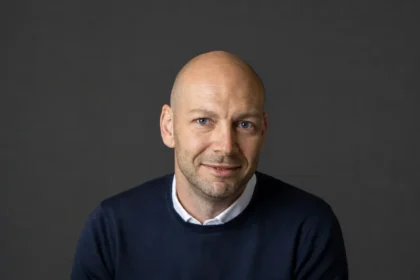

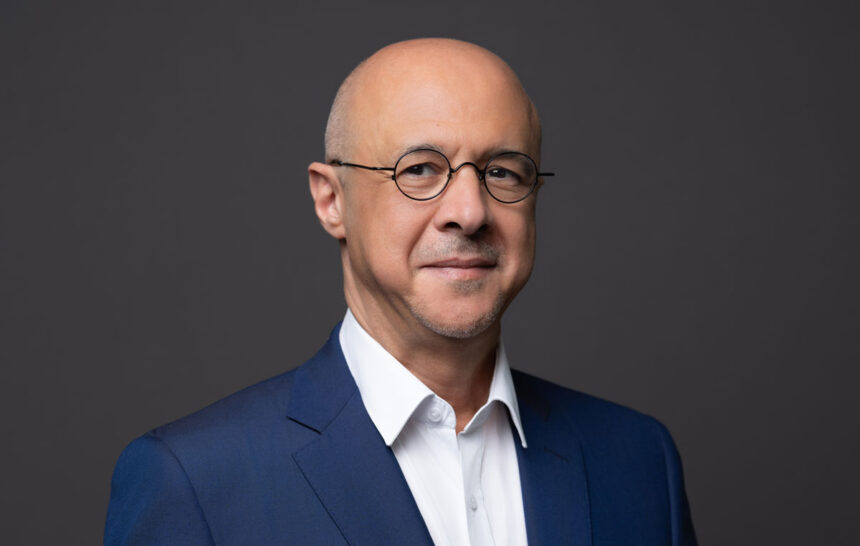
Thales has built its reputation on the engineering of mission‑critical systems over decades, from aerospace and defense to digital security and advanced sensing. For some time now, the group has started extending that legacy into quantum technologies. Sitting at the center of this effort is David Sadek, Vice President for Research, Technology & Innovation at Thales, who oversees the group’s global quantum activities spanning sensing, computing, cryptography, algorithms, and benchmarking.
- Singapore activities
- The second quantum revolution
- Why Thales does not build quantum computers
- Quantum sensing: two decades of work
- From drones to GPS‑denied navigation
- Quantum computing: global teams, real machines
- Six quantum use cases
- Radar tracking, drones, and real acceleration
- Benchmarking, standards, and sovereignty
Sadek walks Quantum Spectator through Thales’ quantum strategy in detail: grounded in physics, constrained by engineering realities, and guided by real operational use cases.

Singapore activities
Thales has been operating in Singapore for more than half a century, employing over 2,000 people locally. Singapore hosts Thales’s largest aerospace site in Asia and a growing portfolio of R&D laboratories.
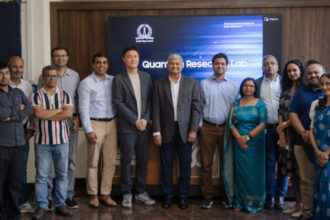
One of the most recent initiatives is cortAIx Singapore, launched roughly a year ago. Although presented as an AI accelerator, cortAIx also includes quantum computing activities. Thales also maintains partnerships with HTX, operates a joint laboratory with DSTA, and works under agreement with EDB. All of this feeds into what Sadek describes as Thales’s innovation strength in the region.
The second quantum revolution
Quantum physics, Sadek notes, has been embedded in real-world systems for decades. Lasers, atomic clocks, MRI machines, and even mobile phones all rely on quantum principles. This was the first quantum revolution.

The second quantum revolution is defined by something fundamentally different: the ability to manipulate and control individual quantum objects—single atoms, single photons—and to exploit properties such as superposition and entanglement in engineered systems.
From Thales’s perspective, this shift breaks into several technological streams:
- Quantum sensing
- Post‑quantum cryptography
- Quantum communications
- Quantum computing
Each has a different maturity curve, with quantum sensing already transitioning into industrial deployment.
Why Thales does not build quantum computers
Thales is not trying to manufacture quantum computers, and Sadek is explicit about that. Instead, the company’s ambition is to pioneer the first at‑scale quantum applications in its core sectors: defense, simulation, aeronautics, and security.
The approach began about five years earlier, when Thales systematically interviewed its business lines to identify problems that cannot be solved tractably with classical computing. These use cases were collected, prioritized, and then explored through proof‑of‑concepts with a range of quantum hardware partners.
At this stage, Sadek says, it is still impossible to declare a winning technology. That uncertainty is precisely why Thales engages with many platforms simultaneously—superconducting, photonic, annealing, and others.
Quantum sensing: two decades of work
Quantum sensing is where Thales is furthest advanced. The company has been working in this area for more than twenty years, particularly in defense, but increasingly in civil and homeland security domains.
Two core technologies underpin Thales’ sensing work:
- SQUIDs (Superconducting Quantum Interference Devices)
- NV (nitrogen‑vacancy) centers in diamond
These sensors serve two fundamental functions:
- Navigation through time and position
- Electromagnetic field sensing
Using SQUID technology combined with compact cryogenic systems, Thales has engineered devices on the order of 20 centimeters in size. Sadek contrasts this with classical antennas: at high frequencies, antennas are on the order of one meter; at low frequencies, ten meters; at very low frequencies, up to one hundred meters. Against this backdrop, a 20‑centimeter quantum sensor represents a dramatic reduction in size.
SQUIDs require cryogenic cooling, but Thales has worked extensively on high‑temperature superconducting technologies, reducing cooling requirements and enabling smaller cryo‑coolers.
NV‑center technology takes a different path. By exploiting structural defects in diamonds—specifically nitrogen vacancies—these sensors operate at room temperature, requiring no cooling at all. They are less sensitive than SQUIDs, but can be miniaturized even further.
From drones to GPS‑denied navigation
Sadek explains the use of quantum sensing in homeland security and civil applications, where he describes three major classes of use cases being prevalent.
The first is drone detection. Every drone has a motor, and every motor produces a distinct electromagnetic signature. By placing quantum magnetometers on surveillance platforms, it becomes possible to detect and identify unauthorized drones in controlled airspace—an increasingly important public‑security capability.
The second, and perhaps most strategically important, is GPS‑free and GPS‑denied navigation. GPS jamming, Sadek notes, is already a severe problem in contested environments. Jamming may be intentional or accidental, but the effect is the same: conventional navigation becomes unreliable.
Quantum inertial navigation systems offer an alternative. By precisely mapping Earth’s magnetic field, they enable navigation without external signals. Sadek illustrates the difference with a concrete comparison. With classical inertial navigation systems, an aircraft flying from Paris to New York can reach the general region, but must rely on additional instruments to land accurately due to accumulated drift. With a quantum‑based inertial system, the aircraft can navigate from takeoff track to landing track with almost no drift at all.
“There is drift,” Sadek acknowledges, “but very, very small.”
The third class of applications is anomaly detection—detecting underwater mines in coastal areas, buried objects, or subtle electromagnetic variations relevant to public security and maritime intelligence.
While not all of these systems are yet deployed, Sadek stresses that quantum sensing has reached a level of maturity where the remaining challenges are primarily engineering challenges, particularly miniaturization and industrialization.
Quantum computing: global teams, real machines
Thales’s quantum computing effort spans teams in France, Singapore, the UK, Canada, and Germany. Some years ago, the company organized a week-long corporate quantum hackathon involving teams from five countries.
Each national team partnered with its local quantum ecosystem and accessed different quantum machines—IBM, Google, Pasqal, D‑Wave, and others. Singapore and Germany emerged as winners, though Sadek notes that hardware differences possibly played a role. The goal was not standardization, but momentum: to prove that distributed teams could build real algorithms on real machines for real use cases.
The question of timelines comes up repeatedly, and Sadek frames it historically. Five years ago, first useful quantum applications were forecast 15 years out. Three years ago, that horizon moved to 10 years. Today, roadmaps increasingly converge on five years—around 2030.
“Five years,” Sadek says, “is tomorrow.”
Hardware roadmaps now predict hundreds of logical qubits by 2028–2029, with IBM projecting roughly 2,000 logical qubits by 2033. These shrinking horizons are compressing timelines for post‑quantum cryptography, especially given the reality of “harvest now, decrypt later” attacks.
Six quantum use cases
Sadek broadly organizes quantum use cases into six categories:
- Optimization problems, such as satellite constellation mission planning. Even with two or three satellites, the combinatorial space becomes NP‑hard.
- Monte Carlo problems, involving massive randomness.
- Quantum machine learning, accelerating ML workflows.
- Post‑quantum cryptography crash-testing, using quantum algorithms to attack supposedly quantum‑resistant schemes.
- Linear systems and differential equations, including matrix inversion (HHL‑type problems).
- Quantum behavior simulation, especially materials and chemistry.
He also highlights the role of quantum emulators—HPC systems that emulate quantum behavior, allowing algorithm development before large‑scale quantum hardware arrives.
Radar tracking, drones, and real acceleration
In Singapore, Thales has applied quantum approaches to radar tracking, where incoming detections must be associated with existing tracks. Classical systems rely heavily on pruning possible solutions, whereas quantum approaches explore the solution space more fully. In one project, Sadek reports a 15x speed improvement, with expectations of scaling up to 5,000x faster.
Other use cases include drone planning, urban drone tracking, SAR image anomaly detection, electromagnetic simulation, and mission logistics.
A key partner in Singapore is AngelQ, a startup focused on quantum algorithms. Sadek repeatedly returns to the idea that quantum algorithmics is a major blind spot globally: machines exist, but algorithms, software stacks, and compilers lag behind. He also highlights the possibility that a war for engineering talent is coming in the quantum industry.
Benchmarking, standards, and sovereignty
The interview concludes with benchmarking. Thales has been tasked by the French government to lead BACQ—the Benchmark of Applications on Quantum Computers. The objective is to define evaluation matrices and standards for assessing real application performance on quantum machines. Deployment in France and Europe will require compliance. To support this, Thales contributes tools such as Myriad Q, a quantum‑enabled, multi‑criteria decision system derived from existing AI tools.
“There’s a sovereignty issue,” Sadek observes. “Those who define the metrics define the rules of the game.”