


Pasqal and Aeponyx Launch a PIC Packaging Center of Competency for Sensing and Quantum Applications at C2MI
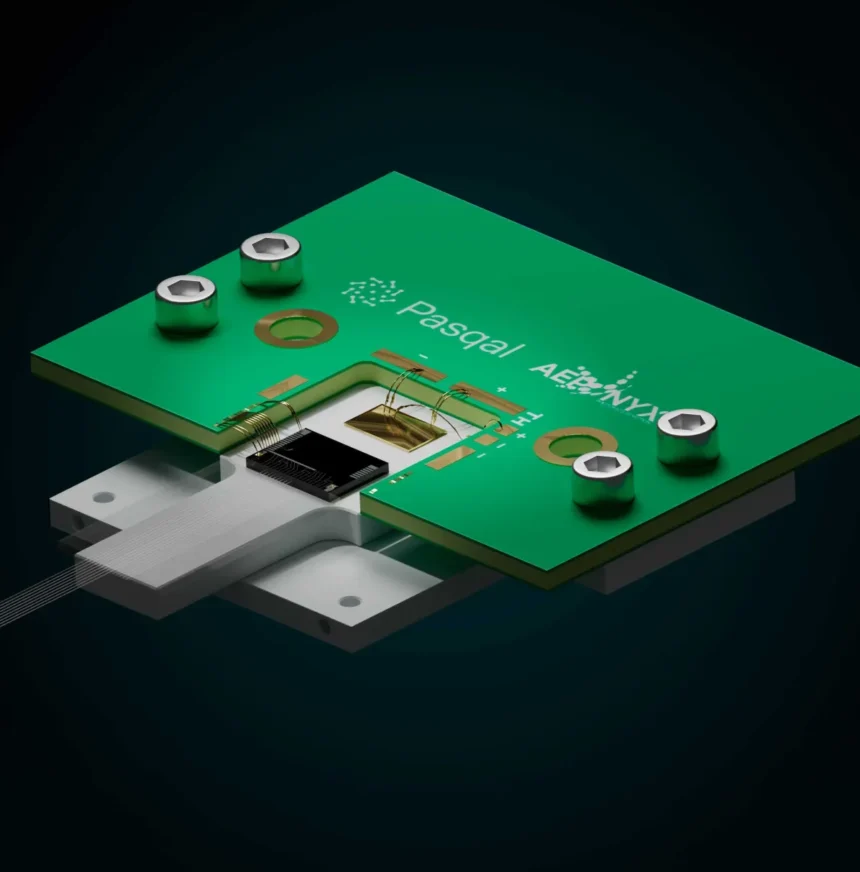
Pasqal, through its Canadian subsidiary Aeponyx, has announced the creation of a specialized center of competency focused on assembling and packaging key components used in quantum and advanced sensing technologies in Canada. The Center of Competency in Photonic Integrated Circuit (PIC) Packaging for quantum and sensing applications will be based at C2MI in Bromont, Quebec. Supported by the Canadian government, the initiative brings together Aeponyx, HOP Technologies, and Phantom Photonics to “strengthen Canada’s domestic capabilities in advanced photonics and quantum technologies” according to a Pasqal media release.
Aeponyx is a Canadian photonic integrated circuits (PICs) company specializing in silicon nitride (SiN) and hybrid photonic integration technologies. Founded in 2012 and headquartered in Montréal, Quebec, Aeponyx designs, develops, and manufactures advanced photonic chips and modules for high‑performance applications, including quantum computing, optical communications, and sensing. Aeponyx’s core experience spans PIC design, wafer‑scale fabrication, advanced packaging, and opto‑electronic integration, with a strong focus on scalable, manufacturable solutions.

Bridging Research and Industry at C2MI
Anchored at C2MI, one of Canada’s leading R&D and commercialization hubs, the initiative is intended to bridge the gap between research, prototyping, and low-volume manufacturing in a field that is critical to enabling scalable quantum systems. It will focus on advanced PIC packaging processes tailored for PIC based quantum technologies, with the objective of standardizing and making novel packaging capabilities available to the broader ecosystem – solving a bottleneck that is critical to scaling PIC based quantum technology. Central to the project is the installation at C2MI of state-of-the-art packaging equipment specifically designed for PIC based quantum computing applications, made possible through Aeponyx’s long-standing partnership with Aixemtec Gmbh, a leading German equipment manufacturer.
“Building on more than a decade of strong collaboration with C2MI on silicon nitride PICs, this initiative directly supports Pasqal’s roadmap by enabling a reliable, domestic supply chain for advanced photonic packaging in Canada,” said Philippe Babin, CEO of Aeponyx. “Creating this Center of Competency is an important step in strengthening the capabilities that will firmly position Canada as a global leader in the next generation of quantum and sensing technologies.”

“With Aeponyx, we validated our active-alignment technology on quantum photonics prototypes, and we believe the collaboration has created a strong foundation for scalable production,” said Tobias Müller, Chief Commercial Officer at Aixemtec GmbH. “We look forward to supporting Aeponyx as it advances capabilities that are important to Pasqal’s quantum hardware roadmap.”
Complementary Experience Across Canada’s Innovation Landscape
The consortium brings together complementary experience that “reflects the breadth of the opportunity”. HOP Technologies leverages photonic integration for physiological monitoring and wearable biosignals applications, targeting real-world human health impact. Phantom Photonics adds “strong expertise” in next-generation LiDAR and optical sensing designed for demanding environments including autonomous systems and defense. Pasqal believes this international consortium demonstrates that the packaging capabilities being developed at C2MI extend far beyond a single application field, they can serve a growing range of high-stakes applications across Canada’s innovation landscape.
The project is backed by $4 million in combined federal and provincial support, including $3 million from Next Generation Manufacturing Canada (NGen) through its Advanced Manufacturing Technology Program. The total project budget is $7.9 million and marks the first phase of a broader effort to develop a domestic supply chain for advanced PIC packaging.
The first phase of the project will establish low-volume manufacturing capabilities and is intended to support thousands of devices. The second phase aims to scale production to 500,000+ modules per year.
“C2MI has built a strong and recognized leadership in advanced packaging through years of close collaboration with the industry,” said Marie-Josée Turgeon, CEO of C2MI. “With this Center of Competency, we are now activating that expertise at scale, partnering with new players and unlocking new applications to fast-track the development and commercialization of next-generation photonic and quantum technologies.
A Strategic Move for Pasqal’s Quantum Roadmap
For Pasqal, the project highlights the strategic importance of PIC technology to the company’s long-term leadership in neutral-atom quantum computing. Aeponyx, acquired by Pasqal with the intention of bringing PIC experience in-house, will help enable Pasqal to strengthen the precision, robustness, and scalability of the photonic layer underpinning its quantum hardware roadmap.
“This PIC Packaging Center of Competency at C2MI, launched in collaboration with Aeponyx and our partners, helps turn advanced integrated photonics into repeatable, industrial-grade capabilities in Canada — a key step toward more robust, scalable controls for our neutral-atom quantum processors,” said Loïc Henriet, CTO of Pasqal.
Crédit Agricole CIB, Pasqal Advance Strategic Partnership on Quantum Computing for Finance
In a separate announcement, Crédit Agricole CIB, the financing and investment banking arm of Crédit Agricole Group, and Pasqal announced the signing of a strategic partnership to accelerate the transition from quantum research to operational deployment in capital markets activities.
Building on a collaboration initiated in 2019, the partnership enters a new phase focused on the industrialization of quantum computing applications, with initial production use cases targeted as early as 2028.
Since 2021, Crédit Agricole CIB and Pasqal have conducted several major projects focusing on counterparty credit default risk measurement and portfolio optimization to preserve the Bank’s scarce resources. The results indicate that quantum algorithms can, under specific conditions and use cases, improve performance compared to classical approaches for capital markets and risk management applications, supporting the business case for production deployment. The partners believe there may be an opportunity to unlock additional value as quantum hardware and algorithms continue to mature.
A Clear Roadmap to Production (2026–2028)
The next phase of the partnership will focus on monitoring capital reserve consumption linked with risk-weighted assets.
This roadmap is structured around three activities:
- Enhanced classical production: Deployment of quantum-inspired algorithms on existing IT infrastructure, aiming to deliver immediate performance improvements without reliance on quantum hardware
- Quantum experimentation: Operational testing on Pasqal’s neutral atom quantum computers to validate real-world performance under production conditions
- Hybrid large-scale deployment: Integration of classical and quantum computing resources with the goal of solving complex problems beyond the reach of today’s systems
Structuring the Quantum Ecosystem: Three Action Levers
To achieve this industrialization, Crédit Agricole CIB is structuring its quantum ecosystem around three pillars: business teams trained in quantum technologies (software and hardware), strategic coordinators ensuring monitoring, and project managers ensuring production deployment. This is supported by access to Pasqal’s platforms (simulators and physical machines).
“Quantum computing has the potential to establish itself as one of the most structurally transformative technological breakthroughs of the next decade. This partnership marks our transition from an exploratory posture to an industrialization logic. By 2028, we aim to integrate quantum computing into some of our daily operational processes, offering our clients an unprecedented level of performance and precision in portfolio optimization. This ambition fully aligns with our technological innovation strategy and our determination to maintain our leadership in capital markets,” explains Pierre-Olivier Pagnon, Chief Information Officer of Crédit Agricole CIB.
“Quantum computing has reached a pivotal moment where its potential is translating into real operational value,” said Wasiq Bokhari, CEO of Pasqal. “Through our long-standing partnership with Crédit Agricole CIB, we are accelerating this shift—combining advanced neutral atom quantum technology with real-world financial use cases to build a clear path toward production-scale deployment. Together, we are laying the foundation for quantum solutions that we believe will redefine optimization and decision-making in capital markets.”