

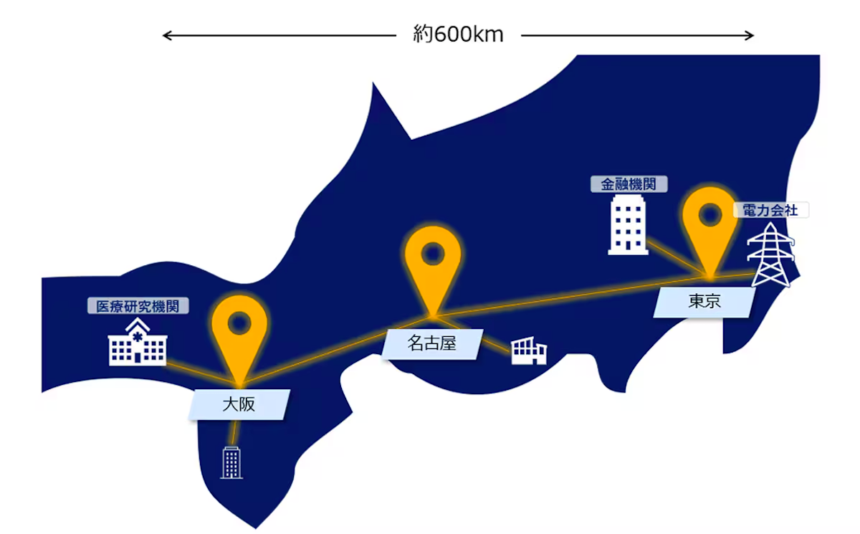
NTT DOCOMO Business (formerly NTT Communications), Toshiba and NEC have begun construction of a wide-area quantum cryptography communication network connecting the three major metropolitan areas of Tokyo, Nagoya, and Osaka, approximately 600 km in length.
This is part of the efforts toward the social implementation of quantum key distribution promoted by the Ministry of Internal Affairs and Communications and the National Institute of Information and Communications Technology.

After its construction, they will conduct a demonstration experiment of quantum key distribution using this network.
This demonstration aims to create promising use cases by verifying secure communication using quantum technology, with a view to social implementation in industries such as healthcare, finance, and power generation, which handle highly confidential data such as national security information and personal information.
In recent years, with the advancement of AI and the shift towards a data-driven society, there has been a growing need to link and utilize diverse data, including critical data, across organizations and regions.

However, the development of quantum computing technology has raised concerns about a decline in the encryption strength of existing encryption technologies, which are currently widely used and whose security depends on the computer’s performance.
The companies noted that, consequently, the importance of new communication technologies for securely protecting highly confidential information over the long term, as well as secure operation and key management, is increasing.
In particular, addressing the “Harvest Now, Decrypt Later (HNDL)” risk, which involves eavesdropping on and storing currently used communications and decrypting them with quantum computers in the future, is a critical issue from the perspectives of national security, economic security, and industrial competitiveness.
Against this backdrop, quantum key distribution (QKD) and quantum cryptography — a secure communication technology using encryption keys obtained from QKD — are attracting attention as technologies that can realize extremely secure communication.
To date, NICT has been conducting technology demonstrations utilizing the “Tokyo QKD Network”. In this demonstration, the partner companies intend to significantly expand these efforts to the Tokyo, Nagoya, and Osaka areas, and establish the largest wide-area quantum cryptography communication network in Japan.
The demonstration will use two main technologies. One is quantum key distribution (QKD), which uses the principles of quantum mechanics to securely share encryption keys between communication partners.
Unlike conventional encryption that relies on computing power, it theoretically allows for the detection of eavesdropping and prevents key duplication. Further, by combining quantum key distribution with a “one-time pad” that securely encrypts data, information-theoretically secure quantum cryptographic communication can be realized.
Another technology is quantum secure cloud, which builds a distributed storage system using secret sharing protocols on a quantum key distribution network, enabling the secure transmission, storage, and utilization (confidential computation) of highly confidential data.
Secret sharing divides data into multiple parts and stores them in a distributed manner, providing “information-theoretic security” where even if data below a threshold is leaked, the information of the original data cannot be obtained.
According to the partner companies, they intend to verify the performance, stability, and security of quantum cryptography communication in long-distance environments, as well as the ease of operation of the network with a view to actual operation.
Also, by involving users from various industries, they intend to verify the feasibility of secure wide-area distribution of highly confidential data and cross-organizational data collaboration.
In addition to technical verification, they intend to promote the consideration of business models and the development of new application areas and users, with a view to the social implementation of quantum cryptography communication.
Through interviews with participating users, they will organize the challenges and expectations from the user’s perspective and proceed with considerations toward the practical application of a wide-area quantum cryptography communication network.
NTT DOCOMO Business is tasked with overall project management, technical verification and user demonstration, social implementation studies, provision of network, data center, and application services.
Toshiba will take care of the provision of quantum key distribution equipment, construction of quantum key distribution networks, technology verification and user demonstration.
NEC will focus on the provision of QKD equipment, construction of QKD networks, technology verification and user demonstration.
The three companies will also be collaborating with Exeo Group, Exeo Digital Solutions, NTT ME, Deloitte Tohmatsu, and Sakura Internet.
Going forward, the three companies will work with participating users and others to consider and verify the implementation of the QKD network in society by 2030, as set out by the Ministry of Internal Affairs and Communications.