


Understanding and wielding the quantum properties of nature is the ambitious objective of eight research institutes that will collectively receive more than $290 million from the U.S. National Science Foundation (NSF), according to a media release from the NSF. The investment is an expansion of the NSF Quantum Leap Challenge Institutes program, which NSF created in 2020 as part of the agency’s strategy to fulfill the 2018 “National Quantum Initiative Act.”
Of the eight institutes, three are newly formed. The other five were established with previous NSF funding and will receive renewed funding from NSF to continue their work. Each institute will receive between about $28 and $37 million over five years and is helmed by researchers in quantum information science.

Since 2020, the institutes have made major scientific strides in a range of areas, from finding new ways to make quantum computers to developing quantum sensors that could one day enable earlier detection of diseases. The institutes also serve as a productive nexus between scientists, federal science agencies, quantum technology companies and educational organizations.
“For more than four decades, NSF has been laying the foundational groundwork of research and discovery that is powering today’s modern quantum computing, sensing and communication,” said Brian Stone, Performing the Duties of the NSF Director. “It’s time for focused activities to leverage that base of knowledge to drive us even farther forward to the benefit of all Americans. The NSF Quantum Leap Challenge Institutes are a next step for us in understanding the quantum world we live in.”
Quantum-based technologies, which use natural phenomena like entanglement and superposition, have the theoretical capacity to far outstrip so-called classical technologies commonly used today. For example, just as an electronic calculator can outperform an abacus, a functional quantum computer could theoretically outperform every supercomputer for certain types of tasks. Similarly, new types of quantum sensors could precisely measure properties far too subtle or even impossible for current technologies to detect. The NSF Quantum Leap Challenge Institutes are focused on solving the many underlying scientific and technological challenges required for quantum devices to achieve such levels of performance.

Each institute is a broadly collaborative effort spanning academia, government and private industry. Through the eight institutes, funding from NSF will support researchers in 19 states at 36 institutions of higher education. The institutes’ federal collaborators include multiple U.S. Department of Energy national laboratories, the U.S. Department of War and the National Institute of Standards and Technology. More than 30 U.S. companies are partnering with the institutes to help inform and accelerate the transfer of fundamental scientific results into products and techniques that can be used and scaled up for industrial production.
NSF is also funding the institutes’ education and training programs to help grow the future U.S. scientific workforce. The institutes will collectively train hundreds of graduate students, undergraduate students and early career researchers over the next five years. The institutes carry out that training through partnerships and activities with community colleges, dozens of universities and high schools, and community science organizations. Their educational activities span internships and summer schools, K-12 teacher programs and unique mentorship opportunities with leading experts in quantum information research.
The NSF Quantum Leap Challenge Institutes are:
NSF FTQSAA will investigate new methods to make quantum technologies more robust and resistant to the inherent fragility of quantum information. Their work will span experimentation with new software and hardware, including new materials that can be used to make quantum sensors and computers more reliable.
NSF Quantum Leap Challenge Institute for Hybrid Quantum Architectures and Networks (NSF HQAN)
NSF HQAN will tackle the science and engineering needed to create modular quantum computers that are interconnected and work together. Unlike a single quantum computer that uses a particular qubit technology, their modular approach will join different types of qubit technologies, each optimized for particular tasks to achieve enhanced performance. NSF first invested in NSF HQAN in 2020.
NSF HQAN studies modular approaches to quantum computing, in which smaller quantum processing units (QPUs) are networked to achieve greater combined computing power. This approach avoids the technical difficulties of directly scaling QPUs, and most experts agree that this is the approach most likely to yield quantum computers with the largest advantage. In its first phase, center researchers have made many technical achievements that have laid the foundation for modular approaches. The second phase will build on these achievements to deliver an industry-ready pathway for implementing modular principles.
“The first phase of HQAN has made substantial progress in terms of both research advances and building the quantum workforce of the future,” said Brian DeMarco, Illinois physics professor and NSF HQAN director and principal investigator. “We have set the stage for modular quantum computing, which was largely unexplored when we started but now appears on the quantum roadmaps of major companies. I am also proud that we are a regional center anchored in the Midwest, where we have been a key parter of the Chicago Quantum Exchange and driven new initiates such as the Illinois Quantum Microelectronics Park.”
The center brings together 45 senior researchers from six institutions to develop modular quantum computing architectures. Its participants are also working to build a quantum workforce through educational programs that have brought quantum science to over 12,000 participants. By training researchers of all levels, NSF HQAN has placed 27 alums into high-profile industry positions, 17 into faculty positions and nine to national laboratories.
“Illinois has made a bold commitment to becoming a global leader in quantum technology, and Grainger Engineering is proud to help turn that vision into reality,” said Rashid Bashir, dean of Illinois’ Grainger College of Engineering where NSF HQAN is hosted. “Together with our partners and NSF, we will advance the fundamental architectures needed to make quantum computing scalable and useful, while strengthening the talent, partnerships and innovation ecosystem that will drive the industry forward. Our leadership in this center reflects the U of I’s unique ability to help shape the quantum economy of the future.”
A core regional cohort is formed by Illinois, The University of Chicago, the University of Wisconsin–Madison and Northwestern University with Stanford University and the MIT Lincoln Laboratory providing critical capabilities. The second phase center will have 16 industry partners that include Google, IBM, IonQ and Quantinuum.
“Quantum technology is a strategic priority for the state of Illinois, and HQAN’s efforts are vital to addressing the needs of the state, the Midwest region, and more broadly the nation,” said Preeti Chalsani, the chief quantum officer for the state of Illinois. “HQAN is a major driver of quantum research and quantum workforce pipeline in the area. It is bringing together the region’s major universities to address questions that will advance quantum technologies in meaningful ways and train the highly specialized workforce that is needed to bring this technology to life.”
NSF HQAN was established in 2020 as part of NSF’s mission to address the United States’ strategic need for foundational science that can unlock viable quantum technology. At the time, academia and industry were attempting to scale single-platform technologies. However, NSF HQAN was formed to explore the possibility of modular approaches to mitigate the difficulties encountered with monolithic scaling. The center draws inspiration from standard computing devices, which rely on the integration of several distinct technologies, to study hardware, algorithms and software optimized for modular systems.
Today, most researchers agree that quantum computing will need to scale through modular approaches. NSF HQAN has been laying the foundations for this approach by developing interconnects and transducers to transmit quantum information across platforms, constructing testbeds for modular quantum devices, and researching software and algorithms that take advantage of modular approaches.
The achievements of the first phase include: entangled states in a four-node superconducting circuit (SC) quantum network; quantum-limited millimeter-wave–optical transduction using cold atoms coupled to a superconducting resonator; the first reconfigurable SC quantum computing modules; the first autonomous stabilization of remote entanglement in a network; the first algorithms implemented on a small neutral atom array; the first atom-array modules with over 1,000 sites; the first two-species neutral atom array module with interspecies gates; and quantum secret sharing in a triangular SC modular processor. To date, NSF HQAN researchers have published over 210 peer-reviewed articles.
The second phase will build on the achievements of the first to close the remaining gaps so modular quantum computing can be fully implemented. This involves demonstrating basic operations, or application primitives, on modular platforms, laying the foundations for software implementations such as algorithms, error correction and compilers. These efforts will be complemented by advances in the interconnects used to link QPU modules. In addition, researchers will explore new approaches to quantum computing, focusing on chip-scale integration of quantum architectures, more energy efficient quantum photonics and compact internode entanglement.
In addition to foundational research, NSF HQAN has created two programs to support K-12 education which have reached over 12,000 students across the country: TeachQuantum, which gives teachers a six-week research experience and one year of curriculum development support, and Wonders of Quantum Physics, which brings quantum sciences topics to classrooms with demonstrations, hands-on activities and inquiry-based learning. NSF HQAN also works to develop a quantum workforce by training researchers at the graduate and postdoctoral levels.
By the end of the program, NSF HQAN aims to deliver a comprehensive pathway to modular quantum computing with integrated hardware and software. The result will be ready to translate to an industry-ready solution that realizes quantum advantage.
NSF MARQUIS will use materials science, semiconductor fabrication techniques and other disciplines to develop Josephson junctions with improved abilities. Such junctions are key electronic components in quantum computers and other technologies that use superconducting qubits.
The Princeton-led Quantum Leap Challenge Institute will devise techniques for fabricating hardware and develop education and workforce training programs that deepen U.S. leadership in quantum science and engineering. The research institute will gather experts from wide-ranging fields to break a single, critical bottleneck — the manufacture of core components for quantum processors. The new institute will be titled MARQUIS: Manufacturable and Resilient superconducting Quantum Information Systems.
“The whole community has been using essentially the same materials technology for about a quarter century,” said Nathalie de Leon, a professor of electrical and computer engineering at Princeton and co-director of the Princeton Quantum Initiative, who will direct the new institute. That technology has worked well for experimental prototypes and small-scale systems. But to build quantum computers at a scientifically useful scale, she said, the most basic elements must be reinvented.
The Princeton-led institute will receive $27.9 million in NSF funding over five years, according to the agency. The research team harnesses expertise from three broad disciplines — materials science, quantum devices and semiconductor processing — spanning two dozen laboratories across nine research institutions.
“There’s a huge barrier to solving the problem,” said Valla Fatemi, a physicist at Cornell University and the institute’s deputy director. “That’s why we need an institute like this, with all this multi-interdisciplinary expertise to solve it.”
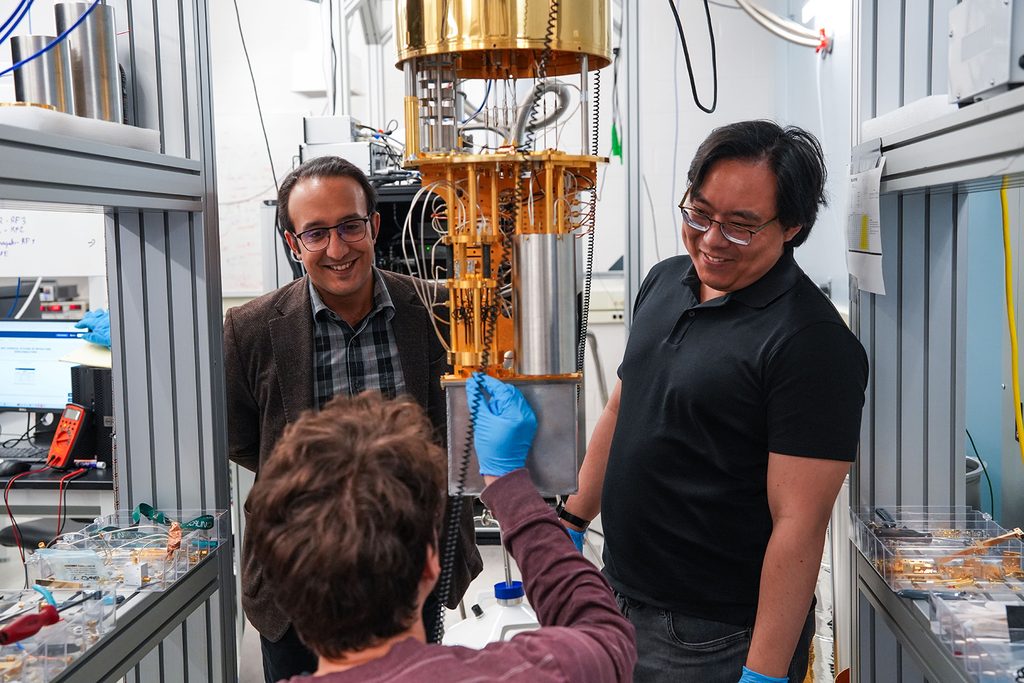
Participating institutions include Princeton, Cornell, the Massachusetts Institute of Technology, University of California at Santa Barbara, Stanford University, Dartmouth College, NY Creates, Michigan State University and the University of Iowa. The organizations represented on the advisory board include Google Quantum AI, NVIDIA, Applied Materials, Oxford Instruments, Bluefors, KU Leuven/Imec and MIT Lincoln Laboratory.
“For more than four decades, NSF has been laying the foundational groundwork of research and discovery that is powering today’s modern quantum computing, sensing and communication,” said Brian Stone, performing the duties of the NSF director. “It’s time for focused activities to leverage that base of knowledge to drive us even farther forward to the benefit of all Americans. The NSF Quantum Leap Challenge Institutes are a next step for us in understanding the quantum world we live in.”
In addition to reinventing the materials systems, the MARQUIS team will also develop methods to validate and compare the performance of various designs and to test them in mid-scale quantum processors — a step between the small systems typically developed in academic labs and the large processors that will one day run useful quantum algorithms.
These test beds will help standardize research efforts across disparate labs and allow experts from other fields to contribute meaningfully to the core challenge, according to the institute leaders. For example, semiconductor fabrication techniques that could prove valuable for quantum computing often involve highly specialized expertise that quantum researchers don’t have.
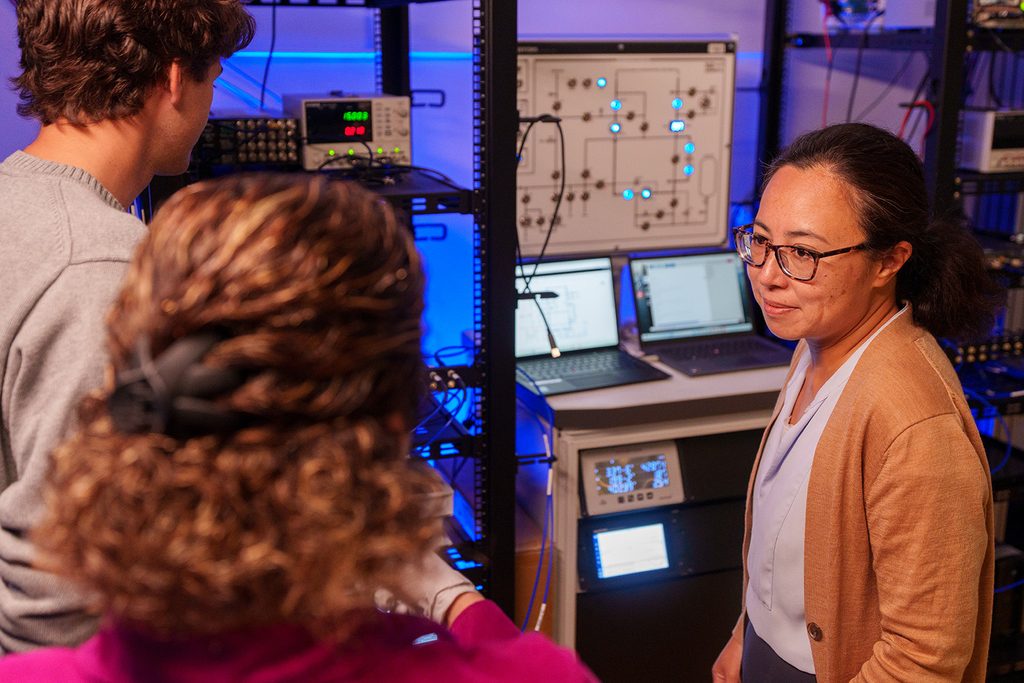
“In the semiconductor industry especially,” de Leon said, “a lot of the best knowledge is behind a curtain. And the literature is so vast, it’s hard for us to make sense of. So having a few key experts in the field who know what the right waypoints are and how to think about it is really crucial.”
David Graves, a Princeton professor of chemical and biological engineering and expert in the use of plasmas for semiconductor processing, serves as a co-principal investigator of the new institute.
De Leon’s own research has helped revolutionize component technologies for superconducting quantum devices through a collaboration with Andrew Houck, Princeton’s dean of engineering, and Robert Cava, a renowned solid-state chemist, as well as junior researchers from all three labs. The new institute’s work will focus entirely on finding new approaches to fabricating the Josephson junction.
Nobel laureate Michel Devoret, who first demonstrated how these devices work, has called the decades-long effort to make better superconducting qubits a “graveyard” of ideas for aspiring physicists and engineers. He has also praised de Leon for taking on such a risky endeavor and making real progress. Devoret, a professor at UC Santa Barbara and chief scientist at Google Quantum AI, is one of the new institute’s senior investigators.
NSF PRACTIQAL will create new and more effective methods to correct errors commonly encountered in quantum computing systems, thus increasing the usefulness and scalability of quantum computers broadly. Their research will span experimentation with hardware, algorithms and other software, and theoretical methods that can enable better error correction techniques for large-scale quantum computers that have yet to be made.
“Today, error correction is the main scientific and engineering challenge for making quantum computing useful,” said Professor Robert Schoelkopf, director of the center at Yale, who leads a multidisciplinary team of researchers. “With this project, we want to understand the science and engineering that makes the computers better and easier to build. We’ll come up with new ideas at all levels of the stack to make error correction and fault-tolerant machines much more achievable, efficient, and practical.”
To that end, the research team will launch a new effort titled the NSF Quantum Leap Challenge Institute for Physics and Engineering of Practical Quantum Error Correction (NSF PRACTIQAL), a center that brings together computer scientists, chemists, physicists, and engineers from numerous universities. NSF PRACTIQAL is focused on making advances at every level of the quantum computer, from the physical qubits and control electronics to the way algorithms are run. The center is designed to foster a community of scientists and engineers from a wide range of disciplines who can contribute to a comprehensive understanding of the hardware and software needed to realize large-scale, error-corrected quantum computing.
“Part of the reason we have not just physicists, but engineers and computer scientists, is so we can understand the physics of the devices and the kind of errors that occur, and then optimize the codes and the algorithms to work with that,” said Schoelkopf, the Sterling Professor of Applied Physics.
NSF PRACTIQAL will primarily focus on two challenges in quantum computing. One is identifying key issues that have hindered the scaling of error-corrected machines and finding ways to make quantum error correction more practical and efficient. Second, the researchers will explore the uses of specially designed qubits known as “erasure qubits.” Pioneered by members of the PRACTIQAL team, these qubits act as flags that signal exactly where and when an error has occurred.
Researchers in the field typically work on one specific component of quantum computing. While this component could work perfectly on its own, though, it might not work well as part of a larger system made from components developed in other labs. By applying their individual specialties in a coordinated fashion, the PRACTIQAL team aims to develop a quantum computing system in which the whole machine is optimized. For instance, the hardware and software will be designed to run the same types of code so that the machines run more efficiently and be less prone to errors.
Michael Hatridge, co-director of PRACTIQAL, noted that much of the work in this area has been done on very small machines optimized for error correction. The PRACTIQAL group aims to shorten the route to large-scale, error corrected quantum computers.
“Because we’re academics, we’re not going to build a giant system, but we’ll prove our ideas and build a pathway towards how you could build a much bigger system,” said Hatridge, associate professor of applied physics. “That’s why we have industrial partners. We also have an external advisory board helping us not just do isolated experiments, but to stay relevant to the broader community.”
By the end of the ambitious five-year project, the researchers expect to have developed a path toward building practical error-correcting computers on an industrial scale.
“We’re looking forward to it,” Hatridge said. “PRACTIQAL is big, it’s complicated, and it has a lot of moving parts, but we’re very excited to do it.”
In addition to Schoelkopf and Hatridge, Yale faculty involved in NSF PRACTIQAL include Yongshan Ding and Lin Zhong of the Department of Computer Science and Aleksander Kubica and Shruti Puri of the Department of Applied Physics, all at Yale Engineering, as well as Steven Girvin and Konrad Lehnert of the Department of Physics and Victor Batista of the Department of Chemistry.
NSF Quantum Leap Challenge Institute for Quantum Computation (NSF CIQC)
NSF CIQC will discover and demonstrate new quantum algorithms and hardware architectures and use them to in turn discover new materials and methods that can enhance quantum computation. Their work spans a broad range of quantum computing techniques including neutral atoms, trapped ions and solid-state systems. NSF first invested in NSF CIQC in 2020.
The far-reaching grant will supply UC Berkeley and its partner institutions’ advanced quantum research hub with $37.5 million in funding over the next five years to address three priority research challenges: discovering and realizing the power of quantum computation, understanding nature through the lens of quantum information science, and developing quantum technologies and their applications.
“The NSF’s support allows us to continue serving the nation as a leading institute for quantum computing, generating fundamental advances in science and engineering and developing the talented workforce that will translate these advances into the quantum technologies of the future,” said NSF CIQC Director Dan Stamper-Kurn, a physics professor at UC Berkeley.
“We find ourselves at the sprint stage in the development of the quantum computer,” continued Stamper-Kurn. “Our focus on addressing long-term roadblocks to this development by combining theoretical, experimental, and engineering research will continue to fuel this sprint.”
The NSF CIQC was founded in 2020, as one of the five original NSF Quantum Leap Challenge Institutes motivated by the National Quantum Initiative Act’s call to strengthen America’s scientific leadership in foundational quantum information research.
True to the nature of quantum information science, the institute is multidisciplinary, combining expertise in chemistry, computer science, engineering, mathematics, and physics. Researchers explore how to harness quantum systems to create next-generation technologies for sensors, computing, and communications.
Through collaborative efforts over the past six years, the institute’s researchers have stress-tested claims of quantum computers that outperform classical ones, stimulating aggressive development by the quantum industry. By asking how quantum information evolves within physical systems, they discovered new kinds of phase transitions and established rigorous insights on the structure of quantum matter. They also advanced frontier research on neutral-atom platforms for quantum computing, setting the stage for the current explosion of activity and investment in such systems.
“The renewal and expansion of the NSF CIQC is a momentous event for the field of quantum science and for the quantum ecosystem in the state of California,” said Shimon Kolkowitz, the Herst Chair in Physics at UC Berkeley. “UC Berkeley’s position as a world leader in quantum research over the past century, as exemplified today by the NSF CIQC, was a large part of what drew me to relocate my research group here three years ago, and I am thrilled to now be joining NSF CIQC 2.0 as both a funded researcher and a member of the leadership team. This center enables and enhances large-scale academic collaboration on basic quantum research at a pivotal moment for the field.”
By linking leading quantum research teams and educational initiatives across the state of California, the NSF CIQC serves as the backbone of an integrated, statewide ecosystem. UC Berkeley, UCLA, UC Santa Barbara, Stanford University, and the California Institute of Technology are core research partners.
The renewal of the NSF CIQC will feature several new initiatives. California State University San Marcos and Cal State East Bay will anchor plans to establish system-wide degree programs in quantum information science, and the Computer History Museum and Berkeley Oral History Center will document the history of quantum computing in real time as it unfolds.
NSF’s re-investment will act as a force multiplier for other federal, state, and university commitments to quantum research:
- Last year, concurrent with the inaugural convening of the Quantum California Initiative, UC Berkeley opened the Roger Herst Quantum Nexus to nucleate a coordinated quantum ecosystem in the Bay Area.
- Lawrence Berkeley National Laboratory leads the Quantum Systems Accelerator, a National Quantum Information Science Research Center backed by the U.S. Department of Energy with strong university participation.
- California passed legislation in 2025 to stimulate the state’s quantum economy, with Governor Gavin Newsom signing the bill at a UC Berkeley event.
These moves recognize the growing energy around quantum and build on the long history of exceptional quantum research in California. Notably, the 2025 Nobel Prize in Physics was awarded to UC Berkeley Professor Emeritus John Clarke, together with his former postdoctoral fellow Michel Devoret and graduate student John Martinis (both now on the UC Santa Barbara faculty), for quantum tunneling experiments that lay the groundwork for today’s superconducting quantum computers. A modern-day version of that technology in the form of a UC Berkeley-produced superconducting quantum processing unit was even included in California’s contributions to a time capsule buried in honor of the nation’s 250th birthday.
“NSF’s commitment to quantum information science is a testament to the field’s world-changing possibilities and the inherent value of basic research,” said Claire Cramer, the executive director of Berkeley Quantum and executive director of the NSF CIQC. “The future of the quantum industry is being decided right now, and we are prepared to lead. We are excited to be able to continue the frontier research that will keep US industry in the global lead while welcoming an expanded cohort of scientists and engineers to our institute.”
NSF QuBBE will use quantum properties of nature, such as entanglement, to create sensors that can probe and measure biological processes with unprecedented sensitivity and accuracy. Their research includes the development of quantum nanoprobes, techniques to measure properties inside living cells and how such technologies can improve capabilities in biology and medicine. NSF first invested in NSF QuBBE in 2021.
NSF Q-SEnSE will focus on fundamental science and technology development to achieve new precision sensing and measurement capabilities through experimental and theoretical research. Their work includes quantum simulations, solid-state systems, molecular sensors, new types of exceptionally precise atomic clocks and other innovations. NSF first invested in NSF Q-SEnSE in 2020.
NSF Q-SEnSE is led by JILA and University of Colorado Boulder in collaboration with universities and national laboratories across the United States, and seeks to advance the emerging field of quantum sensing and realize impactful quantum speedup for science and technology.
Building on accomplishments from its first phase, the Institute will develop new quantum technologies capable of measuring physical phenomena with unprecedented precision, enabling advances in both fundamental science and practical applications. These efforts will improve capabilities in areas such as position, navigation, and timing, medical diagnostics, environmental monitoring, while strengthening U.S. leadership in quantum science and engineering. NSF Q-SEnSE will also educate and train the next generation of quantum scientists and engineers through collaborative research, partnerships with industry, and expanded access to quantum education and workforce development opportunities.
NSF Quantum Leap Challenge Institute for Robust Quantum Simulation (NSF RQS)
NSF RQS will target the development and applications of quantum simulations that are valuable for scientific investigation of complex phenomena, industrial production of large-scale quantum technologies or both. Their work spans new algorithms, systems architecture, materials science and other areas. NSF first invested in NSF RQS in 2021.
The renewal for NSF RQS, which takes effect Sept. 1, reflects UMD’s long-term commitment to advancing quantum computing to take on society’s grand challenges and to spark a new era of scientific, technological and economic development, UMD President Darryll J. Pines said.
“Our researchers in quantum simulation are an important part of the vibrant quantum ecosystem we’ve built,” Pines said, “helping establish our campus and the surrounding region as the Capital of Quantum and making our Discovery District a dynamic hub where research, industry and community combine for real-world impact on the public good.”
Established in 2021 with a $25 million federal award, NSF RQS has developed novel ways to verify quantum systems, reduce errors and demonstrate increasingly sophisticated quantum simulations while building a collaborative community of scientists, engineers, educators and students.
Quantum simulation is widely viewed as one of the first practical applications of quantum computing. Rather than trying to make every type of computation faster, quantum simulators are designed to model extraordinarily complex quantum systems that overwhelm even today’s most powerful conventional computers.
The new award expands the institute’s scientific agenda; sustains education and workforce development programs; strengthens partnerships across academia, federal laboratories and industry; and positions NSF RQS to pursue the next generation of challenges in quantum simulation. Harvard University also will join the NSF RQS consortium, expanding the current collaboration between UMD, Duke University, Princeton University, Yale University and researchers from the National Institute of Standards and Technology (NIST).
During its first funding cycle, NSF RQS researchers achieved breakthroughs in fault-tolerant quantum simulation with neutral atoms, new methods for verifying quantum advantage on analog quantum simulators, erasure detection in Rydberg atoms and quantum simulations of gauge theories and quantum materials. Together, these advances brought robust quantum simulation closer to becoming a practical tool for scientific discovery.
That progress was matched by the institute’s growth as a national research enterprise. NSF RQS researchers collectively produced more than 600 papers, generating nearly 17,000 citations. Along the way, NSF RQS trained more than 400 graduate students and postdoctoral researchers while developing programs designed to strengthen the nation’s future quantum workforce.
“NSF’s investment in the QLCIs established hubs for research on critical topics in quantum information science at a time when the field is rapidly advancing,” said Andrew Childs, a UMD professor of computer science who directed NSF RQS during its first five years. “I’m grateful for all the collaborations it enabled and proud of the progress RQS researchers made in just five short years.”
The new award funds a shift toward what institute leaders call “quantum simulation engineering”—developing quantum technologies that are increasingly scalable and capable of addressing important scientific problems. Researchers will focus on three research themes: interacting fermion simulation, which seeks to model the particles that make up matter; fermion-boson simulation, which examines how matter particles interact with force-carrying particles in complex quantum systems; and dissipative quantum simulation, which studies quantum systems interacting with their environments instead of treating environmental effects solely as unwanted noise.
NSF RQS benefits from technical and administrative support provided by UMIACS, which helps coordinate research activities across the institute’s university and federal partners, Hafezi said.
The institute also will expand its educational mission alongside its research portfolio.
During its first funding cycle, NSF RQS helped launch the University of Maryland’s quantum science and engineering minor, supported K-12 teacher professional development workshops that reached 75 educators, and developed innovative quantum activity toolkits used by 100 teachers to introduce more than 2,000 middle and high school students to concepts like superposition and measurement.
The institute also established an international QSim conference series that attracted more than 600 attendees and launched the Quantum Leap Career Nexus, which connects students with more than 50 companies, government laboratories and universities through career fairs and networking opportunities.
The renewed award will build on those efforts through additional teacher development workshops, public outreach, K-12 quantum education programs, research seminars and summer schools while creating new opportunities for students and postdoctoral researchers to prepare for careers throughout the quantum workforce.
Gretchen Campbell, associate vice president for quantum research and education at UMD, will lead the institute’s education and workforce development efforts moving forward.
“Preparing the future quantum workforce means creating opportunities at every stage—from K-12 classrooms to graduate education and professional careers,” Campbell said. “By connecting students, educators and researchers across that entire pipeline, we can help ensure the talent needed to advance quantum science and technology is ready when the next breakthroughs arrive.”