



Universal Quantum is developing trapped-ion quantum computers based on a modular architecture designed to be scalable all the way to fault tolerance. Founded in 2018 as a spin-out from the University of Sussex, the UK-based company has been busy this year.
In September, Universal Quantum announced it would open a centre in Singapore with an initial team of 25, backed by an investment of over SGD 30 million (USD 23.3 million), which will serve as its Asia-Pacific (APAC) hub. In October, it announced it had secured over USD 100 million in Series A funding – marking the largest Series A ever raised by a UK-headquartered quantum company. A month later, in November, the company launched iQPU, its quantum chip manufactured on a commercial 200mm semiconductor line.

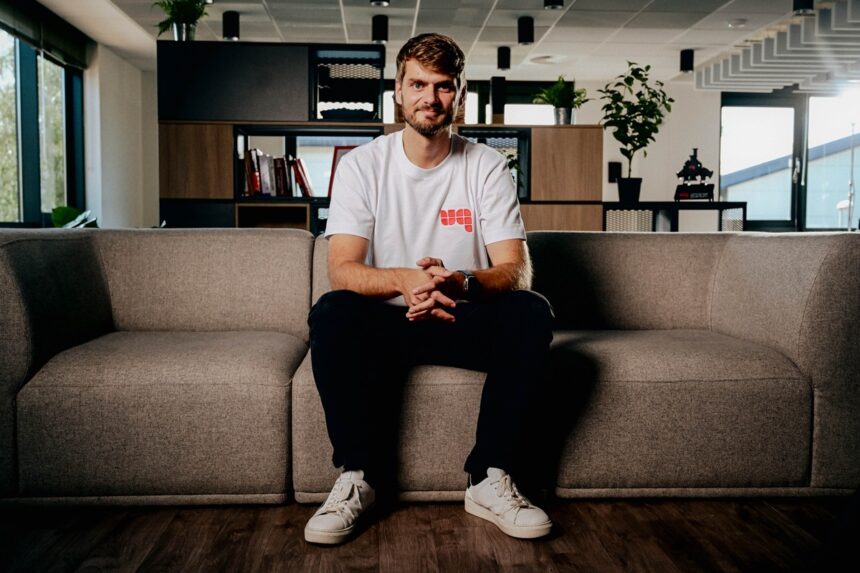
On the sidelines of the Singapore Week of Innovation and Technology (SWITCH), we interviewed CEO Sebastian Weidt on what it takes to raise $100 million, Universal Quantum’s iQPU chip and its UQConnect interconnects, scalability within the industry, and its Singapore office.
Funding, investment and commercial strategy
Following the funding round, Universal Quantum is preparing to expand both its technology development and commercial operations during what Weidt describes as a pivotal stage in the company’s growth.
“The main bit for this round is really for us to be able to scale. As a business, we’re growing quite significantly, and we can now build up our commercial team in a larger way. But also, to really scale our tech. We’re at this really nice inflection point now where we’re able to deploy our tech to our customers, Germany obviously being one of our key customers that awarded us two contracts a little while ago — I think at the time they were the world’s largest government contracts in quantum — to build two prototypes for them. We’re in the final stages of delivery on that side,” he said.

The German contracts in question were awarded to Universal Quantum by the German Aerospace Center (DLR) through its Quantum Computing Initiative (DLR-QCI) in 2024. Worth approximately EUR 67 million (approximately USD 73 million), the contracts cover the development of two trapped-ion quantum computers intended to demonstrate different aspects of the company’s architecture.
According to Weidt, the contracts have played an important role in the company’s financial development.
We started with a seed round, very traditionally, by getting a few million from some great seed investors. But then we went more the bootstrap way, which I think is very uncommon in quantum.
“Because of the large revenues that we were able to attract through the contracting work, we were able to fund our R&D purely through revenue. Therefore, we didn’t have to raise money for a long time,” he added.
Choosing your investors
In selecting investors for its Series A, Weidt said the objective was to secure highly regarded deep-tech investors who understood the challenges involved in building quantum computers and could evaluate the company’s strategy to reach millions of qubits.
“For us it was all about finding highly regarded, highly respected deep tech leads who can look under the hood and really check our claims and verify that what we’re really excited about — i.e., the scalability part of how to get to millions of qubits — actually holds up. And the two co-leads that we’ve brought in [DCVC and Firgun Ventures] are highly skilled, with strong expertise in quantum, and were able to dig deep. So that was the focus initially, to get that lead syndicate in place.”
Weidt emphasised that choosing investors is not simply a matter of securing as much capital as possible, but also about making sure both partners are aligned in their vision.
It’s a bit like a marriage. You really need to be careful in who you partner with, and it goes both ways, right? There needs to be alignment in terms of what we would like to do and what the investor is excited about.
He continued, “If there’s misalignment, and it’s just a short-term partnership, this will cause you problems down the line. You have to stay true to yourself and be quite clinical. It is very tempting to just take any cheque that comes in, but that will not bode well for the future.”
He continued, “At the end of the day, if you have a clear vision, if you believe in how you want to do it, you need to find people who buy into that. I think everything starts with being very, very open and transparent with investors and hopefully they will be transparent as well. It is not in their interest to invest in something that is misaligned with where they want to take it.”
A modular architecture designed to scale
The capital raised will enable Universal Quantum to move from its current prototypes towards building larger systems based on its modular architecture, comprising the iQPU chip along with its interconnect technology UQConnect.
He said, “That then enables us to basically make lots of the same chips and connect them together in an error-free way to scale up. We’re at this inflection point now where we can totally focus on making more and more of these chips to connect them together into bigger quantum processors.”
Weidt said this emphasis on scalability was established even before the company was formally founded. Rather than concentrating initially on building smaller systems and gradually expanding them, Universal Quantum began by considering what would be required to reach millions of high-quality qubits.
“Even before Universal Quantum was established, we had a strong focus on scalability. It was always a question of, how do we get to millions of high-quality qubits as quickly as possible? We never focused too much on the very small scale. What that enabled us to do was to start thinking, ‘What happens at 10,000 qubits? What happens at 100,000 qubits? What sort of blockers will come in?’ And then we started to develop solutions for those,” he said.
Weidt added that modularity is critical to scalability. While the industry as a whole has demonstrated increasingly sophisticated chips, fitting more and more qubits onto a single device eventually encounters physical and engineering limitations, Weidt argued. Beyond that point, scaling requires the development of reliable quantum connections between separate chips.
Modularity is a big thing. At the moment, many people will show you beautiful chips that they use to power their machines. However, most of the time you can’t really make these chips bigger and bigger and fit more and more qubits on it.
He continued, “At some point, you have to stop. You reach the maximum size that you can reach. And at that point, you have to make more chips, and then you need to find a way to connect them together in a quantum way. It turns out that’s really, really difficult to do. Not many people know how to do that well. I don’t think anyone’s truly shown how to do that at the right quality and speed level required.”
Manufacturing chips in commercial foundries
Universal Quantum’s architecture is designed around the use of standard silicon foundries, an approach that Weidt sees as a significant advantage as the company moves towards producing larger numbers of devices.
“All of our chips come out of standard silicon foundries. We don’t do any of our own manufacturing. It’s one of the big advantages that we have, that we’ve been able to design our chips in such a way that they can come out of standard silicon fabs,” he said.
He added, “A lot of companies work with commercial foundries, but they have to work with them in quite an extensive way to get them to change their processes, build new machines, develop new technologies for them to be able to make the chips that they need. We focused a lot on using conventional technology that’s available today, to make the chips that are coming out the fab now.”
Weidt said achieving this compatibility had required years of development.
“One of the big things is to get the chip manufacturing, to get the chip design to a point where a standard silicon foundry can actually make it without having to know too much about it or change all their processes. That was a difficult nut to crack. We spent years doing that. We’re at this exciting point now where we’ve solved that,” he said.
Demonstrating scalability remains an industry-wide challenge
Despite considerable progress, Weidt argued that the industry has yet to demonstrate that its technologies can scale to deliver commercially useful systems. He believes that proving scalability, rather than announcing increasingly ambitious roadmaps, will be one of the defining challenges for quantum companies.
I think at the end of the day, we need to get real utility, where people get real commercial value, encompassing everything — including the cost involved in running the machine. That’s an important line we need to cross as quickly as possible.
He added, “And we need to demonstrate that the tech scales. I think as soon as it becomes obvious who’s really scaling their tech — and IBM hasn’t shown that, Google hasn’t shown that, none of the startups have shown it — I think then we’re going to see some interesting dynamics in the market because at that point, more money, more people will push this.”
He suggested that modularity provides one way of assessing whether a company is making genuine progress towards scalability. In particular, he believes that companies should demonstrate that they can increase qubit numbers by replicating existing hardware designs, rather than developing substantially different systems each time.
“I would argue modularity is fundamentally important. Being able to show that it’s turning into a business of, more of the same to get to larger qubit numbers. And that’s not the case right now. Every time people develop new machines, they redesign a lot of the hardware. They develop new chips, design new chips, and so on and so forth. I think as soon as you can show that you just doubled the qubit numbers by just doing the same again, and you show that again and again, then at some point it would be much more obvious to people, to cut through the hype of everyone saying they’re going to scale,” he said.
The Singapore development centre
Alongside its technology and commercial expansion, Universal Quantum is preparing to establish a development centre in Singapore. The company’s investor base includes EDBI (the corporate investment arm of the Singapore Economic Development Board), and Weidt described the planned presence as part of a broader partnership with Singapore’s technology and research ecosystem.
He said, “We see this as a holistic approach. It’s not just about getting the investments. It’s about us being good partners in the ecosystem. How can we help Singapore achieve its goals, and how can Singapore help us achieve our goals? One is the capital, but the other bit is also around co-development of key components of our machine. And Singapore has great talent, great expertise in certain parts of our stack — in particular around chips, for example. But also on the application side, there’s some great work going on here, and we’re excited to partner on that front as well.”
One area of focus will be the commercial manufacturability of Universal Quantum’s technology, particularly the transition towards larger-scale production. Weidt explained that the company intends to explore how its devices can move from lower-volume development facilities to higher-volume foundries.
“It’s about the commercial manufacturability all the way to larger scale devices — to do this on as commercial a footing as possible, such as getting into higher volume fabs. That’s a natural transition that you go through. You start with a lower volume fab where you can do some of the development work, and then you need to transition to the bigger, higher volume fabs. And Singapore is a really good place to support that journey,” he concluded.