



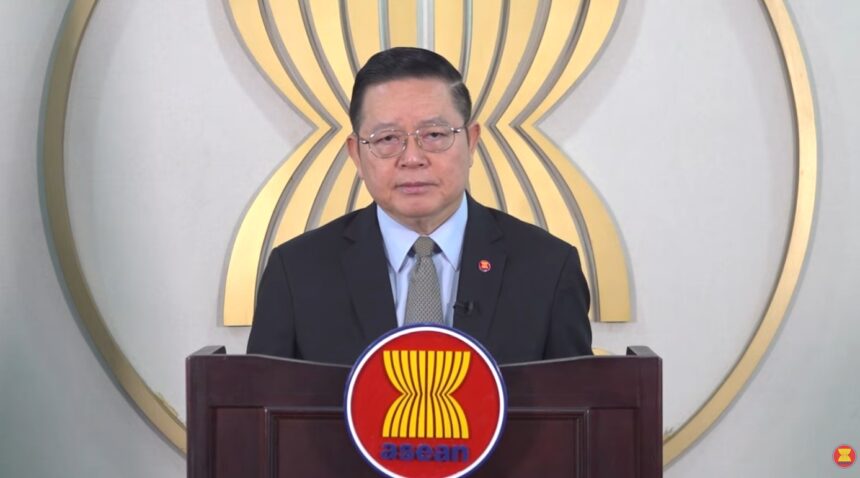
The Secretary-General of the Association of Southeast Asian Nations (ASEAN), Dr. Kao Kim Hourn, delivered a video message at the first ASEAN Quantum Summit, which took place from 10-12 December in Johor Bahru, Malaysia.
In his speech, Dr. Kao outlined the growing importance of quantum technologies and their potential impact on the region’s economic and technological development.
He noted that global investment in quantum technologies has exceeded USD 40 billion, with the market expected to expand significantly over the coming decade. He said the rapid pace of investment reflects the increasing recognition of quantum technologies as a driver of future innovation and competitiveness.
Dr. Kao also highlighted the relevance of quantum technologies for ASEAN economies, citing their potential to strengthen data protection, support the growth of digital economies, and enhance productivity across sectors such as manufacturing, transport, energy, advanced materials, and agriculture. He also pointed to the role of quantum technologies in accelerating the convergence of artificial intelligence, high-performance computing, and broader digital innovation.
The Secretary-General referred to a range of initiatives underway across ASEAN member states:
- In Malaysia, efforts are being made to develop artificial intelligence infrastructure through collaboration between Nvidia Corporation and YTL Power International, including the creation of ILMU, the country’s first multimodal large language model.
- In Singapore, the Centre for Quantum Technologies is world-class in driving research and talent development, and in the establishment of quantum-safe network testbeds.
- Thailand’s Quantum Technology Research Initiative Consortium is expanding its ecosystem through multi-institutional collaboration and pilot projects in areas such as quantum communication, metrology, and sensing.
- Both the Philippines and Thailand are also exploring the use of quantum-based approaches to improve power grid efficiency.
Dr. Kao also highlighted the SEA Quantathon 2025, a Southeast Asia-wide hackathon held in August this year in Bangkok, Thailand. He commended the event for providing young innovators with hands-on experience in developing quantum-inspired solutions for areas including cybersecurity, logistics, and sustainability.
Concluding his remarks, the Secretary-General emphasized the need for ASEAN to build a strong foundation to participate effectively in the emerging quantum economy. He identified key priorities including:
- Talent development
Growing the pool of researchers, engineers and practitioners, along with training programmes and industry partnerships.
- Applied research and commercial applications
Promoting research that links quantum science to industries such as finance, healthcare, manufacturing, and logistics, particularly applications that deliver tangible benefits to businesses and communities across ASEAN,
- Development of an investment ecosystem
Attracting capital via supportive policies, shared platforms, and predictable digital governance.
Concluding his address, Dr. Kao said the foundations of an ASEAN quantum economy are already being built through frameworks such as the ASEAN Plan of Action on Science,
Technology and Innovation (APASTI) 2026–2035, the ASEAN Digital Economy Framework Agreement (DEFA), and the forthcoming ASEAN Digital Masterplan 2030.