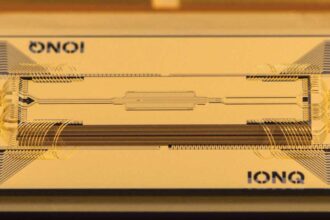



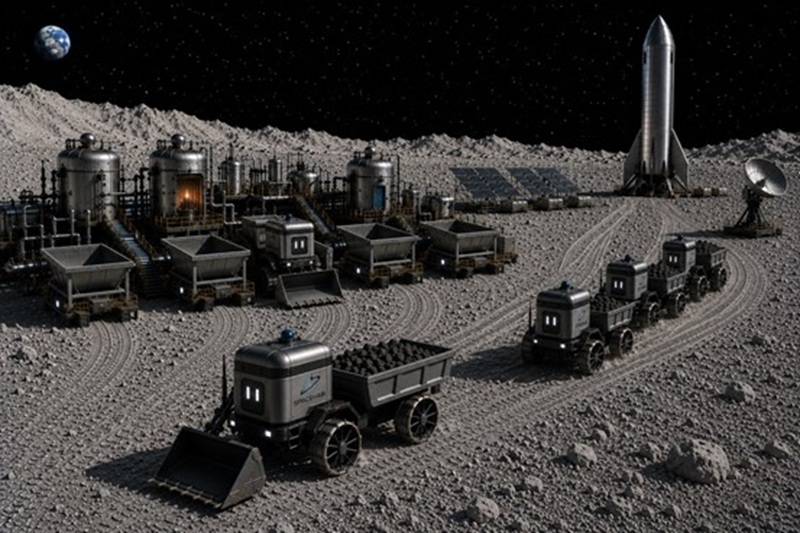
Astrotech Corporation announced that its Board of Directors has approved a strategic initiative focused on lunar resource development, autonomous lunar industrial infrastructure, and future Moon-based advanced computing and semiconductor manufacturing opportunities. Much of this will be dedicated towards developing lunar-based quantum computing infrastructure, including materials quantum chips and cryogenics.
Astrotech’s initiative is expected to focus on four strategic lunar resource and infrastructure categories:
- Silicon and ultra-pure silicon-28 (“Si-28”) for advanced semiconductor and quantum computing applications;
- Helium-3 (“3He”) for potential quantum cooling and cryogenic infrastructure applications; and
- Platinum group metals (“PGMs”) for potential terrestrial industrial applications.
- Water ice for potential propellant production and life-support infrastructure
The initiative is intended to position Astrotech to evaluate emerging opportunities associated with NASA’s Artemis Program, the Commercial Lunar Payload Services (CLPS) program, and next-generation commercial lunar transportation systems.

STRATEGIC FOCUS ON LUNAR-BASED QUANTUM COMPUTING INFRASTRUCTURE
As part of the initiative, Astrotech intends to evaluate and develop infrastructure technologies that could support future semiconductor processing, advanced computing systems, and quantum computing manufacturing operations on the lunar surface.
Astrotech said it believes the convergence of abundant solar energy, extreme lunar thermal conditions, reduced gravity, autonomous robotics, and access to strategic lunar materials such as Si-28 and 3He may ultimately make the Moon an attractive long-term platform for advanced computational infrastructure and next-generation quantum manufacturing systems.
The company expects to evaluate infrastructure concepts supporting:
- lunar silicon purification and isotope processing;
- semiconductor wafer production;
- AI and high-performance computing infrastructure;
- ultra-low-temperature quantum cooling systems; and
- future quantum computing fabrication capabilities utilizing lunar-derived silicon-28.
“Quantum computing, artificial intelligence, and advanced semiconductor manufacturing are rapidly becoming strategic national security and economic priorities,” said Tom Pickens, Chairman and Chief Executive Officer of Astrotech Corporation. “We believe the Moon may offer unique long-term value from regolith mining, quantum computing solutions, and autonomous manufacturing infrastructure . This Board-approved initiative provides Astrotech with a strategic framework to evaluate technologies, partnerships, and mission architectures that could support the development of a future lunar industrial economy.”
BUILDING THE INFRASTRUCTURE FOR A LUNAR INDUSTRIAL ECONOMY
Astrotech intends to pursue technologies and partnerships supporting scalable lunar industrial infrastructure, including autonomous excavation systems, lunar mapping, water extraction systems, thermal processing facilities, sealed material-transfer systems, and autonomous process-control technologies.
The company believes these capabilities may be important to future lunar operations involving resource extraction, in-situ processing, energy infrastructure, advanced materials production, and commercial lunar logistics.
STRATEGIC IMPORTANCE OF SILICON-28 AND HELIUM-3
Astrotech said in its press release that it believes ultra-pure Si-28 and 3He may become strategically important resources in the emerging quantum computing ecosystem. Si-28 is expected to play an important role in certain advanced semiconductor and quantum computing applications, and the 3He provides crucial cryogenic quantum cooling systems.