


Thales Alenia Space and its partners said they have recently established a “quantum bridge” between La Palma and Tenerife.
This was achieved In the frame of the Spanish GEO QKD project, which aims to develop the first quantum key distribution (QKD) system from geostationary orbit.

This is an essential step to validate the GEO QKD system in a real environment before its deployment in space.
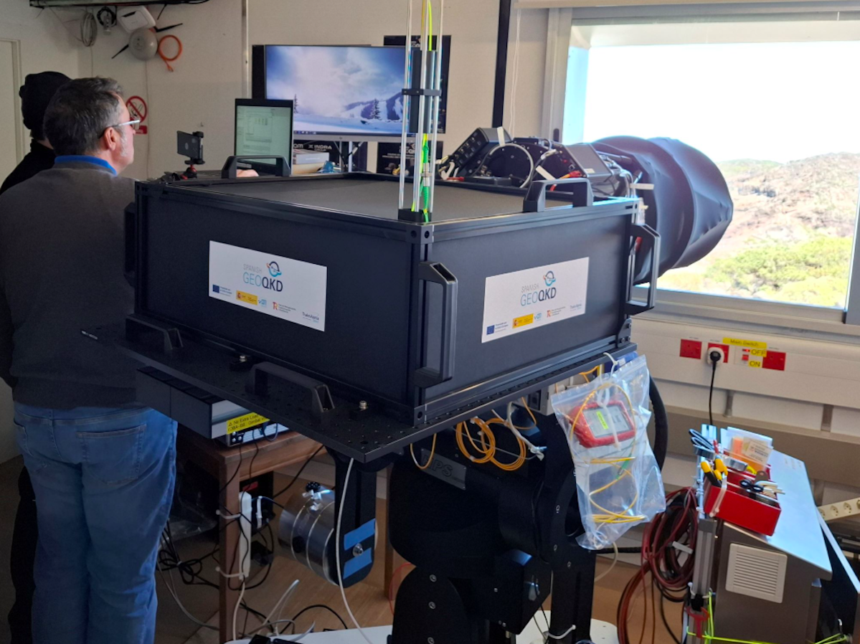
The field tests were conducted by means of an engineering model that faithfully replicates both the payload to be embarked on a geostationary satellite and the related ground segment.
The project team was split between the Roque de los Muchachos Observatory in La Palma, where the QKD payload was installed, and the Teide Observatory in Tenerife, where the terrestrial optical receiver is located.

The goal was to transmit QKD signals (individual photons) in free space, covering a distance of 140 km through turbulent atmosphere, and to inject this signal into a single-mode optical fiber of just 10 microns in diameter (about ten times thinner than a human hair).
“The accuracy record we set during field trials of the GEO QKD system between La Palma and Tenerife places our optical quantum technology at the global cutting edge,” said Ángel Álvaro, Thales Alenia Space’s Project Design Authority of the Spanish GEO QKD project.
The system passed calibration, synchronization, and photon transmission protocols, which the company said demonstrated that quantum theory is now an operational reality.
In the coming months, the project team will continue expanding the potential of the system in the Canary Islands to refine its performance and complete a technical validation that will mark a turning point in European digital sovereignty.
This project is an initiative of the State Secretariat for Telecommunications and Digital Infrastructure of Spain, managed by the CDTI (Center for Technological Development and Innovation), and financed with EU recovery funds through the PERTE Aeroespacial.