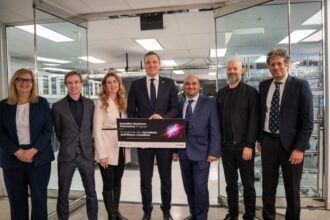




The European Space Agency (ESA) has chosen Equal 1 to install a Hybrid Quantum Computing (HQC) System for Earth Observation (EO).
This partnership will bring Equal1’s advanced Bell-1 Quantum Computer to ESA, advancing the application of quantum technologies to critical space applications.
The installation of HQC will be part of ESA Φ-lab’s Quantum Computing for Earth Observation (QC4EO) initiative and aims to leverage the unique capabilities of quantum systems to accelerate the processing of complex Earth Observation data structures.
Equal1’s approach, utilizing silicon spin qubits fabricated in CMOS technology, offers a solution to tackle some of the most challenging computational problems in space science.
“This collaboration underscores our shared vision of making quantum computing a powerful tool for accelerating complex data center workloads, especially in vital areas like Earth Observation,” said Jason Lynch, CEO of Equal1.
Earth Observation generates vast amounts of data, essential for climate modeling, weather forecasting, disaster monitoring, and precise image analysis. Classical computing, while powerful, faces limitations in processing these increasingly complex datasets.
Hybrid Quantum Computing, which combines the strengths of quantum processors with traditional High-Performance Computing (HPC), offers a promising pathway to overcome these challenges.
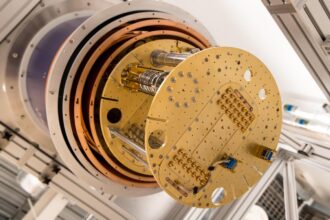
Equal1’s Bell-1 Quantum Computer, a 6-qubit system, will serve as the core quantum processing unit. Its rack-mounted design, integrated closed-cycle cryocooler, and low power consumption (1600 W) make it ideal for deployment within ESA’s existing infrastructure.
This integration will enable ESA scientists to explore quantum algorithms for applications such as Synthetic Aperture Radar (SAR) raw data processing and mission planning for satellite constellations, demonstrating theoretical and practical advantages over purely classical methods.
“The complexities of Earth Observation data, from environmental monitoring to disaster response, require unprecedented processing power, and we are thrilled that this collaboration between Equal1 and ESA could pave the way for hosting the first quantum computer at ESA ,” stated Simonetta Cheli, director of ESA’s Earth Observation Programmes and head of ESRIN.
The design of this system will emphasize “plug-and-play” upgradeability, ensuring seamless integration of future Bell quantum servers. This forward-looking approach ensures ESA’s investment is future-proof, allowing the HQC system to evolve with advancements in quantum technology.
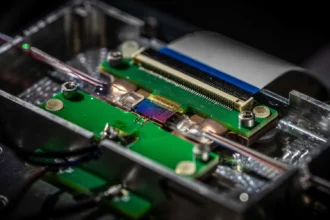
Future versions of Equal1’s UNITY-Q chips will integrate both quantum and classical computing hardware on the same chip, potentially enabling novel features like real-time quantum error detection and correction. This continuous innovation will be crucial for unlocking the full potential of quantum computing for complex Earth Observation challenges.
Equal1’s technological foundation covers scalable silicon spin qubits; UNITY-Q quantum-classical processor; and rack-mounted quantum computing.
“Our vision is to provide practical, scalable quantum computing that can be readily adopted by organizations like ESA,” said Brendan Barry, CTO of Equal1. “The integration of our quantum hardware within ESA’s HPC environment will not only accelerate critical Earth Observation research but also serve as a blueprint for how quantum and classical systems can collaboratively address grand scientific challenges.”
Beyond the technological advancements, a core aspect of this collaboration is the dissemination of knowledge and fostering of a collaborative community. This collaboration is set to establish a pioneering HQC capability within the European space sector, driving innovation in Earth Observation and demonstrating the profound potential of quantum technologies for scientific and societal benefit.