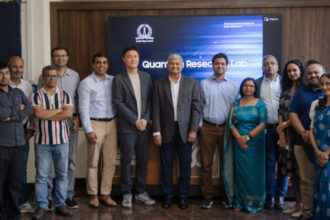




GlobalFoundries has launched Quantum Technology Solutions, a new quantum business to scale the manufacturing capabilities the quantum industry needs to achieve utility-scale quantum computing.
The new business launched with customer engagements, and a pipeline of quantum innovators positioned to scale on its platform.

With more than a decade of partnership with the United States government and customers across critical semiconductor technologies, and sustained investment in cryogenic CMOS, advanced packaging and materials science, GF has built the industrial layer that quantum companies, the US government and allied innovators can build on.
These capabilities mark GF’s entry into the next generation of high-performance computing (HPC).
While the past decade of HPC has been defined by advanced-node CPUs, GPUs and AI ASICs, the next generation will be focused on enabling real-world quantum computing, and GF will manufacture the complete quantum hardware solution from quantum processor units (QPUs) to the cryogenic read-out and control ICs that operate them and the advanced packaging and superconducting interconnects that bind them into systems.

The effort is anchored by quantum companies already engaged with GF’s manufacturing and by the US Department of Commerce, a longstanding partner of GF across critical semiconductor technologies.
The US Department of Commerce and GF have entered into a letter of intent to award GF $375 million to accelerate the build-out of Quantum Technology Solutions, reflecting the national-security importance of a domestic quantum manufacturing base.
In a separate agreement, the US Department of Commerce will receive a strategic equity investment in GF, representing approximately one percent ownership.
“Deepening our partnership with the United States government will support a coordinated national push to expand domestic manufacturing, build supply-chain resilience and ensure that revolutionary technologies such as next-generation quantum systems are developed and manufactured in the US,” said Tim Breen, CEO of GlobalFoundries.
Quantum Technology Solutions will be able to leverage GF’s trusted US manufacturing capabilities, with flexibility across its US footprint, to support the foundational capabilities the quantum industry needs to scale.
GF’s FDX platform delivers the cryogenic CMOS that provides the sensing, control and readout functions required for quantum systems.
Building on that base, GF is developing the manufacturing platforms to build QPUs across multiple qubit modalities — including superconducting, trapped ion, photonic, topological and spin — along with the cryogenic and superconducting heterogeneous interconnect platform that integrates these components into utility-scale quantum systems.
“Quantum is at its inflection point. The hardware is moving from lab-scale to industrial scale, and that transition can only happen inside an advanced semiconductor manufacturing environment,” said Gregg Bartlett, chief technology officer of GF.
“The cryogenic CMOS, advanced packaging and 3D heterogeneous interconnect needed for utility-scale quantum computing are exactly what we make every day,” he said.
Charina Chou, COO of Google Quantum AI, said that quantum computing promises to unlock solutions to otherwise impossible problems, and progress will depend on a strong manufacturing base in the United States.
Lauri Sainiemi, corporate VP of fabrication at Microsoft Quantum, said that a secure US manufacturing base, capable of building across multiple qubit modalities, is essential to moving quantum from research milestones to practical computing.
“Accelerating the path to useful quantum computing will require deep collaboration across a broad range of technological and infrastructural challenges — from advanced semiconductor manufacturing to the GPU-supercomputing that quantum processors must integrate with to run useful applications,” said Timothy Costa, VP and general manager for computational engineering and quantum at NVIDIA.