



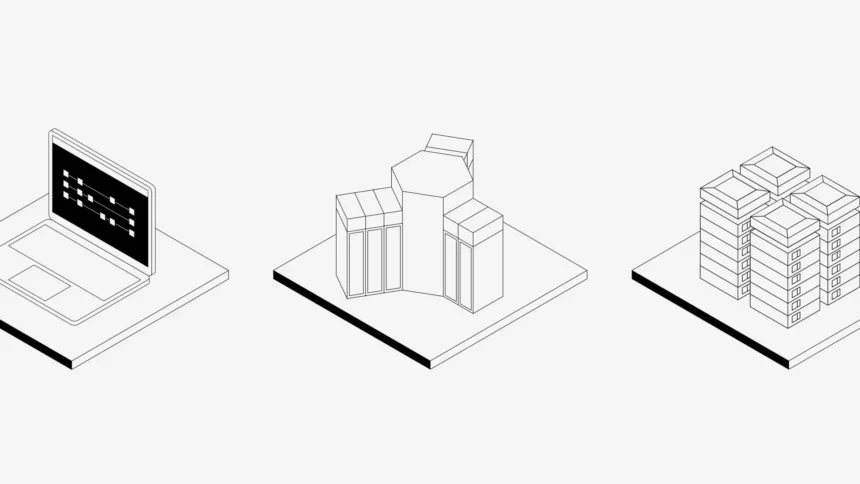
IBM has published a new supercomputing reference architecture – a blueprint for integrating quantum computing into modern supercomputing environments. The architecture shows how quantum processors (QPUs) can work alongside GPUs and CPUs—across on‑premises systems, research centers, and the cloud—in order to tackle scientific challenges that no single computing approach can solve on its own.
The architecture brings quantum and classical systems together into a unified computing environment. It combines quantum hardware with classical infrastructure, including CPU and GPU clusters, high‑speed networking, and shared storage, to support computationally intensive workloads and algorithms research.
IBM said its approach enables coordinated workflows that span quantum and classical computing. Through integrated orchestration and open software frameworks, including Qiskit, developers and scientists can access quantum capabilities through familiar tools and workflows—making it easier to apply quantum computing to problems in areas such as chemistry, materials science, and optimization.
According to IBM, scientists are already using the architecture to deliver accurate results for real experiments, citing the following examples:
- Researchers from IBM, the University of Manchester, Oxford University, ETH Zurich, EPFL, and the University of Regensburg created a first‑of‑its‑kind half‑Möbius molecule, verifying its unusual electronic structure with a quantum-centric supercomputer published in Science.
- Cleveland Clinic simulated a 303‑atom tryptophan‑cage mini‑protein, one of the largest molecular models ever executed on a quantum-centric supercomputer.
- A team from IBM, RIKEN, and the University of Chicago uncovered the lowest‑energy state of engineered quantum systems, outperforming state-of-the-art classical‑only approaches.
- RIKEN and IBM scientists achieved one of the largest quantum simulations of iron‑sulfur clusters, a fundamental molecule in biology and chemistry, through closed loop data exchange between a co-located IBM Quantum Heron processor and all 152,064 classical compute nodes of RIKEN’s Fugaku supercomputer.
- Algorithmiq, Trinity College Dublin, and IBM collaborators published methods in Nature Physics to accurately simulate many-body quantum chaos systems, such as collections of atoms and electrons, using classical compute resources for noise mitigation.
The full blueprint can be found here.