



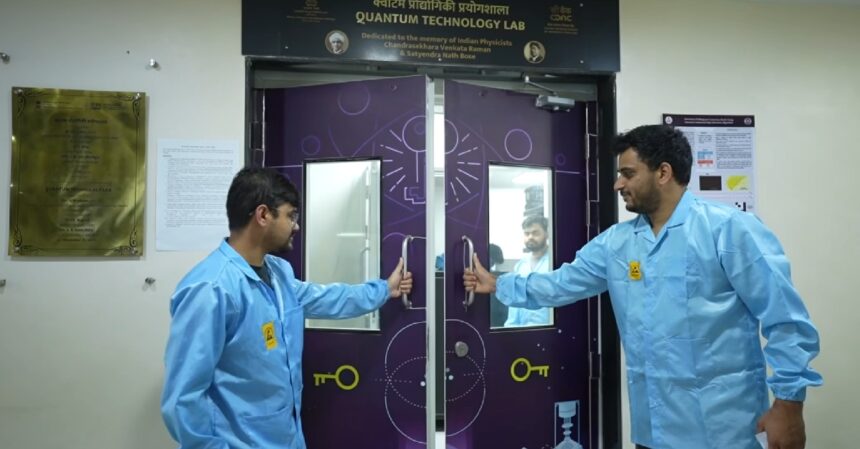
India’s Centre for Development of Advanced Computing (C-DAC), a research institute that is part of the Ministry of Electronics & Information Technology (MeitY), announced it has successfully demonstrated a Quantum Key Distribution (QKD) system on a mobile platform using hybrid classical-quantum networking.
The field trial featured a 50-metre Free-Space Optical (FSO) link with GPS-based precision time synchronization, while quantum data post-processing was enabled via a drone-based RF link.
In this demonstration, the receiver module was mounted on a moving vehicle, validating the feasibility of maintaining a stable quantum link during motion. The setup employed the B92 QKD protocol, with key generation taking place through the atmosphere. The data was later processed using classical communication via a drone-based RF link.
C-DAC reported that the system delivered robust performance under mobility, achieving a Quantum Bit Error Rate (QBER) of ~5% and a Secure Key Rate (SKR) of ~2 kbps. The Centre said this is significant because it established stable and reliable operations in real-world conditions.
Part of the project “Agile and Adhoc quantum communication using Drone” under MeitY, C-DAC is currently developing agile and rapidly deployable quantum-secure communication, which will eventually be used in Indian defence and emergency response systems.