

Infleqtion said it has achieved 30 entangled logical qubits using just 80 physical qubits on its Sqale quantum computing platform, delivering a key milestone on its 2026 roadmap.
According to Infleqtion, this achievement makes it the first neutral-atom quantum computing company to reach 30 logical qubits on a commercial system.

The breakthrough combines hardware and software co-design with an AI-assisted discovery that halves the physical gates needed for a key logical operation.
By entangling 30 logical qubits in a single, coherent quantum state, Infleqtion has validated the core architecture of its Sqale hardware and Superstaq software, on its roadmap to deliver 100 logical qubits by 2028.
“Co-design between our hardware and software enabled this demonstration with just 80 physical qubits,” said Matt Kinsella, CEO of Infleqtion.

“We’re moving quickly toward our target of 100 logical qubits in 2028, and we’re already developing applications with customers. The goal is to give them a quantum computer that can take on problems they can’t solve today,” said Kinsella.
Unlike fragile physical qubits, which suffer rapid calculation decay from environmental noise, logical qubits group multiple physical qubits together using software protocols to ensure computational stability and accuracy.
Infleqtion said its achievement of 30 logical qubits was experimentally confirmed by a signal that is approximately 1000x stronger than underlying noise.
The company has three customers for logical qubit circuits on the Sqale platform. Among them is the Wellcome Leap Quantum for Bio (Q4Bio) program, where Infleqtion pioneered and demonstrated on hardware a quantum neural network approach with training on GPU and inference on QPU for biomarker discovery.
In quantum computing, scaling logical qubit counts is only half the battle; the true threshold of computational power is the ability to entangle those logical qubits across a coherent circuit.
With this announcement, Infleqtion has successfully executed a highly complex circuit that entangles all 30 logical qubits into a single, unified quantum state, using a novel logical operation that Infleqtion discovered using GPT 5.6 Sol.
Altogether, Infleqtion’s experiment executes approximately 1,000 physical operations, or 1 KiloQuOp—a critical transition from fragile academic experiments to robust, commercially viable systems, proving that neutral-atom technology is the fastest path to fault tolerance.
A full technical write-up from Infleqtion CTO Pranav Gokhale, including the circuit, the AI-discovered gate identity and the loss correction results, is available on the Infleqtion blog.
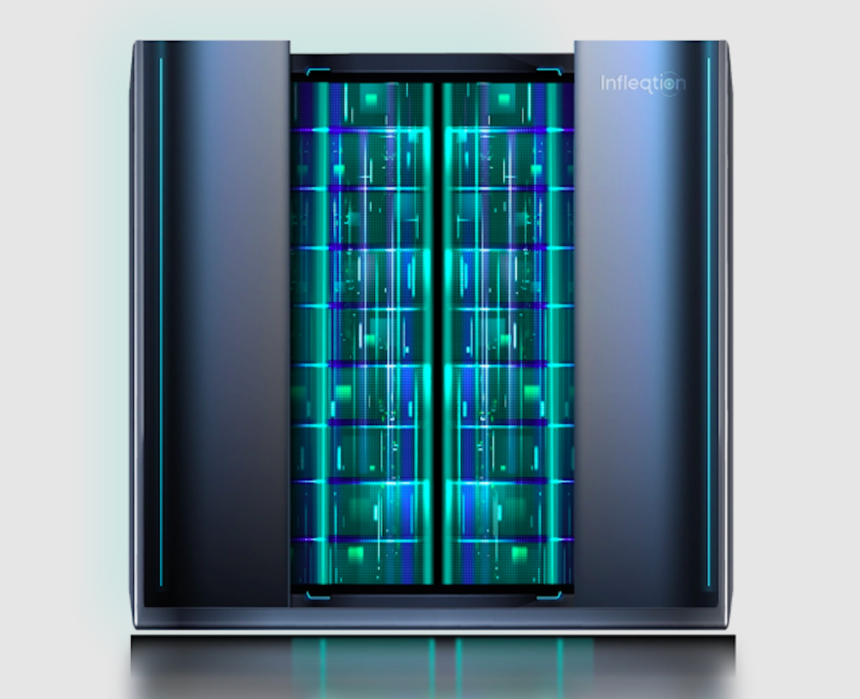
The breakthrough is powered by Infleqtion’s Sqale QPU hardware and Superstaq quantum software platform, which unite individual qubit-addressing capabilities with dynamically reconfigurable atom arrays.
This unique combination maintains all-to-all connectivity while minimizing the typical pitfalls of atom movement, including error accumulation, atom loss, and runtime delays.
“We’re using the dynamic reconfigurability of Sqale’s neutral-atom architecture to move faster toward quantum utility,” said Pranav Gokhale, CTO and general manager of computing at Infleqtion.
“A core accelerant for our work was the AI-assisted discovery of a new entangling operation between logical qubits that performs a key operation with half as many physical gates as was previously known,” said Gokhale. “Every gate can introduce an error, so doing the same work with fewer gates matters as we build toward longer computations.”
By utilizing individual qubit addressing and reconfigurable atom arrays to minimize error and atom loss, Infleqtion remains firmly on track to deliver 100 logical qubits in 2028 and 1,000 by 2030.