


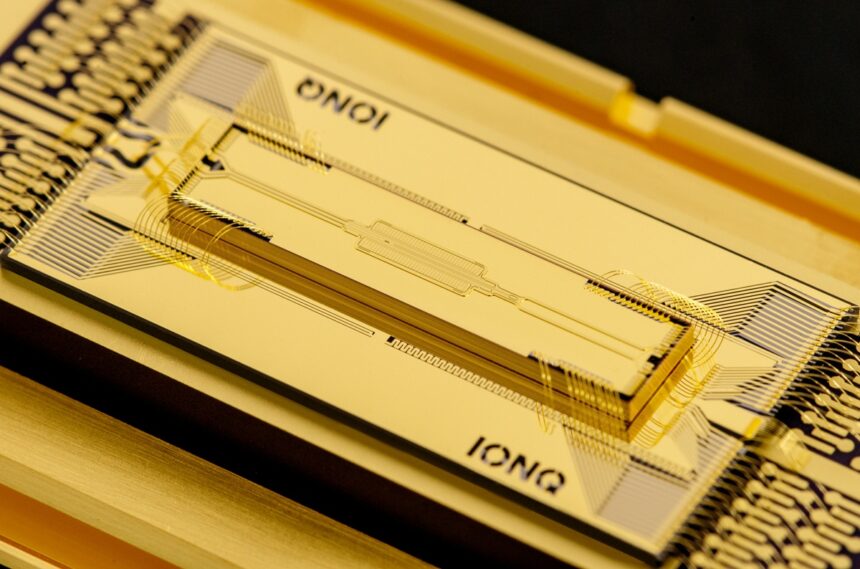
IonQ, which is building trapped ion quantum computers, has released an engineering blueprint for building scalable, fault-tolerant quantum computing. The technical paper describes the company’s end-to-end architecture for fault-tolerant quantum computing, spanning compiler design and error correction to hardware, control systems, and ion movement. It outlines in detail how the company intends to move from today’s systems to utility-scale quantum computers.
According to the publication’s abstract, the blueprint includes a compiler, a detailed description of all the quantum error-correction protocols, a micro-architecture, a sufficiently fast decoder, and thorough simulations. The backbone of the architecture is a cat factory, producing cat states distributed throughout the machine, which are consumed to perform logical operations. Named ‘the walking cat architecture’, it is based entirely low-density parity-check (LDPC) codes, a method of error correction.

“The level of detail and completeness in our blueprint is a major global first and milestone for the quantum industry. IonQ’s specificity sets a new standard and distinguishes IonQ with its tangibility, resting on capabilities our hardware has already demonstrated including 99.99% two-qubit fidelity and reliable ion transport. This historic work demonstrates precisely why IonQ is on track to be the first to unlock fully fault tolerant quantum computers – as we published in June 2025,” said Niccolo de Masi, IonQ Chairman and CEO.
In its announcement, IonQ said that achieving the next level of performance in quantum computing means moving past the constraints of noise, scale, and lack of modularity, and that its fault-tolerant framework creates a logical computing layer that actively detects and corrects errors in real time. The result is a practical path toward quantum computers capable of running longer, more complex computations with greater reliability.
The full technical roadmap is available here.