


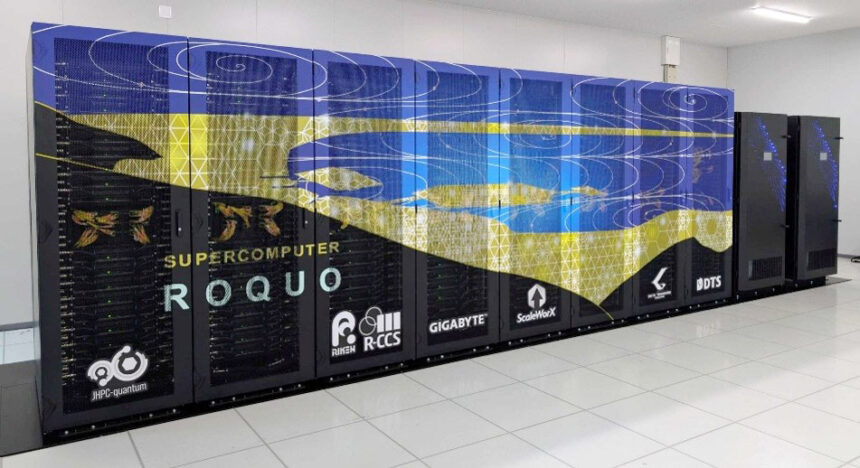
The Quantum-HPC Hybrid Platform Division (Director: Mitsuhisa Sato) of the RIKEN Center for Computational Science (hereafter “R-CCS”) has installed a new JHPC-quantum GPU supercomputer, “ROQUO”, at R-CCS in Kobe. It has begun operating, with the intetion to accelerate the integration of quantum computing and high-performance computing (HPC).
“ROQUO” is introduced as part of the NEDO-commissioned project “Research and Development of Quantum-Supercomputers Hybrid Platform for Exploration of Uncharted Computable Capabilities” (JHPC-quantum project). It was built primarily by DTS Corporation as the “Supercomputer for the Quantum-HPC Hybrid Platform” announced on November 18, 2025. Construction has now been completed as planned, and the system has reached the stage of operational launch.

New Energy and Industrial Technology Development Organization (NEDO) is a national agency that supports technology development to address energy and global environmental problems and to enhance Japan’s industrial technology through commissioned projects and subsidies. With approximately 1.4631 trillion yen in funding allocated in FY2024, NEDO is Japan’s largest incorporated administrative agency.
In the High Performance LINPACK (HPL) benchmark measurement conducted as part of operational preparations, “ROQUO” achieved 19.80 petaflops (PFLOPS; 1 peta = 10^15) in double-precision floating-point (FP64) operations.
System Overview
“ROQUO” comprises 135 compute nodes equipped with the NVIDIA GB200 NVL4 (540 NVIDIA Blackwell GPUs in total). The nodes are interconnected by NVIDIA Quantum-X800 InfiniBand networking, enabling high-speed communication of up to 3.2 terabits per second (Tbps; 1 tera = 10^12), and the adoption of warm-water-cooled servers achieves both high performance and high energy efficiency.

“ROQUO” is among the world’s first systems in full-scale operation to adopt the GB200 NVL4, and—together with “RIKYU”, the AI-for-Science supercomputer announced by RIKEN on the same day as this release—it is among the first systems in full-scale operation in Japan to adopt the GB200 NVL4. In contrast to the NVIDIA GB200 NVL72, a 72-GPU configuration specialized for large-scale training and inference of generative AI, the GB200 NVL4 is a 4-GPU configuration designed with HPC (scientific and technical computing) applications also in mind. While retaining the ability to handle AI workloads, its design emphasizes a balance among the FP64 performance heavily used in HPC, flexibility in installation and operation, and cost performance, making it well suited to a research platform that handles diverse workloads with differing computational characteristics.
In addition, NVIDIA Quantum-X800 InfiniBand and the NVIDIA Quantum-X800 switches that constitute this fabric were deployed for the first time in Japan, together with “RIKYU.” This realizes the low-latency, high-bandwidth inter-node communication required by the Quantum-HPC Hybrid Platform.
The system is installed at R-CCS in Kobe and is connected, via the SQC Interface, which draws on platforms like NVIDIA CUDA-Q to allow the development of hybrid systems of supercomputers and quantum computers including Japan’s flagship supercomputer “Fugaku”.
| Item | Specification |
|---|---|
| System name | JHPC-quantum GPU supercomputer “ROQUO” |
| Installation site | RIKEN Center for Computational Science (Kobe) |
| Compute nodes | NVIDIA GB200 NVL4 × 135 |
| Total GPUs | 540 (NVIDIA Blackwell) |
| Total CPUs | 270 (NVIDIA Grace) |
| Inter-node network | NVIDIA Quantum-X800 InfiniBand (up to 3.2 Tbps) |
| Cooling | Warm-water cooling (free cooling, 32°C coolant) |
| FP64 performance (theoretical peak) | Over 21 PFLOPS |
| FP8 performance (theoretical peak) | Over 5 EFLOPS |
| FP64 measured performance (HPL) | 19.80 PFLOPS |
Performance Measurement Results
As part of operational preparations, an HPL benchmark measurement was conducted using the entire “ROQUO” system (135 compute nodes, 540 GPUs). The measured performance (Rmax) in double-precision floating-point (FP64) operations reached 19.8 PFLOPS, demonstrating performance that exceeds the design target for the core computing resource of the Quantum-HPC Hybrid Platform.
The NVIDIA Quantum-X800 InfiniBand platform—adopted in Japan for the first time by “ROQUO” together with “RIKYU”—plays a key role in achieving this performance. The Q3400 switches, based on the InfiniBand standard, which support a communication speed of 800 gigabits per second (Gbps) per port, couple the compute nodes with low latency and high bandwidth, efficiently handling the collective communication that HPL requires.
The HPL benchmark is a communication-intensive workload that involves numerous data transfers and synchronization across compute nodes. In “ROQUO,” the combination of the latest-generation NVIDIA Grace Blackwell accelerators and the NVIDIA Quantum-X800 InfiniBand fabric forms a system with a well-balanced ratio of computational to communication performance, providing the stable performance required of a computing platform for the Quantum-HPC Hybrid Platform.
Anticipated Outcomes
With the launch of “ROQUO,” the following initiatives will move into full swing:
- Enhancement of quantum-computing simulation environments on supercomputers, and acceleration of quantum-algorithm development and performance evaluation.
- Demonstration of quantum-HPC hybrid computing through tightly coupled integration with “Fugaku,” the IBM Quantum System Two “ibm_kobe”, and the Quantinuum trapped-ion quantum computer “Reimei”.
- Pioneering of new application areas that combine quantum computers and GPUs, such as quantum machine learning.
- Flexible response to advanced computational needs that are difficult to meet with “Fugaku” alone.
In addition, “ROQUO” is operated primarily by R-CCS. By directly operating a system with such an advanced configuration—the NVIDIA Grace Blackwell platform and the NVIDIA Quantum-X800 InfiniBand fabric, deployed in Japan for the first time—R-CCS will reliably accumulate, within the organization, the operational expertise needed for next-generation supercomputers.
Through this accumulation of operational experience, R-CCS will improve the efficiency of future supercomputer operations, and the results obtained will also be applied to the next-generation flagship machine “FugakuNEXT” (development codename), currently under development. The knowledge accumulated in this project—including operational know-how for large-scale GPU clusters and demonstration data on energy-saving operation through warm-water cooling—will form a cornerstone of Japan’s next-generation supercomputing.

Construction and Operation Structure
“ROQUO” was built primarily by DTS Corporation in accordance with the requirements specified by R-CCS. NVIDIA provided the accelerated computing and networking platform; Giga Computing Technology was responsible for the design and manufacture of the compute nodes; and DataDirect Networks provided the high-speed file system. Using these components, ScaleWorX carried out the overall system integration.
Following the start of operations, R-CCS will take the lead in operating the system, making it available to the research community and to industry as the core computing resource of the Quantum-HPC Hybrid Platform. R-CCS will apply to “ROQUO” the operational expertise it has cultivated through operating supercomputers such as “Fugaku,” while accumulating and systematizing the new operational knowledge it gains.
Comments from Representatives (on the Start of Operation)
Mitsuhisa Sato, Director, Quantum-HPC Hybrid Platform Division, RIKEN Center for Computational Science:
The JHPC-quantum project aims to advance hybrid computing technologies that integrate quantum computers with high-performance computing (HPC) systems. In recent years, the integration of GPU-accelerated computing and AI technologies has attracted significant attention, and the deployment of this new GPU supercomputer comes at a particularly opportune time. We expect that this system will contribute to further advances in quantum-HPC hybrid computing and enable the exploration of new application area.
Tim Costa, General Manager, Industrial Engineering and Quantum, NVIDIA:
The next era of scientific discovery will be shaped by systems that unite quantum computing and accelerated supercomputing, opening new paths to problems beyond the reach of either technology alone,” said Tim Costa, general manager of industrial engineering and quantum at NVIDIA. “With ROQUO, RIKEN is bringing that vision into operation by connecting NVIDIA GB200 NVL4 systems and NVIDIA Quantum-X800 InfiniBand with Fugaku and quantum computers through its Quantum-HPC Hybrid Platform.