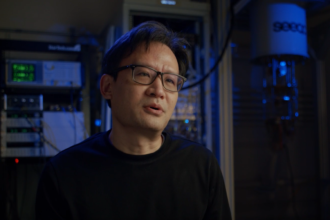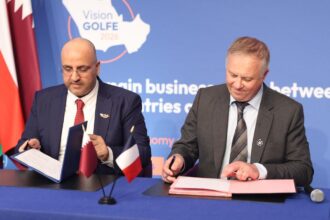





Optimind, a combinatorial optimization startup from Nagoya University, and Quanmatic, a hybrid quantum-classical software startup, have signed a business partnership aimed at advancing the logistics and transportation sectors.
The two companies will combine the expertise rooted in the transportation and delivery field cultivated through “Loogia,” a last-mile delivery optimization solution provided by Optimind, with Quanmatic’s expertise in supply chain design and strategy planning, as well as its mathematical optimization, AI, and quantum computing technologies, to jointly advance the logistics and delivery fields.
Background of the partnership

With the full implementation of the revised Logistics Efficiency Act in April 2026 in Japan, shippers above a certain size will be required to take new measures to improve logistics efficiency, such as appointing a Chief Logistics Officer (CLO) and submitting medium- to long-term plans. This has increased the importance for shippers, including manufacturers, to proactively drive logistics reforms. Optimind has been providing the transportation optimization solution “Loogia” (a last-mile transportation optimization service) to shippers and logistics companies, but in order to meet the diversifying needs of customers, it has become increasingly important to expand the scope of solutions it offers, with a view to optimizing the entire supply chain beyond just transportation.
Meanwhile, Quanmatic has been developing solutions utilizing supply chain design, mathematical optimization, AI, and quantum computing technologies. However, in order to deploy these technologies to actual operations in the logistics and transportation sectors, the company believes that on-site knowledge and collaboration with customer contacts are crucial.
Therefore, the two companies will combine Optimind’s expertise in the transportation and delivery field with Quanmatic’s mathematical optimization, AI, and quantum computing technologies, as well as its expertise in the supply chain field, to advance the logistics and transportation sector through the development of supply chain design support applications and the expansion of consulting services.
Details of the collaboration
The two companies have set the following three areas as the scope of their collaboration and will build a solution that can comprehensively support everything from supply chain strategy planning and decision-making to the execution of transportation operations.
- Building a supply chain design and consulting platform — expanding the scope of consulting services from the last mile, which was previously the focus of “Loogia,” to the entire supply chain and logistics. Optimind will support the planning and decision-making of supply chain strategies by optimizing the entire network design based on logistics performance and operational constraints.
- Research on the application of quantum technology to the supply chain domain to address the increasing scale and immediacy required for the projects under consideration. The two companies will jointly research the advancement of optimization algorithms utilizing quantum annealing, quantum gate, and quantum-classical hybrid methods.
- Joint development of a general-purpose optimization algorithm applicable to the entire supply chain. Starting with the optimization algorithms held by both companies, they will expand the scope to include trunk network design, loading, shift planning, etc., and jointly develop optimization algorithms applicable to the entire supply chain.
Future developments
Through this partnership, the two companies aim to gradually incorporate advanced computing technologies, including quantum technology, starting with optimization solutions that can withstand real-world operation. Their goal is to go beyond simply improving the efficiency of individual transportation operations and elevate the entire supply chain, from design to execution, to a level where it can be consistently optimized.
The two companies aim to gradually materialize the initiatives based on this partnership through joint seminars and other means, while prioritizing the establishment of a supply chain design and consulting platform, and aiming to commercialize the collaborative scheme as a business model.
Yuichiro Yasaka, Director and COO, Optimind, said: “By combining our expertise in optimizing transportation and delivery, honed through our experience in the last mile, with Quanmatic’s supply chain design expertise and cutting-edge computing technologies, including quantum computing, we can provide comprehensive support, from strategic planning to execution, for the entire supply chain, not just improving transportation and delivery operations. With the revised Logistics Efficiency Act now in full swing, leading to increased logistics reforms driven by shippers, this partnership will contribute to solving structural challenges in the logistics and transportation sectors and realizing sustainable logistics.”
Yosuke Mukasa, COO, Quanmatic, said: “To further enhance the value of our strengths in supply chain design expertise and mathematical optimization, AI, and quantum computing technologies, it was essential to integrate them with extensive on-the-ground knowledge in the logistics and transportation sector. Optimind is a company with expertise, customer relationships, and a wealth of experience cultivated in the field of transportation optimization. By combining the strengths of both companies, we will provide comprehensive support from supply chain strategy planning to the execution of transportation operations, contributing to the advancement of decision-making and overall optimization in the logistics and transportation sector.”
Daisuke Tanaka, CEO, Quanmatic, said: “Logistics requires highly complex design and adaptation for sustainable, flawless operations. A highly sophisticated integration of classical optimization methodologies and quantum algorithms is a must-have for next-generation supply chains. Optimind’s proven last-mile solutions combined with Quanmatic’s optimization intelligence will generate a whole new level of impact.”