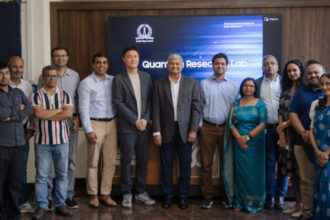




Photonics quantum computing company PsiQuantum will partner with the University of Tokyo and the Mitsubishi Chemical Corporation to provide education and training for Japan’s growing quantum workforce. This initiative is supported by the Government of Japan’s New Energy and Industrial Technology Development Organization (NEDO) under the Post-5G Information and Communication Systems program (2025–2027).
Together, the three partners have launched a six-month training program for participants from the private sector and academia. More than 80 participants from over 20 companies with operations in Japan have already joined the program. Attendees will learn more about the fundamentals of fault-tolerant quantum computing, explore potential use cases across a range of sectors, and gain experience using advanced tools such as Construct, PsiQuantum’s platform for designing, analyzing, and optimizing algorithms for fault-tolerant quantum computing.

Under the program, PsiQuantum, the University of Tokyo, and Mitsubishi Chemical Corporation will combine academic education, industrial application development, and advanced quantum computing technologies. The curriculum will be designed by the University of Tokyo, while PsiQuantum will share expertise in fault-tolerant quantum computing and related software tools. Mitsubishi Chemical Corporation will contribute industrial use cases in chemistry and materials science.
Subsequent phases over the next two years will focus on joint research and development opportunities in chemistry and materials science applications, with the shared objective of advancing toward deployment on fault-tolerant quantum computers.
“Fault-tolerant quantum computers will only reach their full potential if we are prepared to use them effectively once they are built and deployed,” said Victor Peng, PsiQuantum Interim Chief Executive Officer. “We are proud to partner with Mitsubishi Chemical Corporation and the University of Tokyo to further strengthen and prepare Japan’s globally recognized quantum workforce—and we are grateful to the Government of Japan for their support.”

“Developing human resources capable of connecting quantum technologies with real-world challenges is essential for the advancement of quantum computing,” said Takeshi Sato, University of Tokyo Associate Professor. “Through this partnership, we aim to provide students and professionals with hands-on experience in both the theoretical foundations and practical applications of fault-tolerant quantum computing.”
“Quantum computing has the potential to significantly accelerate innovation in chemistry and materials science,” said Qi Gao, Mitsubishi Chemical Corporation Distinguished Scientist. “By collaborating with the University of Tokyo and PsiQuantum, we aim to cultivate the next generation of quantum professionals while exploring future industrial applications of fault-tolerant quantum computing.”